
TL;DR
- Self-revive devices provide solo revival capability for 2,500 gold bars at mending machines
- Strategic timing and positioning are critical for successful self-revival without immediate re-elimination
- Team coordination around self-revive usage creates powerful bait and ambush opportunities
- The single-use nature demands careful economic planning and situational assessment
- Advanced players use self-revives for zone control and psychological warfare tactics
Mastering the strategic implications of self-revival mechanics in Fortnite Chapter 7 transforms your approach to team engagements and survival tactics. This revolutionary feature fundamentally alters squad dynamics by providing individual agency during critical knockdown situations.
The introduction of autonomous revival capabilities represents a paradigm shift in team-based combat strategy. When engagements turn against your squad, you no longer face complete dependency on teammate positioning and safety. Proper preparation combined with precise timing enables dramatic comebacks from near-elimination scenarios, allowing you to surprise opponents who assume victory is secured.
The self-revive device constitutes a legendary-tier equipment item that automatically activates when you’re downed in team-oriented game modes. Diverging from conventional revival mechanics requiring ally proximity and secure positioning, this innovative tool places resurrection control directly into individual player hands.
Strategic deployment requires comprehensive consideration of multiple factors:
Each device shatters immediately following activation, rendering every unit a single-opportunity investment demanding judicious situational evaluation.

The primary guaranteed acquisition pathway involves purchasing from mending machines distributed strategically across the battle royale landscape. Securing this legendary-tier equipment demands exactly 2,500 gold bars, representing a substantial resource investment necessitating deliberate economic strategy throughout your match progression.
This purchase-based method delivers several distinct tactical benefits:
Advanced acquisition strategies involve systematic gold accumulation through complete contracts, eliminating opponent players, and thorough loot collection during early and mid-game phases. Professional players often designate one squad member as the “economy manager” responsible for ensuring sufficient collective resources for critical purchases.
Alternative finding methods include rare spawns in legendary chests and supply drops, though these involve significant chance elements. The guaranteed purchase approach remains superior for consistent strategic planning.

Understanding the precise mechanics of self-revival activation separates average players from tactical masters. The revival sequence initiates automatically upon knockdown, provided the device resides in your inventory during the incapacitation event.
Critical timing considerations include environmental awareness and opponent positioning. Successful reactivations require approximately 4-5 seconds without taking additional damage, making cover and concealment paramount during the revival sequence. Advanced players utilize natural terrain, building structures, or smoke grenades to create protective screens during this vulnerable period.
Post-revival positioning strategy determines whether your second chance becomes meaningful. Upon successful self-revival, you return with exactly 30 HP, necessitating immediate healing item usage or strategic disengagement. Professional players often pre-select their first post-revival action while the animation completes, minimizing decision delay.
Common timing mistakes include activating too early before opponents reload or too late when storm damage prevents completion. The optimal activation window occurs when enemies believe you’re eliminated and lower their guard.
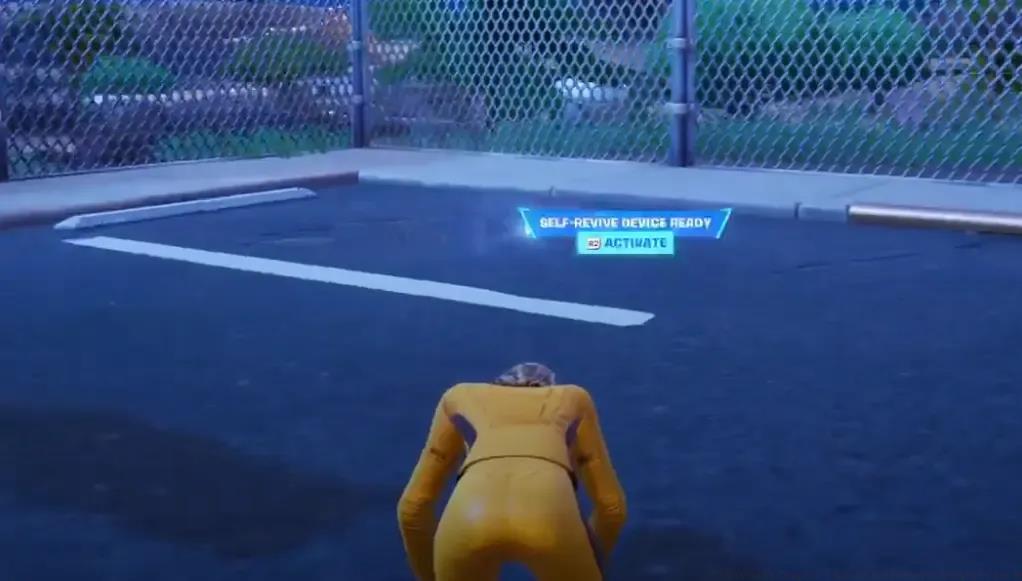
Strategic deployment of self-revive devices extends far beyond simple survival mechanics. Advanced tactical applications transform this tool into an offensive weapon through carefully orchestrated team coordination.
Bait and ambush strategies represent the most sophisticated application. Teams deliberately position a self-revive equipped player as apparent vulnerable bait while teammates establish overlapping fields of fire. When opponents commit to eliminating the “vulnerable” player, the self-revival creates confusion while teammates initiate coordinated counter-attacks.
Zone control applications involve using self-revives to maintain position in late-game circles. When storm positioning forces dangerous rotations, a player with self-revive capability can take aggressive positioning knowing they have revival insurance. This enables territory denial and flank prevention that would otherwise be too risky.
Psychological warfare elements emerge when opponents know your squad possesses self-revive capabilities. This knowledge forces altered engagement patterns, with enemies committing more resources to confirm eliminations or avoiding engagements entirely when outnumbered.
For comprehensive team strategy development, consult our Class Guide to understand how different roles can maximize self-revive effectiveness.
Self-revive functionality maintains specific compatibility restrictions across Fortnite’s diverse game mode offerings. The device operates exclusively in team-based modes where revival mechanics exist naturally, including Duos, Trios, and Squads variants.
Significant limitations include incompatibility with solo battle royale modes, where elimination remains permanent upon knockdown. Additionally, certain limited-time modes and competitive tournaments may disable self-revive functionality for balance purposes, necessitating mode-specific strategy adaptation.
Strategic limitations extend beyond mode restrictions. Opponents familiar with self-revive mechanics develop counter-strategies including immediate thirsting (rapid elimination of downed players), area denial through fire or explosives, and coordinated focus fire to prevent revival completion.
Risk assessment frameworks help determine when self-revive investment justifies the cost. High-value scenarios include final circle positioning, carrying valuable loot for teammates, or when playing the designated medic role. Low-value scenarios involve early-game engagements or when squad resources are critically limited.
Understanding these limitations is crucial for comprehensive battle planning, similar to the strategic considerations covered in our Complete Guide to modern warfare mechanics.
Mastering self-revive mechanics demands advanced optimization techniques that separate elite players from the competition. Professional usage extends beyond reactive survival to proactive tactical tool application.
Advanced timing strategies involve deliberate delay activation to maximize confusion. Rather than immediate self-revival, waiting until opponents engage your teammates creates distraction opportunities. This split-second timing requires extensive situational awareness and game sense development.
Inventory management optimization is crucial for self-revive carriers. Since the device consumes one inventory slot, professional players compensate by prioritizing healing items and ammunition efficiency. The opportunity cost of carrying a self-revive must be justified by expected value based on game state and circle positioning.
Common professional pitfalls include overvaluing the self-revive in early-game scenarios, poor communication about revival status with teammates, and activation during unavoidable elimination scenarios (storm, fall damage, multiple opponents).
Weapon selection synergizes significantly with self-revive strategy, as detailed in our Weapons Unlock guide. Certain weapon combinations create better post-revival survival opportunities through rapid close-range elimination potential or suppression capabilities.
Ultimate optimization involves integrating self-revive strategy into your overall gameplay philosophy rather than treating it as an isolated mechanic. This holistic approach transforms the device from simple insurance to a core tactical component.
Action Checklist
- Designate squad economy manager for gold accumulation targeting 2,500 bars
- Practice activation timing in creative mode with various cover scenarios
- Develop bait and ambush coordination signals with your regular squad
- Establish post-revival action protocols including immediate healing or disengagement
- Create risk assessment framework for self-revive purchase decisions based on match context
No reproduction without permission:Tsp Game Club » Fortnite Chapter 7 How to Self-Revive Complete Guide Master self-revive mechanics in Fortnite Chapter 7 with advanced strategies and tactical coordination techniques