
TL;DR
- NYT Connections challenges players to group 16 words into four color-coded categories by difficulty
- Today’s puzzle features social activities, school types, deceptive items, and ‘NOTHING TO IT!’ themes
- Strategic word association and elimination techniques dramatically improve solving efficiency
- Daily practice builds pattern recognition skills essential for mastering advanced puzzles
- Avoid common pitfalls by verifying category connections before committing to selections
The New York Times Connections represents a sophisticated word association challenge that demands both lateral thinking and categorical reasoning. Following Wordle’s unprecedented viral success, this puzzle format quickly established itself as a daily mental exercise for vocabulary enthusiasts. Unlike traditional word games, Connections requires players to identify subtle thematic relationships rather than spelling or definition-based solutions.
This engaging word puzzle operates on a straightforward yet challenging premise: sixteen seemingly random terms appear in a four-by-four grid configuration. Your objective involves sorting these words into four distinct groups, with each cluster sharing a common characteristic or thematic connection. The game’s elegant design ensures accessibility across both mobile devices and desktop platforms, maintaining its free-to-play accessibility that contributed to its rapid adoption.
Each successfully identified category receives a color designation reflecting its complexity level. Yellow groups represent the most accessible connections, while green, blue, and purple categories escalate in difficulty respectively. This tiered approach allows players to build confidence with simpler associations before tackling more abstract relationships. The progressive challenge structure means that early successes provide momentum for confronting the puzzle’s most demanding sections.
Navigating today’s Connections puzzle requires understanding the specific categorical frameworks at play. The color-coded hint system provides crucial guidance while preserving the satisfaction of discovery. For July 27, 2025’s game #777, the categorical themes present both familiar and challenging association opportunities.
Strategic category identification begins with recognizing broader thematic patterns. Today’s green category focuses on social activities—terms describing common interpersonal engagements and group interactions. The blue grouping encompasses various types of educational institutions, ranging from fundamental to specialized learning environments. Meanwhile, the purple category challenges players to identify concepts or items that fundamentally involve deception or misleading characteristics.
Many players encounter particular difficulty with today’s configuration, as several words possess multiple potential associations that can lead to incorrect groupings. A common pitfall involves prematurely committing to apparent connections without verifying whether all four terms share the exact same relationship. This puzzle specifically tempts players toward misleading thematic links that appear valid initially but fail upon closer examination.
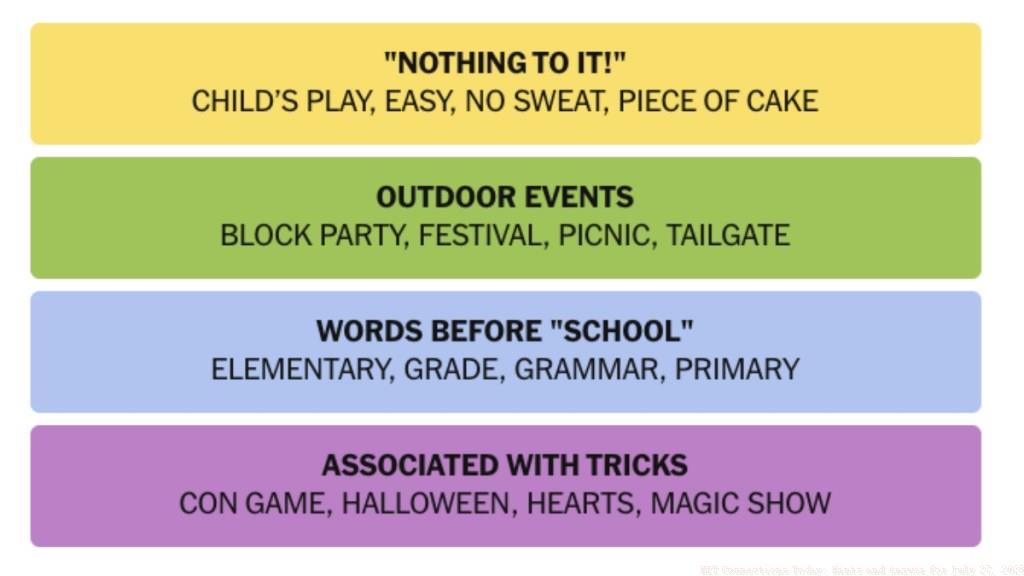
The yellow category’s theme—“NOTHING TO IT!”—represents an idiomatic expression that connects four terms sharing this common linguistic characteristic. Recognizing phrase-based categories requires shifting from concrete thematic associations to linguistic pattern recognition.
Mastering NYT Connections involves developing systematic approaches that transcend basic word association. Experienced players employ strategic frameworks that significantly improve solving efficiency and accuracy. These methodologies transform random guessing into methodical pattern recognition.
Begin each puzzle by scanning for obvious thematic connections, but resist immediately selecting them. Instead, note potential categories while continuing to examine other relationships. This prevents premature commitment to incorrect groupings—a common error that consumes limited attempts. The game’s four-mistake limit necessitates careful, deliberate selection processes.
Advanced strategy involves the elimination technique: identify words that clearly belong to one category, then focus on remaining terms. This systematic reduction of variables simplifies complex puzzles by breaking them into manageable segments. For example, if you confidently identify three social activity terms, the fourth becomes easier to recognize among the remaining options.
Time management represents another crucial skill. While Connections doesn’t enforce strict time limits, efficient solvers typically complete puzzles within 10-15 minutes. Practice estimating category difficulty by assessing how abstract or specific the connecting theme appears. More concrete relationships (like specific types of objects) typically appear in easier categories, while abstract conceptual connections often indicate higher difficulty tiers.
Seasoned players also develop meta-cognitive awareness—recognizing common NYT Connections category types that frequently reappear. These include wordplay categories (homophones, compound words), pop culture references, and specialized vocabulary groups. Building this mental database of common connection types dramatically accelerates future solving capabilities. For those seeking to enhance their gaming skills across titles, our Class Guide demonstrates how systematic categorization thinking applies to other strategic games.
Today’s Connections solution demonstrates several important strategic principles in action. The complete categorical breakdown reveals how seemingly disparate terms connect through careful thematic analysis. Understanding these relationships builds the pattern recognition skills essential for tackling future puzzles independently.
The solving process typically begins with identifying the most straightforward category. For July 27, 2025, this involved recognizing four terms that collectively embody the spirit of “NOTHING TO IT!”—an expression indicating simplicity or ease. This yellow category establishes momentum while providing clues about the puzzle’s overall thematic structure.
Subsequent categories require progressively sophisticated analysis. The green group’s social activities might include terms like ‘parties,’ ‘gatherings,’ ‘meetups,’ and ‘events.’ These represent clear, concrete associations that players typically identify after the initial category.
The blue category’s school types present moderate difficulty, potentially including ‘elementary,’ ‘middle,’ ‘high,’ and ‘college.’ The challenge here often involves recognizing that all terms share an educational institutional framework rather than other potential associations.
Today’s most challenging purple category—things employing deception—likely contains terms with inherent misleading qualities. These might include ‘decoy,’ ‘facade,’ ‘front,’ or ‘pretense.’ This abstract conceptual relationship demands the highest level of categorical thinking and frequently trips up even experienced players. For comprehensive gaming guidance beyond Connections, explore our Complete Guide for strategic insights across multiple game genres.
Learning from today’s solution involves reflecting on why certain connections proved elusive and how alternative categorizations seemed plausible initially. This reflective practice transforms individual puzzle experiences into lasting pattern recognition skills. As with mastering complex game mechanics in titles like Weapons Unlock systems, each solved Connections puzzle builds mental frameworks for future challenges.
Action Checklist
- Scan all 16 words for obvious thematic connections without immediate selection
- Identify and verify potential categories by ensuring all four terms share identical relationships
- Apply elimination strategy by removing confidently categorized words from consideration
- Tackle remaining terms using abstract conceptual thinking for higher-difficulty categories
No reproduction without permission:Tsp Game Club » NYT Connections Today: Hints and Answer for July 27, 2025 Master NYT Connections with expert strategies, daily hints, and actionable tips for puzzle success