
TL;DR
- NYT Connections challenges players to group 16 words into four thematic categories by difficulty level
- Today’s puzzle features unique category themes requiring careful word association analysis
- Strategic hint interpretation significantly improves solving efficiency and accuracy
- Advanced pattern recognition techniques help overcome challenging category combinations
- Daily practice develops cognitive flexibility and creative problem-solving skills
NYT Connections represents an engaging word association challenge that tests players’ lateral thinking and pattern recognition abilities. While many puzzle enthusiasts appreciate its cerebral nature, newcomers often find the categorization process initially daunting. Our comprehensive daily guide provides strategic insights to transform your approach and enhance your solving capabilities for the May 15, 2025 edition.
Building upon the phenomenal reception of Wordle, The New York Times expanded its puzzle portfolio with this innovative grouping game. This intellectually stimulating experience remains completely free to access across both mobile devices and desktop platforms, ensuring broad accessibility.
The game’s elegant design presents sixteen carefully selected terms arranged within a structured 4×4 matrix. Your objective involves identifying underlying relationships and organizing these words into four distinct groups, each color-coded according to complexity—yellow indicates the most straightforward category while purple signifies the most challenging grouping.
As previously noted, each Connections puzzle contains four unique categorization challenges that progressively increase in sophistication. The transition from accessible yellow categories to demanding purple groupings can create significant cognitive hurdles without proper preparation.
To streamline your puzzle-solving experience, we’ve compiled targeted hints for today’s categorization challenges:
Today’s Connections categories present an intriguing assortment of thematic elements that may challenge conventional thinking patterns. The following section reveals the specific categorical solutions for Thursday, May 15, 2025.
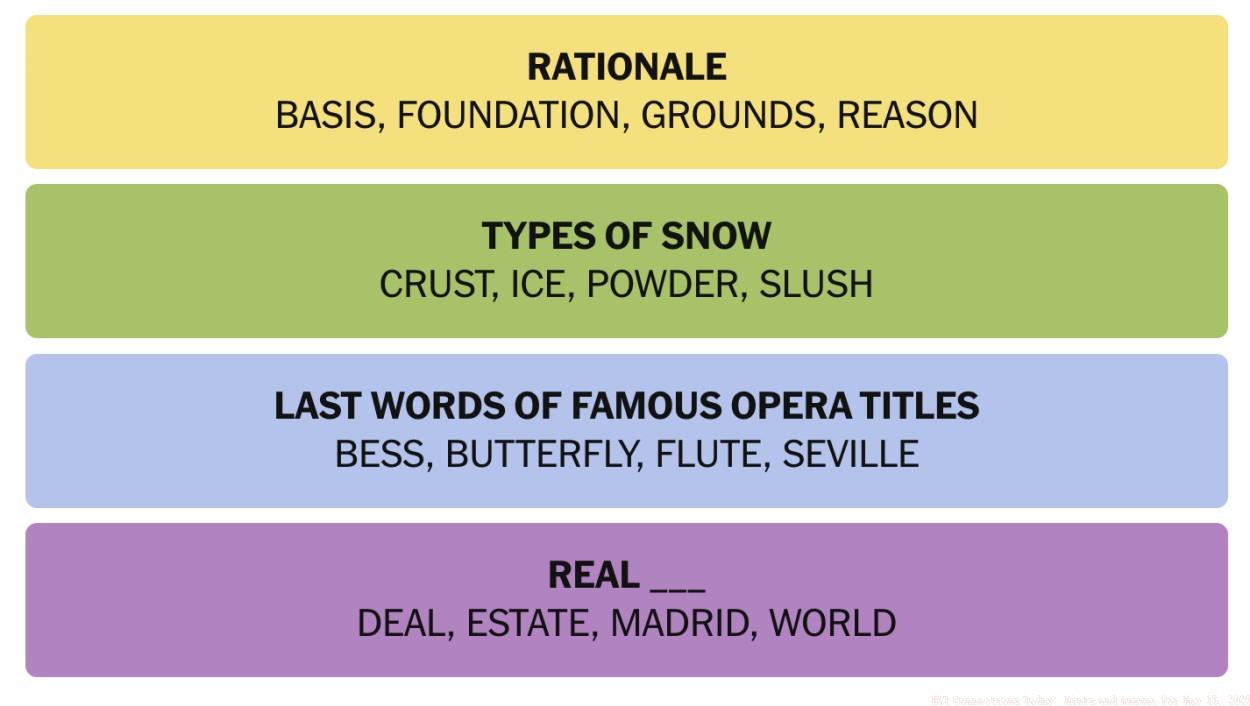
The May 15th puzzle features particularly clever categorical constructions that reward careful analysis. Understanding the solution rationale provides valuable insights for future puzzle-solving sessions.
Yellow Category – Modes of Thought: This grouping explores various cognitive approaches and mental frameworks. The terms relate to different ways people process information and form conclusions.
Green Category – Types of Cold: This meteorological theme encompasses different manifestations and intensities of low-temperature conditions across various contexts.
Blue Category – Opera Terminology: This arts-focused category requires familiarity with musical theater vocabulary and performance elements specific to operatic productions.
Purple Category – Common Prefix Words: This linguistic challenge involves identifying a shared word beginning that completes each term, testing your vocabulary breadth and word formation knowledge.
Successfully navigating today’s puzzle demands flexible thinking and the ability to shift between completely different thematic frameworks. This mental agility develops with consistent practice and exposure to diverse categorical patterns.
Mastering Connections requires developing systematic approaches to word grouping. Begin by scanning all sixteen terms to identify obvious thematic connections, then progressively tackle more subtle relationships. This strategic classification approach mirrors the systematic thinking needed in complex game environments.
Avoid Common Pattern Recognition Errors: Many players prematurely commit to initial assumptions without verifying alternative categorizations. Cross-validate potential groupings by testing whether remaining words form coherent categories.
Develop Category Anticipation Skills: The New York Times editors often employ specific categorical patterns including word pairs, synonyms, antonyms, and thematic groupings. Recognizing these recurring structures significantly improves solving efficiency.
Optimize Your Solving Workflow: Dedicate 3-5 minutes to initial pattern identification before making your first grouping attempt. This prevents early mistakes that can complicate subsequent categorization efforts.
Like mastering complex game systems, Connections proficiency develops through consistent practice and analytical refinement. Each solved puzzle enhances your ability to detect subtle linguistic connections and thematic patterns.
For players seeking to enhance their performance, consider maintaining a puzzle journal to track recurring categorical themes and challenging word relationships. This systematic improvement methodology accelerates skill development and pattern recognition capabilities.
Action Checklist
- Scan all 16 words for obvious thematic connections and word pairs
- Identify potential categories starting with yellow (easiest) progression
- Cross-validate groupings by ensuring remaining words form coherent categories
- Apply strategic hint interpretation to challenging categories
No reproduction without permission:Tsp Game Club » NYT Connections Today: Hints and Answer for May 15, 2025 Master NYT Connections with daily hints, strategic approaches, and expert puzzle-solving techniques