
TL;DR
- NYT Strands challenges players to connect themed words in a 6×8 grid with one grid-spanning Spangram
- Today’s Whodunit theme focuses on detective story characters requiring specific identification strategies
- The Spangram provides the puzzle’s key concept and spans vertically, horizontally, or diagonally
- Advanced techniques include corner scanning, vowel clustering, and thematic association methods
- Avoid common mistakes like overthinking simple words and ignoring letter frequency patterns
When today’s Strands puzzle leaves you struggling to identify theme words, our comprehensive hints and strategies provide the breakthrough you need. As players seek alternatives to popular word games like Wordle and Connections, Strands offers a uniquely challenging experience that tests both vocabulary and pattern recognition skills. If you’re among those finding today’s challenge particularly difficult, our detailed guide offers structured assistance without spoiling the satisfaction of solving it yourself. Below you’ll find carefully crafted hints, strategic approaches, and the complete solution for Friday, August 22, 2025.
The New York Times created Strands as an innovative addition to their expanding Games collection. This sophisticated word puzzle challenges players to connect adjacent letters within a six-by-eight grid, forming multiple words that all relate to a central theme. Mastering Strands requires understanding its unique mechanics and developing systematic solving approaches. For comprehensive gaming strategies beyond word puzzles, explore our Battlefield 6 Complete Guide to enhance your overall gaming skills.
Here’s how the puzzle structure works: Each daily Strands presents a specific theme that guides your word discovery. You’ll need to identify several theme-related words plus one crucial Spangram—a special word or phrase that spans the entire grid vertically, horizontally, or diagonally. This Spangram typically encapsulates the puzzle’s core concept and provides essential context for finding the remaining theme words.
Daily themes vary significantly in complexity and subject matter, ensuring players encounter fresh challenges that test different aspects of their problem-solving abilities. This variety maintains engagement while developing versatile cognitive skills applicable to other puzzle types.
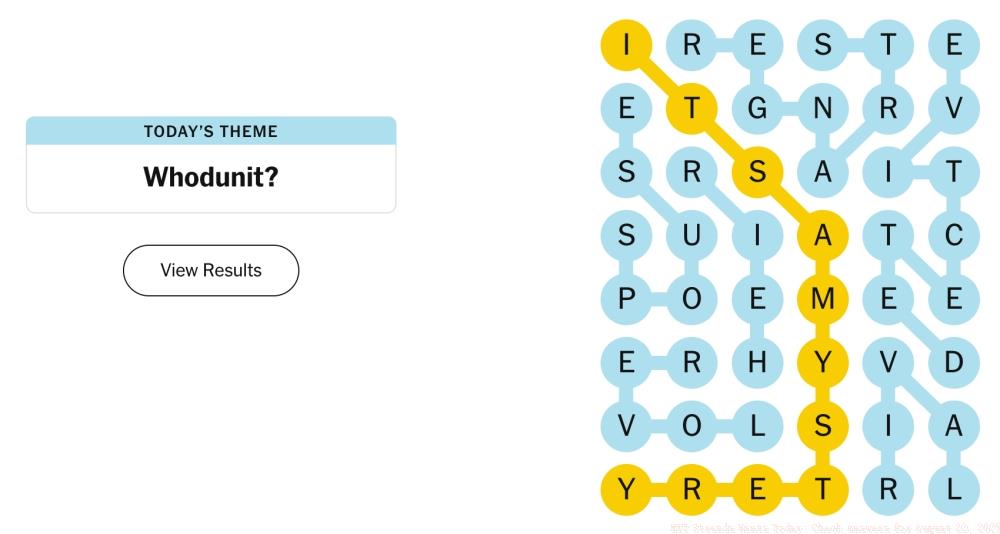
The August 22, 2025 Strands puzzle centers around the compelling theme: Whodunit?
If you’re having difficulty identifying today’s answers, here’s a strategic hint to guide your thinking—focus on character archetypes commonly found in mystery novels and detective fiction.
To help you solve today’s puzzle independently without immediately viewing the full answers, here are targeted hints for specific theme words:
Advanced solving technique: When approaching Whodunit themes, consider both the obvious character types (detective, suspect, witness) and less apparent roles (alibi, motive, evidence). Mystery stories often include specific terminology beyond just character names, so expand your thinking beyond simple job titles.
Common mistake to avoid: Many players overlook compound words or phrases that might represent character relationships rather than individual roles. For example, “sidekick” or “accomplice” could be valid answers depending on the puzzle’s specific requirements.
Looking for a different challenge? Today’s NYT Wordle answer provides an equally demanding test of your word skills with strategic approaches similar to weapon selection in tactical games.
The Spangram represents Strands’ most distinctive mechanic—a single word or phrase that literally spans the puzzle grid from one side to another. This critical element typically appears vertically, horizontally, or diagonally and encapsulates the puzzle’s central concept. Identifying the Spangram early often provides the contextual key needed to unlock the remaining theme words efficiently.
Strategic approach: Begin each puzzle by scanning the grid’s perimeter and major diagonals for potential Spangram candidates. Longer words that could conceptually unite the theme are prime suspects. For today’s Whodunit puzzle, consider what overarching concept connects various detective story characters.
Orientation patterns: Spangrams can traverse the grid in multiple directions, sometimes wrapping around edges or following unconventional paths. Advanced players develop the ability to recognize letter patterns that suggest Spangram possibilities before committing to specific word formations.
Time optimization: Dedicate your first 2-3 minutes exclusively to Spangram identification. This initial investment typically yields significant time savings throughout the remainder of the puzzle by providing thematic clarity. Like mastering class selection in tactical games, understanding this core mechanic dramatically improves your overall performance.
Pro tip: If you suspect a word might be the Spangram but it doesn’t quite span the grid, check if it appears fragmented or requires specific letter connections to complete the spanning requirement.
Mastering Strands requires moving beyond basic word-finding to develop sophisticated pattern recognition and thematic association skills. Here are professional techniques that separate casual players from Strands experts.
Corner Scanning Method: Start your puzzle solving by examining all four corners of the grid. Corners often contain letters that form parts of both theme words and the Spangram, providing crucial starting points for more complex word discoveries.
Vowel Clustering Technique: Identify clusters of vowels (A, E, I, O, U) as these frequently form cores of multiple words. Cluster analysis can reveal word boundaries and potential connection points you might otherwise miss.
Thematic Association Strategy: Once you identify the theme, brainstorm extensively related terms before committing to specific grid connections. This mental preparation significantly increases efficiency when you begin actively connecting letters.
Common Efficiency Mistakes: Avoid these productivity killers: Over-focusing on finding the ‘perfect’ word first, ignoring common prefixes and suffixes that form multiple words, and failing to recognize when a discovered word might be part of a larger phrase or compound term.
Advanced Pattern Recognition: Develop the ability to spot word patterns regardless of orientation. Expert players can identify potential words reading left-to-right, right-to-left, top-to-bottom, bottom-to-top, and diagonally in both directions simultaneously.
Pro-Level Time Management: Allocate specific time blocks for different puzzle phases: 3 minutes for theme comprehension and Spangram hunting, 7 minutes for theme word identification, and 5 minutes for verification and completion. This structured approach prevents time waste and improves overall solving consistency.
Action Checklist
- Scan grid perimeter and diagonals for Spangram candidates during first 3 minutes
- Identify vowel clusters as potential word cores before committing to connections
- Brainstorm 10-15 theme-related terms before actively connecting letters
- Systematically check all word orientations (horizontal, vertical, diagonal both directions)
- Verify all discovered words actually relate to the theme concept
No reproduction without permission:Tsp Game Club » NYT Strands Hints Today: Check Answers for August 22, 2025 Master NYT Strands with expert strategies, daily hints, and actionable tips for solving the August 22 Whodunit puzzle