
Exploring Syphilisation: A Postcolonial 4X Game That Challenges Gaming’s Colonial Legacy
Introduction: A Game That Questions Everything
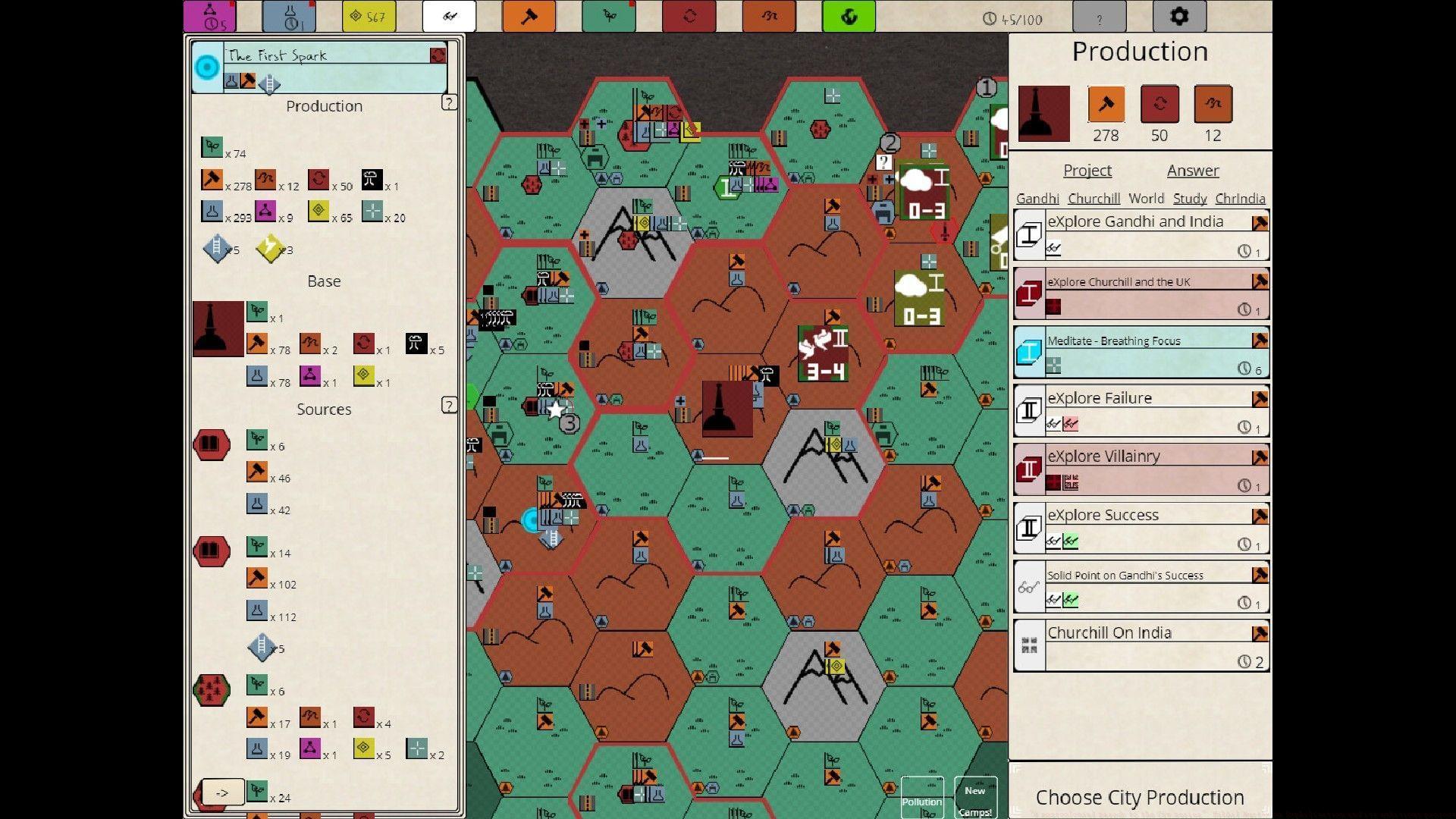
Nikhil Murthy’s Syphilisation represents a bold re-examination of the foundational assumptions within the 4X gaming genre. This innovative title compels players to critically analyze the standard tropes that have dominated strategy games for decades—conquest, resource accumulation, military expansion, and dominance-based victory conditions. The experience becomes particularly compelling as it systematically questions the ideological hegemony embedded in traditional gameplay mechanics.
As the creator Nikhil Murthy explains: “I’ve dedicated over ten years to professional game development, with Syphilisation representing my most ambitious project to date. This postcolonial 4X experience places players in the role of students collaboratively researching Gandhi, Churchill, and the complex legacy of British colonial rule in India.”
The Meaning Behind the Provocative Title
Q: Nikhil Murthy’s Syphilisation. I do notice the parallel with Sid Meier’s and the James Joyce inspiration there. I would love it if you would talk about the choice of the title and what you wanted to convey to someone who comes across the title.
“Several years back, I began exploring how parody functions within interactive media,” Murthy recounts. “While literature and film have rich traditions of parody, gaming has largely neglected this creative approach. During this period of exploration, I encountered James Joyce’s Ulysses, where the author cleverly plays with ‘Syphilisation’ as a critique of British imperial civilization. This literary discovery sparked the concept for a postcolonial parody of the Civilization series, naturally leading to the title Syphilisation.”
Murthy elaborates on the intentional wordplay: “I anticipated that players would recognize how ‘syphilisation’ deliberately undermines and questions the concept of ‘civilization,’ signaling the game’s critical approach to the Civ franchise. Including my name in the title further reinforces the work as a deliberate postcolonial intervention, despite the permanent association with syphilis that this creates.”
Why Challenge the 4X Genre?
Q: Why did you choose 4X as the genre?
“The development process began with the title itself, which felt particularly resonant given how deeply colonial ideology permeates 4X games and their foundational position within gaming culture,” Murthy explains. “The Civilization series has evolved over three decades without substantially questioning its core principles of endless expansion and zero-sum victory conditions. These underlying assumptions remain largely unchallenged across the entire genre.”
He continues: “However, these foundational beliefs don’t align with my personal worldview or my vision for how nations should interact. This inherent tension, combined with the vast unexplored design territory, made the 4X genre particularly compelling to critique and reimagine.”
Practical Insight: For players accustomed to traditional 4X games, approaching Syphilisation requires consciously setting aside established strategies. The game rewards cooperation and sustainable development rather than domination and exploitation.
Intentional Complexity and Learning Curve
Q: When I initially picked up Syphilisation, I must admit that I had difficulties wrapping my head around what was going on and what I was expected to do. Now, while most of it could be ascribed to my ineptitude, I did wonder whether the obfuscation (as I felt it to be) was intentional, maybe to stymie players who are well-versed in other 4X titles. Was that the case?
“Syphilisation was specifically designed to highlight the substantial unexplored potential within 4X game design,” Murthy clarifies. “Players typically approach genres with certain expectations about fundamental mechanics, but to effectively communicate the game’s message, I needed to disrupt these established conventions. This design approach inevitably creates a steeper learning curve.”
He emphasizes the pedagogical value: “This initial difficulty forms the core of the game’s educational purpose. I want players to experience how Syphilisation represents complex ideas and contrast this with conventional 4X representations. Achieving this requires ensuring players engage with the systems as designed, rather than through their preconceived genre expectations.”
Common Mistake: Many experienced 4X players struggle by applying traditional conquest strategies. Success requires embracing the game’s unique mechanics focused on collaboration and historical understanding.
Intellectual and Gaming Influences
Q: Talk to us about inspirations or works that might have had influences as you developed Syphilisation. Are there other games that you would love our readers to try out after Syphilisation?
“Gandhi’s philosophical work and practical principles served as the primary influence,” Murthy states. “If I were to recommend a single text, Gandhi’s Constructive Program effectively demonstrates how to translate idealistic principles into actionable practices.”
“While Syphilisation includes a comprehensive bibliography, several works deserve particular attention: Tagore’s Nationalism, Tolstoy’s The Kingdom of God Is Within You, Kropotkin’s The Conquest of Bread, Hobsbawm’s The Age of Capital, Naipaul’s India Essays, and Sartre’s Colonialism and Neocolonialism with Fanon’s influential introduction.”
Regarding gaming recommendations, Murthy suggests: “The Indifferent Wonder of Edible Places by Studio Oleomingus stands as the most significant reference. I’d also recommend The Cat and the Coup, alongside Sid Meier’s Alpha Centauri, which remains arguably the finest strategy game ever created.”
Advanced Insight: Understanding these philosophical underpinnings significantly enhances gameplay, as many mechanics directly reflect concepts from these influential works.
The Student Protagonist Narrative Choice
Q: The choice of students and group reports as dictating the politics of the game is an interesting one (and one that reminded me of the MUNs, maybe erroneously, I heard of during college). What was the thought process behind this choice of a protagonist? How did it impact how you wrote the narrative of the game in terms of opportunities or limitations?
“Early in development, I committed to presenting authentic historical events rather than creating alternative history scenarios,” Murthy explains. “This required establishing a narrative framework that could deliver factual information to players organically.”
“The student group report concept emerged as an ideal solution, as it parallels the player’s own educational journey learning about Gandhi, Churchill, and British colonial rule. This narrative approach also harmonized beautifully with the game’s postcolonial themes. Players naturally feel more inclined to assist fellow students than abstract nations—interestingly, we often judge interpersonal ethics more strictly than international politics.”
Strategy Tip: Embrace the student perspective fully—success often comes from collaborative problem-solving rather than competitive domination, mirroring effective group project dynamics.
Practical Gameplay Insights and Strategies
Getting Started with Syphilisation: New players should approach this game as a complete departure from traditional 4X experiences. Begin by thoroughly reading the in-game historical materials and focus on understanding relationships between characters rather than optimizing resource production. The initial learning phase may feel disorienting, but this discomfort is intentional and ultimately rewarding.
Avoid These Common Mistakes: Don’t default to military solutions for conflicts. The game penalizes aggressive expansion and rewards diplomatic engagement. Similarly, avoid hoarding resources—sharing knowledge and collaborating with other students typically yields better long-term outcomes than competitive accumulation.
Advanced Optimization Strategies: Experienced players should pay close attention to the philosophical texts referenced throughout the game. Many gameplay mechanics directly implement concepts from Gandhi’s principles of non-violence and Tagore’s critiques of nationalism. Mastering these systems requires understanding their ideological foundations rather than applying standard gaming optimization logic.
Postcolonial Impact on Gaming Genres: Murthy reflects: “Applying postcolonial perspectives to established genres accomplishes two significant goals. It enables game creation that better reflects developers’ authentic beliefs, which proves deeply rewarding, while simultaneously revealing substantial unexplored design territory. In crowded gaming markets, adopting strong ideological frameworks like postcolonialism provides immediate differentiation from conventional titles.”
No reproduction without permission:Tsp Game Club » “A postcolonial parody to the Civ series”: Nikhil Murthy on Syphilisation and its ambitious project Exploring Syphilisation: A Postcolonial 4X Game That Challenges Gaming's Colonial Legacy