
TL;DR
- Seven specialized blueprints automate core production chains from plant ash to fertilizer
- Vertical stacking enables 3x output without expanding factory footprint
- Modular designs work as interconnected systems rather than isolated builds
- Blueprint sharing through .af files accelerates community knowledge transfer
- Progressive implementation strategy ensures smooth scaling from early to mid-game
Transform your Alchemy Factory experience with strategic blueprint implementation that eliminates repetitive rebuilding cycles. Many players waste hours reconstructing production lines when seven carefully designed blueprints can automate your entire operation from basic materials to complex potions.
Starting with an empty factory space often feels daunting, especially when you’re uncertain about optimal machine placement. These proven designs address specific production bottlenecks you’ll encounter between levels 1-4, providing scalable solutions that grow with your factory’s demands. Whether you require consistent plant ash generation or automated fertilizer production, these blueprints deliver reliable performance.
The key advantage lies in their interconnected nature – each blueprint complements others to create a seamless production ecosystem. Your sand tower supplies clay production, which supports brick manufacturing, while quicklime systems ensure continuous fertilizer flow to nurseries. This systematic approach prevents the common pitfall of building disjointed production islands that don’t work together efficiently.
Blueprint functionality represents Alchemy Factory’s most powerful automation feature, allowing you to save and replicate complex structures with single commands. Press F to copy any configured structure, then access your blueprint library with H where you can organize and name your designs for quick retrieval.
Critical Compatibility Note
Blueprint files created during the demo phase remain incompatible with early access versions. Begin building your permanent blueprint collection from scratch to avoid structural conflicts and missing component errors.
Vertical expansion through stacking represents the most efficient scaling method in Alchemy Factory. Most blueprints support direct vertical replication by copying the design and positioning it above the original installation. Some complex configurations require minor adjustments for optimal vertical functionality, but this approach enables triple output capacity without consuming additional factory floor space.
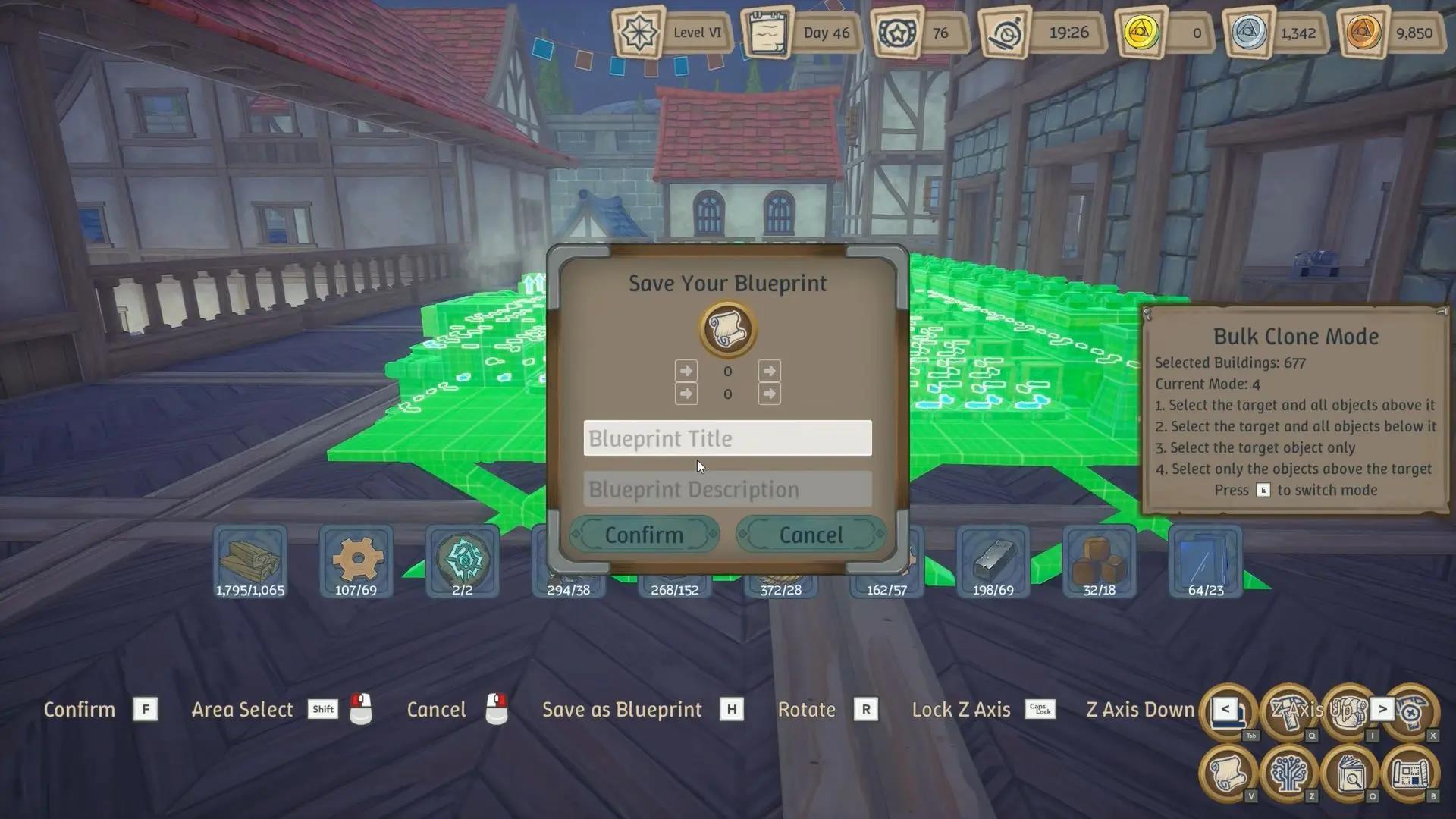
Alchemy Factory Blueprint Interface
This optimized design delivers exactly 90 plant ash units per minute using a resource-efficient three-column configuration. You’ll need wood blocks for structural support, shelving units for equipment mounting, table saws for material processing, furnaces for combustion, and crucibles for final processing arranged in a precise spatial relationship.
Structural Foundation Setup
Begin construction with three vertical wood support pillars spaced four blocks apart. Each pillar should extend three blocks upward, except the crucible column which requires four blocks height to accommodate taller equipment profiles. The crucial building technique involves initially positioning shelves on adjacent walls, then utilizing Caps Lock precision placement to slide them onto your primary support pillars.
Column configuration details:
Establish three conveyor belts extending from table saw outputs on each side. These transport lines must remain segregated since each generates 90 units output, matching the maximum throughput of standard conveyor systems. Premature merging creates immediate bottlenecks that reduce overall efficiency by up to 50%.
Equipment Height Advisory
Furnaces and crucibles possess taller profiles than other machinery. Always construct their supporting column one block higher than other equipment columns to prevent clearance issues and operational failures.
The central column accommodates two input chests with their access faces oriented toward the wall. Connect sage distribution from these storage containers upward to the conveyor network supplying your table saws. This creates a closed-loop processing system that automatically maintains sage processing without manual intervention.
Every production pipeline depends on consistent plant materials. This versatile nursery blueprint supports flax, sage, and red currant cultivation without structural modifications beyond selecting the appropriate crop type. The stackable architecture enables output tripling through vertical replication.
Position nurseries in organized rows with fertilizer inputs running through the central axis and harvest outputs diverging left and right. This symmetrical arrangement simplifies conveyor routing while maintaining visual organization and operational clarity. You’ll connect fertilizer supplies to the central input line while collecting harvests from both sides concurrently.
The design’s primary strength lies in its remarkable adaptability. Construct one instance for flax production today, replicate it for sage tomorrow, then vertically stack three sage nurseries when expanding turquoise potion production. Each nursery integrates directly into processing chains without requiring manual material transfer.
Storage Flexibility Recommendation
Maintain chest placement flexibility across different implementations. Varied configurations demand different storage positions, so add chests after blueprint placement rather than incorporating them into the saved design template.
Clay and brick manufacturing consumes resources rapidly. This integrated blueprint combines crushers for material reduction, table saws for wood processing, charcoal processors for fuel production, and kilns for firing into a compact production unit that generates both materials efficiently.
The configuration requires four vertically stacked table saws (yes, vertical stacking works here) feeding into charcoal production systems. Three crushers process stone into sand at 180 units per minute. All material flows converge into kilns that output finished bricks ready for construction applications.
The sand production component demands particular attention since nearly all advanced production requires sand. Clay manufacturing consumes it. Turquoise potion production depends on it. You’ll deplete sand reserves faster than anticipated, making the crusher section your most critical infrastructure investment.
Scalability Adjustment
This blueprint operates effectively at reduced capacity when moderate brick production suffices. Remove two table saws and one crusher to conserve resources while maintaining functional output for smaller-scale operations.
Addressing sand requirements directly, this stackable crusher installation generates 180 sand units per minute utilizing 500 wood, 176 nails, 36 large gears, 41 rope, and 103 stone. These material requirements appear substantial until you recognize that just two of these assemblies can supply your complete early-game operational needs.
The vertical architecture stacks crushers on shelving units with interlevel conveyors facilitating material transfer. Stone enters at the summit, processed sand exits at the base, and the entire system operates autonomously. Construct it once, replicate it twice, and eliminate sand supply concerns permanently.
Comprehensive materials breakdown:
This blueprint integrates perfectly with clay production since both systems utilize the same sand source. Connect them directly and observe your brick output increase dramatically without continuous manual resource replenishment.
Fertilizer represents the fundamental driver of Alchemy Factory operations. Without consistent fertilizer supply, your nurseries remain inactive and production halts. The standard blueprint employs six crushers, six table saws, and eighteen crucibles to produce quicklime powder, which combines with other components to manufacture fertilizer.
The linear layout simplifies construction complexity. Crushers process stone, table saws handle wood processing, crucibles combine materials into quicklime powder. Connect stone input at one terminus, wood at the opposite end, and collect finished powder from the central region.
Operational costs appear elevated initially, but revenue streams expand significantly once potion sales commence. The genuine value emerges from eliminating fertilizer supply concerns permanently. Your nurseries receive consistent nutrition, your plants continue growing, and your production chains operate uninterrupted awaiting basic materials.
The enhanced compact variant generates 180 quicklime powder units using a space-efficient square configuration rather than the linear layout. You’ll require additional iron ingots and resources, but the spatial economy proves invaluable when constructing multiple production zones.
The square arrangement positions crucibles around the perimeter with crushers and table saws occupying the central area. Conveyors spiral inward, creating an aesthetically pleasing production flow that also delivers exceptional efficiency. Stone enters from the rear, processing occurs centrally, and finished powder exits at designated collection points.
Deploy this blueprint for primary production facilities: turquoise potions, soap, and vitality potions. Each high-value product demands reliable fertilizer supply, and this compact design delivers without consuming your entire factory footprint.

Design Insight: This blueprint appears boxy but conserves substantial space compared to linear arrangements. When establishing three separate production chains, this spatial efficiency becomes operationally critical.
Eight assemblers organized in a stackable grid configuration form the core infrastructure for fertilizer production. This blueprint manages basic fertilizer and advanced fertilizer with straightforward input modifications. Stack multiple copies vertically when tripling output capacity without horizontal expansion becomes necessary.
The central zone contains input chests and distribution mechanisms. Assemblers surround the perimeter for convenient access and maintenance. Each level functions independently, enabling different fertilizer types on separate floors if required.
This design excels during mid-game phases when managing multiple plant varieties simultaneously. Flax demands fertilizer. Sage requires fertilizer. Red currant needs fertilizer. Construct three tiers, assign each to a specific crop pipeline, and witness your automation capabilities achieve new performance levels.
Three additional space-optimized designs warrant recognition for their exceptional spatial efficiency:
Stackable Rope Production utilizes minimal footprint to generate rope from flax. Replicate it vertically when additional rope supplies become necessary for conveyor system expansion.
Compact Green Potion manufactures health potions from sage and flax within a confined 3×3 area. Stack five instances and generate surplus potions exceeding your shop’s sales capacity.
Compact Linen processes flax into linen thread efficiently. This blueprint incorporates integrated storage while maintaining chest placement flexibility for customized configurations.
All three designs support vertical stacking without structural modifications. Construct one instance, verify functionality, then replicate upward as production requirements escalate. The modular methodology ensures you avoid commitment to fixed production rates.
Press Q to activate the Build interface, then select the Blueprints tab positioned beneath the primary Build tab. Your preserved blueprints display here ready for deployment. Choose one, position it within your base, and confirm placement with a click.
Blueprint sharing necessitates accessing your game directory and locating the Blueprint folder. Files utilize the .af extension. Duplicate these files to distribute among colleagues or acquire blueprints from community Discord servers.
Integration Protocol
When acquiring blueprint files, store them in your Blueprint directory for automatic game detection. Restart the application if newly added blueprints don’t appear immediately in your interface.
The Complete Guide covers supplementary automation methodologies that perfectly complement these blueprint strategies.
These blueprints function as an integrated system rather than isolated constructions. Your sand tower supplies clay production. Clay manufacturing requires quicklime from your compact design. Quicklime production depends on plant ash from your generator. All components interconnect through fertilizer production that sustains nursery operations.
Initiate implementation with the plant ash generator and nursery blueprint. These two elements unlock fundamental automation immediately. Incorporate the sand tower subsequently since multiple production chains will demand sand resources. Construct clay production when beginning base expansion with brick structures. Reserve the assembler grid and quicklime designs for phases requiring complete fertilizer automation. These demand greater resource investment but provide long-term returns by eliminating manual fertilizer preparation permanently. The compact rope, potion, and linen blueprints integrate wherever necessary. Stack them adjacent to your shop for convenient restocking or establish dedicated production zones separate from your primary factory.
Most critically, avoid complete reconstruction when output increases become necessary. Replicate your existing blueprints and stack them vertically. This represents the fundamental advantage of modular construction from inception.
Action Checklist
- Master blueprint controls: F to copy, H to access library, Q for build menu
- Construct the 90 Plant Ash Generator as your foundation automation system
- Implement Stackable Nursery for your primary crop (flax, sage, or red currant)
- Build the 180 Sand Tower to ensure continuous sand supply for multiple production chains
- Add Clay and Brick Production when expanding your base with construction materials
- Implement Quicklime Production systems to automate fertilizer manufacturing
- Vertical stack existing blueprints for 3x output instead of rebuilding from scratch
No reproduction without permission:Tsp Game Club » Alchemy Factory Best Blueprints Master Alchemy Factory automation with 7 essential blueprints for efficient plant ash, sand, and fertilizer production systems