
TL;DR
- NYT Connections challenges players to group 16 words into four color-coded categories by difficulty
- Today’s puzzle features categories including casino terminology, anger expressions, and discount-related words
- Strategic pattern recognition and elimination techniques significantly improve solving efficiency
- Avoid common pitfalls like forcing connections and overlooking multiple meaning words
- Daily practice with systematic approaches builds essential word association skills
NYT Connections represents The New York Times’ sophisticated word association challenge that combines logical deduction with creative thinking. Unlike traditional word games, this puzzle demands players identify subtle thematic relationships between seemingly unrelated terms. Each session presents a fresh cognitive exercise that tests both vocabulary breadth and pattern recognition abilities.
Following Wordle’s unprecedented success in popularizing daily puzzle culture, The New York Times expanded their gaming portfolio with Connections. This free-to-play word game maintains accessibility across mobile devices and desktop platforms, ensuring players can engage from anywhere. The game’s elegant design belies its considerable mental challenge.
The core gameplay involves a strategically arranged 4×4 grid containing 16 carefully selected words. Your objective centers on discovering the hidden connections that group these terms into four distinct categories. These groups progress in complexity from straightforward yellow classifications to notoriously tricky purple associations that often require lateral thinking.
Color-coding serves as the primary difficulty indicator, with yellow representing the most accessible category and purple denoting the most challenging connections. This graduated difficulty system allows players to build momentum while preserving substantial endgame challenge. Understanding this progression is crucial for developing effective solving strategies.
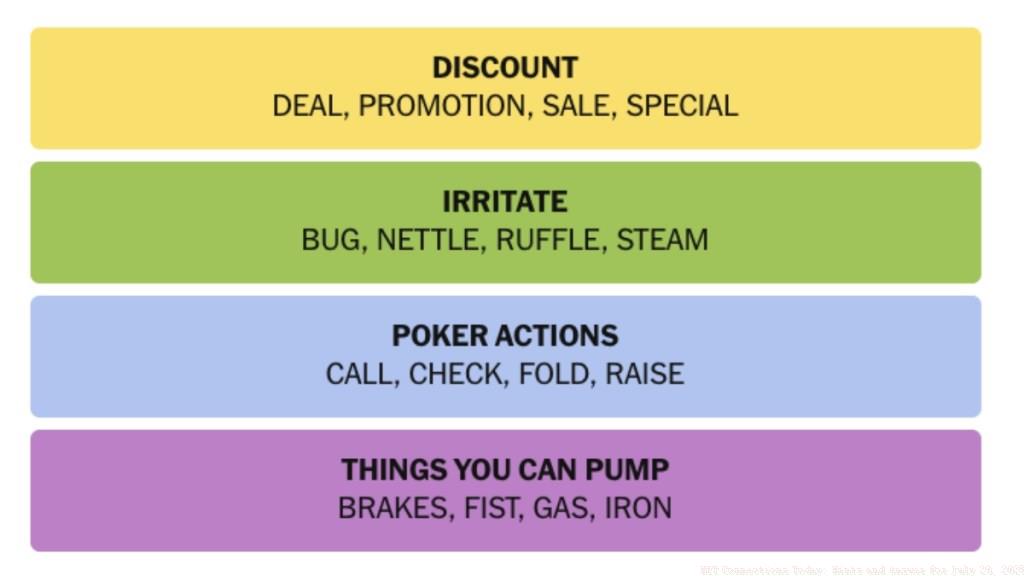
To enhance your solving experience for July 29’s puzzle #779, here are the categorized hints designed to guide without spoiling the discovery process:
- Yellow Category – Financial discount terminology including markdown, sale, and clearance-related terms
- Green Category – Emotional vocabulary describing various states of anger and frustration
- Blue Category – Casino environment phrases and gambling terminology
- Purple Category – Objects associated with sudden pulling or jerking motions
- Complete initial 2-minute word scan identifying obvious thematic connections
- Solve yellow category first to build confidence and establish solving rhythm
- Tackle green and blue categories using elimination and pattern recognition
- Apply lateral thinking for purple category, considering multiple word meanings
- Review remaining words systematically before final category submissions
Today’s puzzle configuration demonstrates moderate complexity with clearly defined categories that still require careful consideration. The casino terminology might immediately resonate with players familiar with gambling environments, while the anger expressions category benefits from understanding emotional vocabulary nuances.
Strategic category identification begins with scanning for obvious thematic connections, then progressively addressing more ambiguous relationships. A common mistake involves forcing connections between words that share superficial similarities rather than genuine categorical relationships. The purple category typically demands the most creative thinking, as these connections often rely on less common word usages or specialized knowledge.
Advanced solvers recommend starting with the yellow category to build confidence, then tackling green and blue before confronting the challenging purple group. This systematic approach prevents mental fatigue and maintains solving momentum. Remember that some words might fit multiple categories conceptually, requiring careful evaluation of all possibilities before committing to selections.
Mastering NYT Connections requires developing systematic approaches beyond basic word association. Begin each puzzle with a comprehensive scan of all 16 words, mentally noting potential thematic groupings without immediate selection. This initial assessment phase should take approximately 2-3 minutes and establishes your strategic foundation.
Pattern recognition forms the core of successful Connections play. Look for words sharing common prefixes, suffixes, or thematic relationships. However, avoid the trap of assuming all connections follow obvious linguistic patterns—the most challenging categories often involve conceptual or situational relationships.
Time management proves crucial for consistent performance. Allocate your effort proportionally to difficulty: spend 30% on yellow, 25% on green, 25% on blue, and 20% on purple categories. This distribution maximizes efficiency while ensuring adequate attention to challenging connections.
Common solving pitfalls include premature commitment to category assumptions and overlooking words with multiple potential meanings. For example, today’s “jerk” category could involve both physical actions and metaphorical applications. Regular players benefit from maintaining a puzzle journal to track recurring category types and personal solving patterns.
For those seeking to elevate their gameplay, our Complete Guide to strategic thinking games provides additional cognitive exercises. Similarly, our Weapons Unlock guide demonstrates similar pattern recognition skills applied in different contexts. Understanding these Class Guide methodologies can enhance your categorical thinking abilities.
Advanced optimization involves recognizing The New York Times’ tendency to reuse certain category archetypes. Familiarize yourself with common thematic groupings like “types of clouds,” “famous pairs,” or “words that precede ‘light’.” This meta-knowledge significantly reduces solving time for experienced players.
Action Checklist
No reproduction without permission:Tsp Game Club » NYT Connections Today: Hints and Answer for July 29, 2025 Master NYT Connections with expert strategies, daily hints, and actionable tips for puzzle success