
TL;DR
- NYT Connections challenges players to group 16 words into four color-coded categories by difficulty
- Today’s puzzle features baking ingredients, types of lists, and desire-related themes
- Strategic approaches include identifying word patterns and eliminating false connections
- Advanced players should focus on thematic consistency and avoid common grouping errors
- Daily practice improves pattern recognition and puzzle-solving efficiency
The NYT Connections puzzle presents a compelling word association challenge that combines mental stimulation with entertainment value. For those seeking assistance with the daily brain teaser, our comprehensive guide provides the strategic insights needed to conquer each day’s unique word grouping challenge. Let’s dive into the essential hints and solutions for game #755 on July 5, 2025.
Following the massive popularity of Wordle, The New York Times expanded its puzzle portfolio with Connections, offering players a completely free gaming experience accessible across mobile devices and desktop platforms.
The game’s fundamental structure arranges 16 carefully selected words within a 4×4 grid layout. Your objective involves discovering the hidden relationships between these terms and organizing them into four distinct groups, each color-coded to indicate progressive difficulty levels from simplest to most challenging.
As previously noted, Connections organizes its categories using a color-based difficulty scale. The Yellow group represents the most straightforward connections, while Purple categories demand sophisticated lateral thinking and often feature wordplay or obscure relationships that challenge even experienced puzzle solvers.
To enhance your puzzle-solving experience, we’re providing targeted hints for today’s specific categories that will guide your thinking without completely revealing the solutions:
When approaching today’s Connections puzzle, begin by scanning for obvious thematic connections while remaining alert for potential red herrings. Seasoned players recommend initially identifying the most straightforward category (typically Yellow) to establish momentum, then progressively tackling more complex groupings. Avoid the common mistake of forcing connections based on superficial similarities—instead, look for deeper conceptual relationships.
The current Connections assortment presents an intriguing combination of themes that may challenge even regular players. Below are the specific category designations for the July 5, 2025 edition:
Analyzing today’s categories reveals interesting patterns: the baking ingredients theme requires understanding culinary processes, while the lists category demands knowledge of organizational systems. Intermediate players often struggle with distinguishing between similar thematic groupings, so pay close attention to contextual clues within each word’s potential meanings.
For optimal solving strategy, consider that Connections puzzles frequently include words that could fit multiple categories, testing your ability to identify the most precise grouping. The color progression typically moves from concrete associations (Yellow) to abstract relationships (Purple), with today’s Green category representing a moderate challenge level.
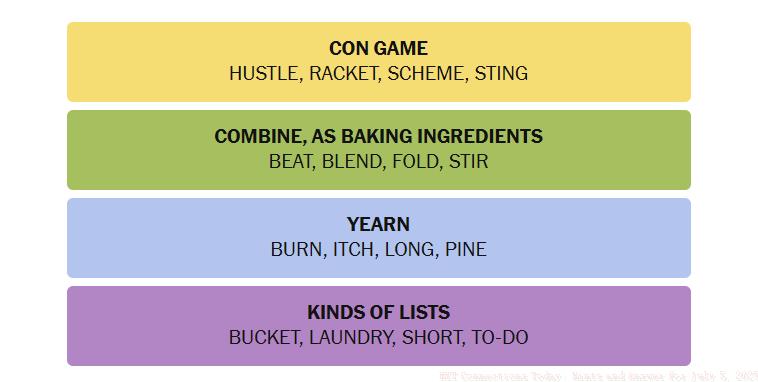
The complete solution set for today’s puzzle demonstrates how these thematic groupings interconnect. Understanding the precise categorization helps develop pattern recognition skills for future puzzles.
Common solving errors include: grouping words based on single characteristics rather than comprehensive themes, overlooking alternative word meanings, and prematurely committing to incorrect categories. Advanced players recommend maintaining flexibility in your hypotheses until you’ve examined all potential relationships.
When reviewing the answers, note how certain words might initially seem to belong to different categories, highlighting the importance of considering multiple interpretations before finalizing your selections.
Mastering NYT Connections requires developing systematic approaches that leverage both linguistic knowledge and logical deduction. Here are expert techniques to elevate your puzzle-solving performance:
Pattern Identification Framework: Begin by scanning for obvious thematic connections—words sharing common prefixes, suffixes, or belonging to recognizable categories like professions, animals, or common phrases. This foundational analysis typically reveals the Yellow category quickly.
Elimination Strategy: When facing ambiguous groupings, employ process of elimination by temporarily assigning words to categories and testing consistency. If you encounter resistance, our Weapons Unlock guide demonstrates similar systematic approaches that translate well to puzzle solving.
Time Management: Allocate approximately 3-5 minutes for initial scanning, 5-7 minutes for category formation, and 2-3 minutes for verification. This structured approach prevents rushed decisions and reduces errors.
Advanced Technique: For challenging Purple categories, consider wordplay elements like homophones, compound words, or cultural references. Similar to mastering Class Guide strategies in gaming, Connections rewards deep thematic understanding over superficial pattern matching.
Common Pitfall Avoidance: Regularly reassess your groupings before submission. Many players lose attempts by committing to plausible but incorrect categories early. The Complete Guide to strategic thinking applies directly to optimizing your Connections performance.
Action Checklist
- Scan all 16 words for obvious thematic connections and shared characteristics
- Identify and solve the easiest (Yellow) category first to build momentum
- Group remaining words by potential themes while considering multiple meanings
- Test category consistency by ensuring all four words share a strong, unambiguous connection
- Review groupings for red herrings and false connections before submitting
No reproduction without permission:Tsp Game Club » NYT Connections Today: Hints and Answer for July 5, 2025 Master NYT Connections with daily hints, strategic tips, and expert puzzle-solving techniques