
TL;DR
- NYT Connections challenges players to group 16 words into four color-coded categories by identifying hidden thematic connections
- Today’s puzzle features poker elements, evil twins, piercing locations, and word suffix patterns across difficulty levels
- Strategic approaches include starting with obvious connections and working from easiest to hardest categories
- Common mistakes include forcing connections and overlooking wordplay or double meanings
- Daily practice improves pattern recognition and category identification skills significantly
NYT Connections represents The New York Times’ sophisticated word association challenge that has captivated puzzle enthusiasts worldwide. Following the monumental success of Wordle, this daily brain teaser elevates word gaming by requiring players to identify subtle thematic relationships between seemingly unrelated terms.
The game presents a carefully curated selection of 16 distinct words arranged in a structured 4×4 grid, creating a visual and mental playground for linguistic exploration. Unlike traditional word searches, Connections demands lateral thinking and conceptual linking abilities that test both vocabulary breadth and cognitive flexibility.
Getting acquainted with Connections proves remarkably straightforward despite its depth. Each session challenges participants to discover four groups of four words each, with every category representing a unique thematic connection. These groups are systematically color-coded to indicate progressive difficulty: yellow (simplest), green (moderate), blue (challenging), and purple (most complex). This tiered approach allows players to build momentum while gradually facing more demanding cognitive challenges.
The puzzle’s design intentionally creates cognitive tension between obvious surface-level connections and deeper thematic relationships. This structure encourages players to move beyond literal interpretations and consider metaphorical, cultural, and contextual associations that transform simple word grouping into an engaging intellectual exercise.
To enhance your solving experience for today’s edition, we’ve compiled strategic hints that illuminate the categorical themes without revealing direct answers. These clues are designed to stimulate your pattern recognition while preserving the satisfaction of discovery.
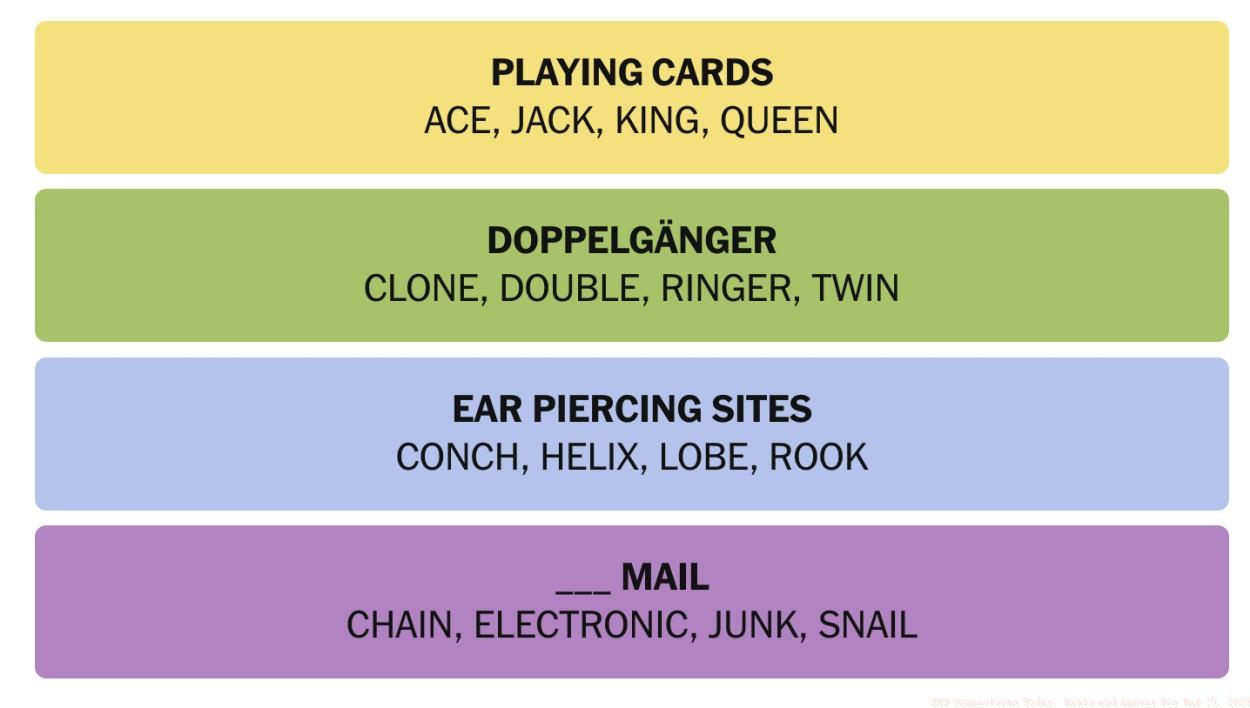
- Yellow Category – You play poker with these (Common gaming implements)
- Green Category – Your twin but evil (Opposing counterpart concepts)
- Blue Category – People get piercings here (Anatomical locations for body modification)
- Purple Category – A word comes after all these (Prefix-based word formations)
Today’s Connections categories present an intriguing blend of thematic elements that challenge conventional association patterns. The yellow group focuses on tangible objects from recreational activities, while green introduces conceptual opposition relationships. Blue category terms relate to physical anatomy, and purple demands linguistic creativity with suffix patterns.
Strategic solving recommends beginning with the yellow category, as it typically contains the most straightforward connections. This approach builds confidence and establishes a solving rhythm before tackling more abstract green and blue groups. The purple category, as always, requires the most sophisticated pattern recognition and often involves wordplay, cultural references, or specialized knowledge domains.
Advanced players should note that today’s puzzle contains several words that might fit multiple potential categories, creating intentional red herrings that test deduction skills. This design element separates casual players from dedicated puzzle solvers who can identify the most precise thematic groupings.
Mastering NYT Connections requires developing systematic approaches that optimize both accuracy and efficiency. Seasoned players typically employ a multi-phase strategy that begins with rapid scanning for obvious connections before progressing to more analytical approaches for challenging categories.
Pattern Recognition Development: Train yourself to identify common connection types including synonyms, categories, word pairs, cultural references, and thematic groupings. Today’s puzzle emphasizes thematic and word formation patterns rather than straightforward synonym relationships.
Common Solving Mistakes: Avoid forcing connections between words that share superficial similarities but lack genuine thematic unity. Another frequent error involves overlooking words that can function in multiple grammatical roles or have double meanings that change their categorical fit.
Time Optimization Techniques: Allocate approximately 2-3 minutes for initial scanning, 5-7 minutes for yellow and green categories, and 8-10 minutes for blue and purple groups. This time distribution prevents frustration while ensuring thorough consideration of complex relationships.
Advanced Strategic Considerations: When stuck, consider whether words might share hidden connections through homophones, abbreviations, or specialized jargon. The purple category often requires thinking beyond dictionary definitions to consider how words function in specific contexts or cultural frameworks.
For gamers looking to apply similar strategic thinking to other challenges, our Complete Guide to Battlefield 6 demonstrates how systematic approaches enhance performance across different gaming domains.
Action Checklist
- Scan all 16 words quickly to identify 2-3 obvious connections for the yellow category
- Group words by potential thematic relationships, starting with concrete objects and moving to abstract concepts
- Verify each grouping by testing if all four words share a strong, unambiguous connection
- Cross-check remaining words for hidden patterns, considering wordplay and contextual meanings
- Review your final groupings against the color difficulty progression to ensure logical categorization
No reproduction without permission:Tsp Game Club » NYT Connections Today: Hints and Answer for May 25, 2025 Master NYT Connections with expert strategies, daily hints, and proven solving techniques for puzzle success