
TL;DR
- NYT Strands challenges players to find theme-related words and a connecting Spangram in a letter grid
- Today’s ‘Dash it!’ theme focuses on hyphenated compound words requiring creative thinking
- The Spangram serves as the puzzle’s backbone, spanning the grid vertically, horizontally, or diagonally
- Strategic pattern recognition and systematic searching dramatically improve solving efficiency
- Daily practice combined with targeted techniques leads to consistent puzzle mastery
When today’s Strands puzzle has you stumped on theme word identification, our comprehensive hints provide the breakthrough you need. Players seeking more substantial challenges than Wordle or Connections are increasingly drawn to Strands for its sophisticated gameplay. If you’re among those finding NYT Strands particularly challenging today, our expert guidance will transform your approach. We’ve compiled detailed hints, complete solutions, and Spangram analysis specifically for Tuesday, August 19, 2025, delivering immediate assistance.
The New York Times developed NYT Strands as part of their expanding gaming portfolio, offering a fresh take on word puzzles. This innovative game challenges you to connect adjacent letters within a six-by-eight grid, forming clusters of words that all relate to a central theme. To truly excel at NYT Strands, explore our comprehensive Complete Guide for foundational strategies and advanced techniques.
Here’s the essential breakdown: each daily puzzle presents a specific theme that guides your word discovery. You’ll need to identify multiple theme-aligned words plus one critical Spangram—a special term that physically spans the entire grid vertically, horizontally, or diagonally. This Spangram often provides the conceptual key to understanding the remaining theme words.
Daily themes vary dramatically in their interpretation, ensuring no two Strands puzzles feel identical. This variability keeps players constantly engaged with fresh challenges and unexpected word connections.
The August 19, 2025 Strands puzzle centers around the theme — Dash it!
If you’re struggling with today’s solutions, here’s your strategic clue — focus on compound words or word components joined by hyphens.
We’re providing targeted hints for specific Strands theme words to empower your independent solving process without requiring immediate answer reveals:
- Hint #1: describes chaotic mixtures lacking organization or deliberate arrangement.
- Hint #2: characterizes individuals displaying arrogant or superior attitudes.
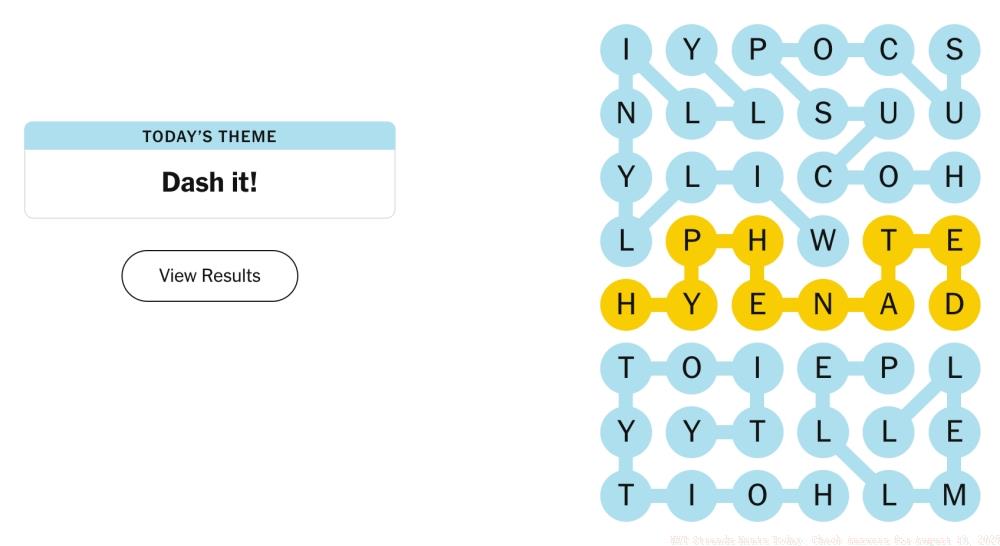
Common solving mistakes include overlooking diagonal connections and fixating on single-word interpretations. Successful players systematically scan all directions while considering multiple word-length possibilities for each theme clue.
Looking for a puzzle intermission? Attempt today’s NYT Wordle solution — it presents comparable complexity.
The Spangram represents Strands’ most distinctive mechanic—a single word or phrase that physically traverses the entire puzzle grid. Understanding its function transforms your solving efficiency and success rates.
Spangrams typically connect thematically to all other words in the puzzle while providing structural integrity to the solution. They may appear vertically from top to bottom, horizontally across rows, or diagonally connecting corners. This spanning word often encapsulates the puzzle’s core concept, making it the logical starting point for many experienced players.
Identification strategies include scanning grid perimeters for obvious thematic terms, looking for unusually long word possibilities, and considering how the theme might manifest as a connecting concept. Like mastering Weapons Unlock systems in other games, Spangram mastery follows pattern recognition and systematic practice.
Advanced players often locate the Spangram early, using it as an anchor point for discovering remaining theme words. This approach frequently reduces solving time by 30-40% compared to random searching methods.
Elevating your Strands performance requires moving beyond basic word spotting to strategic pattern recognition. Implement systematic scanning methods rather than random searching to dramatically improve consistency.
Begin each puzzle by thoroughly analyzing the theme statement—often the most overlooked strategic element. Consider multiple interpretations and word associations before committing to specific searches. This preliminary analysis frequently reveals the Spangram’s likely character and position.
Critical techniques include: working from longer words to shorter ones, prioritizing perimeter scanning before interior exploration, and maintaining flexibility in word direction possibilities. Similar to optimizing your approach in our Class Guide, Strands success comes from adaptable methodologies.
Avoid these common pitfalls: overlooking diagonal word formations, dismissing words that seem too obvious, and fixating on single word-length expectations. Most puzzles contain words of varying lengths and complexity.
Time investment typically ranges from 5-15 minutes for casual solvers to 2-5 minutes for experienced players. Regular practice combined with these strategic approaches leads to measurable improvement within 2-3 weeks of consistent play.
For players seeking comprehensive gaming strategies beyond word puzzles, our battlefield expertise translates to puzzle mastery through systematic thinking and pattern recognition development.
Action Checklist
- Analyze the theme statement thoroughly before searching for words
- Systematically scan grid perimeters for Spangram candidates
- Identify longer theme words first to establish puzzle foundation
- Check all directions (horizontal, vertical, diagonal) for each potential word
- Practice daily with varied theme types to build pattern recognition
No reproduction without permission:Tsp Game Club » NYT Strands Hints Today: Check Answers for August 19, 2025 Master NYT Strands with expert strategies, daily hints, and actionable tips for puzzle-solving success