
TL;DR
- Choose France for military dominance or Portugal for colonial learning with natural protection
- Enable population automation immediately to learn optimal management patterns
- Master economic balance by monitoring treasury and avoiding over-expansion
- Use England’s island position to safely learn trade and naval mechanics
- Focus on core mechanics first before tackling advanced diplomatic systems
Mastering Europa Universalis 5 begins with selecting the right nation for your playstyle and learning objectives. While the game highlights several obvious choices, understanding the strategic advantages of each can dramatically accelerate your learning curve.
Europa Universalis 5 represents a significant evolution in grand strategy gaming complexity. New players typically face initial challenges, which is completely expected given the game’s intricate systems. This masterpiece rewards patience and strategic thinking, offering one of the most satisfying strategy experiences available once you grasp core concepts. Whether you’re new to the franchise or transitioning from EU4, this guide provides the foundation for European domination.
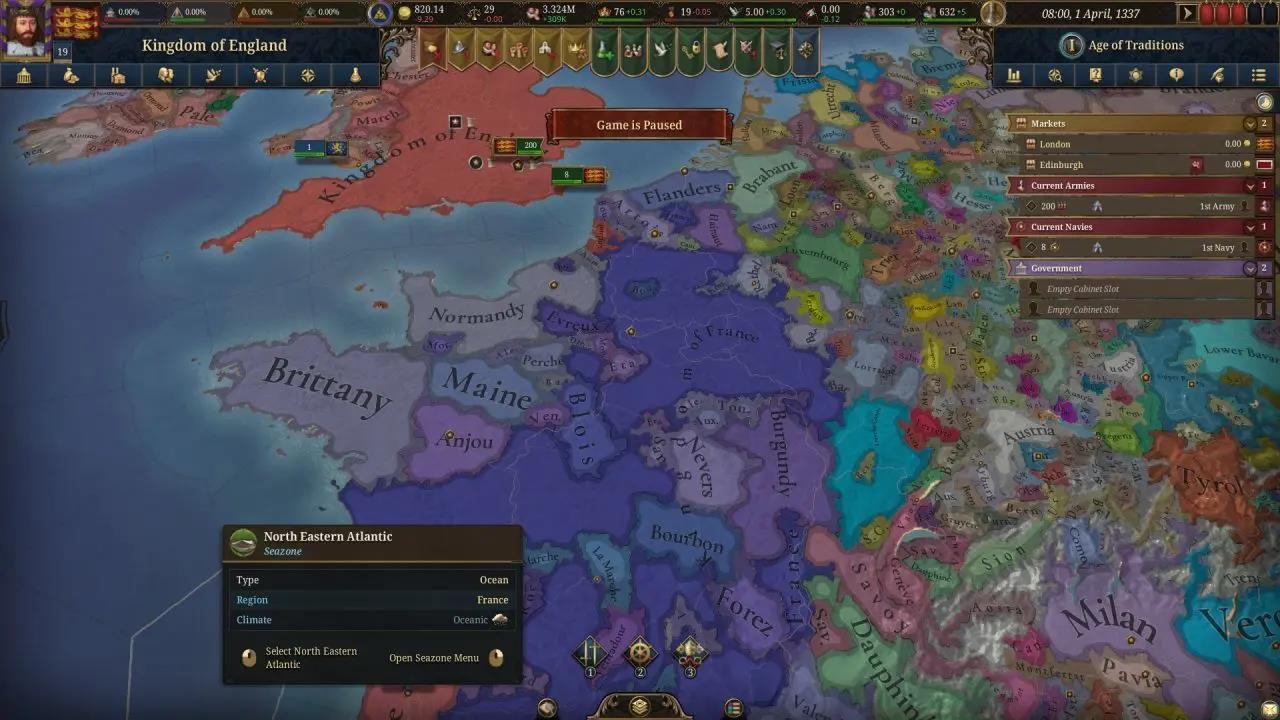
The interface strongly recommends starting with France, England, or Castile for valid reasons. These nations provide resilient economic foundations, established military capabilities, and geographical advantages that allow recovery from early strategic errors.
France emerges as the premier beginner selection due to multiple advantages. You control Europe’s most substantial population base, benefit from advanced starting technology, and enjoy defensible natural borders that minimize early military threats. The renowned French military tradition delivers substantial land combat bonuses, while your economic foundation can sustain numerous armies without financial collapse.
England provides an alternative educational experience through naval and colonial focus. Your island geography creates natural defensive barriers, enabling concentration on maritime supremacy and overseas expansion. The robust English economy centers on trade networks, teaching market mechanics while minimizing invasion concerns.
However, experienced players often recommend Portugal or Poland as superior learning environments. These nations specialize in specific mechanics without overwhelming new players with excessive complexity.
Portugal excels at teaching colonial systems and trade route management. Your compact size ensures military manageability, while the English alliance provides security coverage. You’ll develop expertise in exploration, trade companies, and overseas territory management without navigating complex European political landscapes.
Poland introduces compelling challenges through the elective monarchy system and exceptional cavalry units. You’ll learn internal political management while commanding Europe’s finest mounted forces, providing excellent training for advanced gameplay mechanics.
EU5’s revolutionary automation framework distinguishes it from previous series entries by providing intelligent assistance for complex systems during your learning phase. These tools handle intricate mechanics while you observe and learn optimal strategies.
Population Management Automation should be activated immediately upon starting your campaign. Access this through the Automation > Population interface. The AI manages population promotion, migration patterns, and growth optimization more efficiently than most beginners, allowing you to study effective patterns without micromanaging countless decisions.

Economic Automation provides crucial assistance for financial management. The system automatically adjusts taxation, production investments, and trade route optimization based on your nation’s current needs and economic status. This prevents early-game bankruptcy while teaching sound financial principles through observation.
Military Assistance Systems help manage army composition and reinforcement patterns. The automation handles troop recruitment, unit type balancing, and fortress maintenance, allowing you to focus on grand strategy rather than administrative details. This is particularly valuable when learning combat mechanics and army management.
Common automation mistake: Over-relying on automation without understanding the underlying mechanics. Periodically review automated decisions to learn why certain choices were made, then gradually assume manual control as your comprehension improves.
Understanding EU5’s fundamental systems forms the foundation of successful gameplay. These interconnected mechanics require balanced attention and strategic coordination throughout your campaign.
Economic Management begins with monitoring your treasury and understanding revenue streams. Avoid over-expanding your military early game, as maintenance costs can quickly deplete reserves. Focus on building economic infrastructure in high-value provinces before pursuing aggressive expansion. Tax income, production efficiency, and trade control form the three pillars of sustainable economic growth.
Military Strategy requires understanding unit types, terrain advantages, and supply line management. Cavalry excels in plains warfare but suffers penalties in mountainous regions. Artillery provides siege advantages but requires infantry protection. Always maintain reserve forces for unexpected conflicts and rebel suppression.
Diplomatic Relations determine your geopolitical positioning and alliance networks. Maintain positive relations with potential allies while monitoring rival expansion. Royal marriages can secure dynastic claims, while improving relations with neighboring powers can prevent costly wars during your consolidation phase.
Technology and Innovation progression follows distinct paths: administrative, diplomatic, and military. Balance your research investments based on current challenges and long-term objectives. Falling behind in military technology can prove disastrous during major conflicts, while administrative falling behind slows economic development.
Pro tip: Establish clear objectives for each gameplay era rather than reacting to events. A focused strategy with defined milestones prevents resource dispersion and ensures consistent progress toward your campaign goals.
Implementing strategic approaches from your campaign’s inception prevents common beginner pitfalls and establishes foundations for long-term success. These advanced techniques build upon core mechanics for optimized gameplay.
Early Game Strategy (1444-1500) focuses on consolidation and economic development. Secure your borders through alliances and strategic marriages rather than immediate expansion. Develop your core provinces’ infrastructure to maximize economic output. Avoid costly wars during this period unless strategically necessary for resource control.
Mid-Game Expansion (1500-1600) introduces colonial opportunities and European power projection. Establish trade companies in valuable regions while maintaining continental stability. Carefully manage aggressive expansion to prevent coalition formations. Balance colonial investments with European military readiness.
Late Game Dominance (1600-1821) requires managing large empires and global conflicts. Delegate regional management to automation systems while focusing on major strategic objectives. Monitor revolutionary movements and religious conflicts that can destabilize established empires. Prepare for end-game crises with robust military and economic reserves.
Essential monitoring metrics: Always watch aggressive expansion, overextension, corruption, and inflation indicators. These hidden mechanics can cripple empires that appear superficially strong. Regular stability checks prevent sudden collapse from accumulating penalties.
Remember that EU5 rewards patience and strategic planning over rapid expansion. A carefully managed medium-sized nation often outperforms a rapidly expanded, unstable empire facing constant rebellions and financial crises.
Action Checklist
- Select France for military focus or Portugal for colonial learning
- Enable population automation through Automation > Population menu
- Establish economic foundations by developing core provinces
- Secure defensive alliances with neighboring powers
- Balance technology research across administrative, diplomatic, and military trees
- Monitor aggressive expansion and overextension metrics regularly
No reproduction without permission:Tsp Game Club » Europa Universalis 5: The Ultimate Beginner’s Guide Master EU5 nation selection, automation systems, and core mechanics with expert strategies for beginners