
Expert analysis of the epic Carlsen vs Firouzja chess showdown at EWC 2025 with strategic insights
Clash of Titans: Setting the Stage
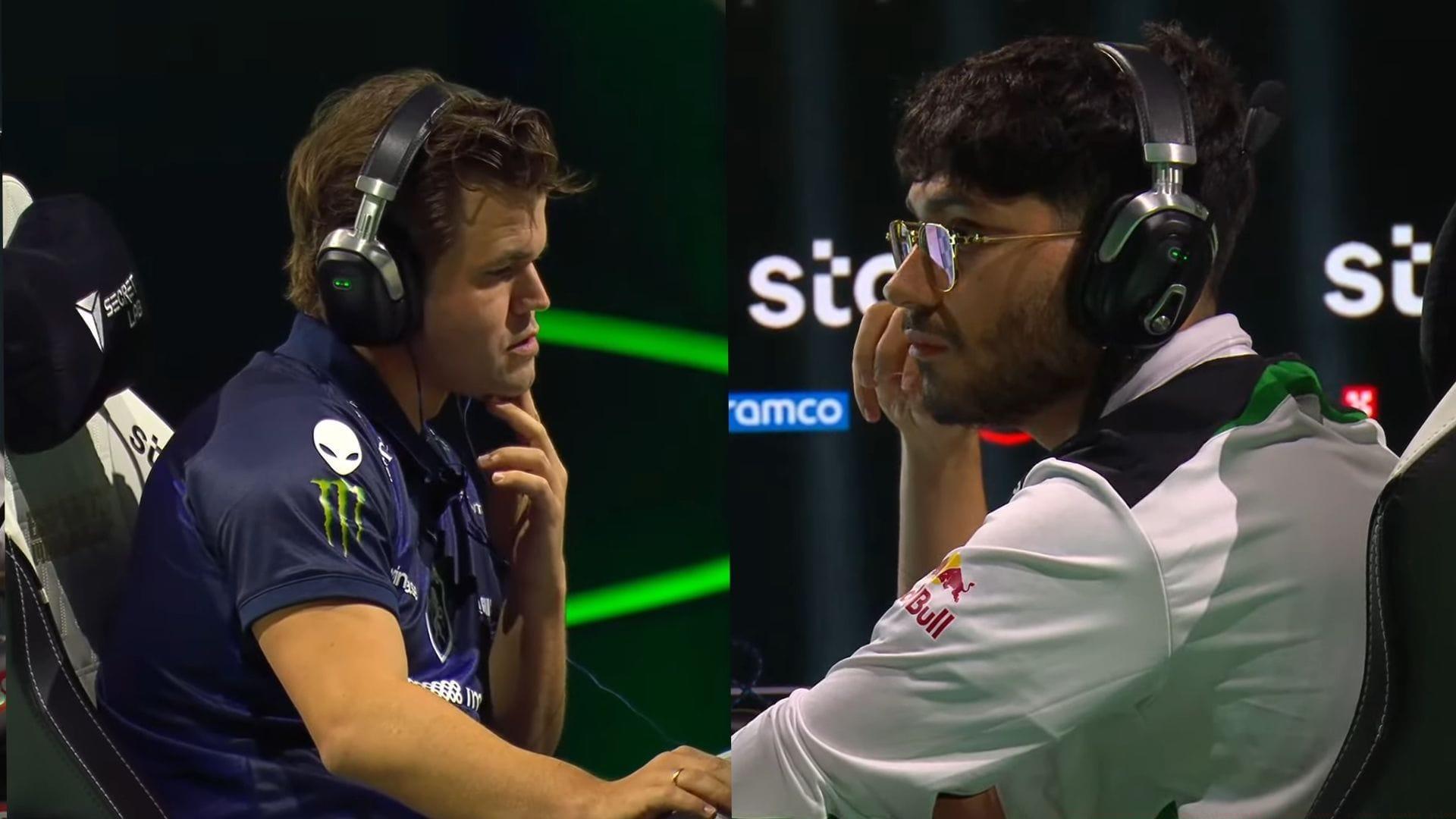
The chess world eagerly anticipates a monumental showdown between generational talents as Magnus Carlsen confronts Alireza Firouzja in the Grand Final of the Esports World Cup 2025 championship. Both competitors have demonstrated exceptional form throughout the tournament, setting the stage for what promises to be a tactical masterpiece that transcends traditional chess rivalries.
This championship duel carries significant implications beyond individual glory, representing a critical battleground for Team Liquid and Team Falcons in their pursuit of club supremacy. The outcome will substantially influence the final club rankings, adding strategic depth to an already compelling narrative of chess excellence.
While Carlsen enters as the statistical favorite, Firouzja’s recent performances suggest he’s evolved beyond the underdog status. Both grandmasters have navigated challenging brackets without suffering a single defeat, establishing their credentials through consistently brilliant play against elite opposition.
Path to the Final: Roadmap Analysis
Carlsen’s journey through the tournament brackets demonstrated his characteristic precision and adaptability. After efficiently navigating the group stages, he encountered formidable resistance from S8UL’s Nihal Sarin during their quarter-final encounter. The initial match presented unexpected challenges as Sarin secured an impressive draw, momentarily testing Carlsen’s resolve.
The Norwegian champion responded with characteristic resilience, identifying and exploiting positional weaknesses in Sarin’s subsequent gameplay. His decisive 2.5–0.5 victory showcased his ability to learn and adapt mid-match, a quality that separates elite players from the competition.
Carlsen’s semi-final confrontation with Hikaru Nakamura evolved into one of the tournament’s most memorable battles, culminating in dramatic Armageddon tiebreakers. Despite establishing an early advantage, Nakamura mounted a fierce comeback to equalize the score at 3–3, setting the stage for high-pressure chess.
The tiebreaker witnessed Nakamura committing a crucial tactical oversight that Carlsen instantly capitalized upon, securing his Grand Final placement with a narrow 4–3 triumph. This match highlighted Carlsen’s composure under extreme pressure and his ability to convert minimal advantages into victories.
Firouzja maintained impeccable form throughout his tournament campaign, showcasing dominant performances during the initial group stages. His quarter-final matchup against Nodirbek Abdusattorov presented temporary obstacles, but the French-Iranian prodigy demonstrated remarkable mental fortitude by regrouping and securing a convincing victory.
The semi-final confrontation with Arjun Erigaisi posed greater challenges, with Firouzja frequently operating under severe time constraints. Despite these pressures, he maintained strategic clarity while benefiting from several critical errors by his opponent. Firouzja secured two crucial draws—in both the opening and closing matches—before achieving a comprehensive 3.5–1.5 victory through composed, calculated maneuvering.
Head-to-Head: Statistical Deep Dive
Historical data reveals Carlsen’s clear dominance in classical encounters, holding a commanding 5-0 record with four draws in traditional time formats. His superiority extends to Rapid and exhibition matches, where he maintains a substantial 77-37 advantage with 38 draws, establishing his consistent excellence across competitive environments.
However, Firouzja demonstrates notable proficiency in faster time controls, suggesting potential vulnerability points in Carlsen’s armor. The younger grandmaster’s innovative opening repertoire and aggressive middle-game tactics have previously troubled Carlsen in rapid formats, providing strategic insights for this championship matchup.
Carlsen’s unparalleled experience, near-photographic memory recall, and positional finesse establish him as the theoretically stronger competitor. Having already overcome Team Falcons’ primary representative Hikaru Nakamura, Carlsen now targets their secondary contender, seeking to complete a team sweep in the Grand Final.
From a strategic perspective, Firouzja’s success often stems from his willingness to embrace unconventional positions and his exceptional calculation speed in complex middlegames. His dynamic playing style contrasts with Carlsen’s methodical approach, creating an intriguing clash of chess philosophies that will likely determine the match outcome.
Strategic Predictions and Key Factors
Current club standings position Team Falcons at the forefront with 2700 points, while Team Liquid occupies fourth place with 2050 points. A victory in this Grand Final awards 1000 Club Points, potentially catapulting Team Liquid to second position and establishing them as serious contenders for the prestigious Best Club designation.
Several critical factors will influence the match outcome beyond raw chess ability. Carlsen’s endurance in extended matches and his ability to capitalize on microscopic advantages provide significant edges. Conversely, Firouzja’s creativity in unfamiliar positions and his rapid calculation abilities could neutralize Carlsen’s strategic superiority.
Psychological elements cannot be underestimated, as both players understand the broader implications for their respective organizations. Carlsen’s experience in high-stakes finals contrasts with Firouzja’s hunger for breakthrough victories, creating compelling narrative tension beyond the chessboard.
For spectators and aspiring players, this match offers invaluable learning opportunities regarding time management, opening preparation, and psychological resilience under tournament pressure. Observing how both grandmasters handle critical moments provides educational insights applicable to competitive play at all levels.
Strategic preparation should focus on neutralizing opponents’ strengths while maximizing positional advantages. Both players will likely employ surprise opening variations and carefully manage their time allocation, particularly as the match progresses toward potentially decisive endgames.
No reproduction without permission:Tsp Game Club » EWC 2025 Chess Grand Final: Magnus Carlsen readies “bow and arrow” to shoot another Falcon Expert analysis of the epic Carlsen vs Firouzja chess showdown at EWC 2025 with strategic insights