
TL;DR
- NYT Connections challenges players to group 16 words into four color-coded categories by identifying hidden associations
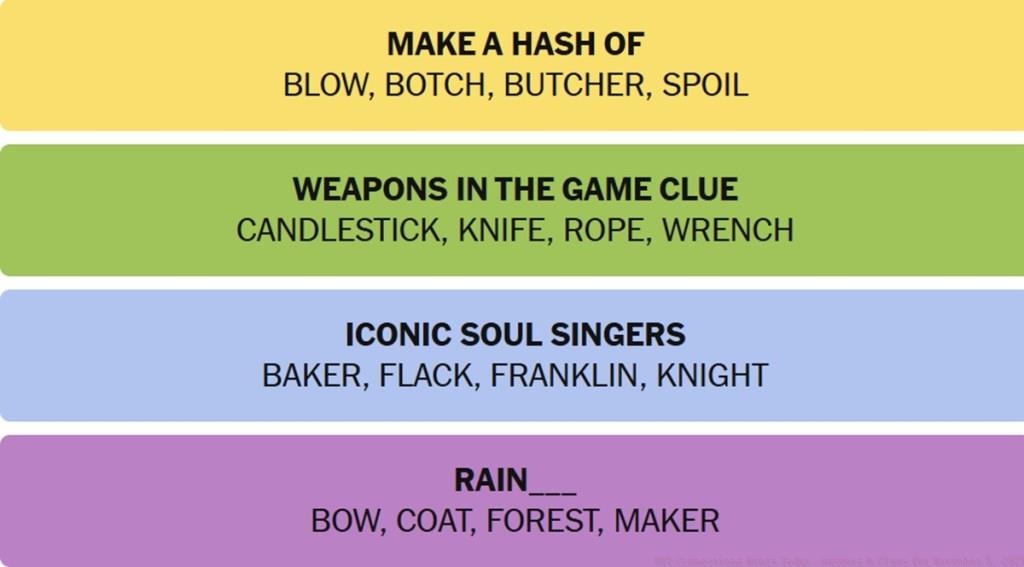
- Today’s puzzle features categories ranging from ‘Messing Up’ (yellow) to ‘Words starting with Rain’ (purple) with increasing complexity
- Strategic solving involves starting with obvious connections and progressively tackling more abstract relationships
- Common pitfalls include forcing connections and overlooking wordplay or multiple meaning possibilities
- Daily practice with systematic approaches significantly improves pattern recognition and solving speed
NYT Connections represents an engaging daily word puzzle that tests your pattern recognition and associative thinking skills. Each day presents a fresh 4×4 grid containing 16 carefully selected words that conceal four distinct thematic groupings. Your objective involves identifying these hidden connections and sorting the terms into their appropriate categories, which are strategically color-coded to indicate escalating challenge levels.
The game mechanics revolve around discovering relationships that might include shared themes, wordplay elements, cultural references, or linguistic patterns. Unlike traditional word games, Connections emphasizes lateral thinking and the ability to perceive non-obvious associations between seemingly unrelated terms. For those seeking comprehensive gaming strategies, our Complete Guide offers valuable insights into systematic problem-solving approaches.
The New York Times developed Connections following the tremendous success of Wordle, creating another daily ritual for puzzle enthusiasts. This word association challenge remains freely accessible across both mobile applications and desktop platforms, ensuring players can engage regardless of their preferred device.
Mastering Connections requires understanding its sophisticated difficulty progression system. The color spectrum begins with yellow representing the most accessible category, progressing through green and blue, culminating with purple as the most conceptually challenging grouping. This tiered structure allows players to build momentum while gradually confronting more complex associative challenges.
To enhance your solving experience, here are the strategically crafted NYT Connections hints for today’s puzzle categories:
Seasoned players recommend beginning with the yellow category to establish early success, then methodically working through the intermediate groupings before tackling the most abstract purple connections. This systematic approach minimizes frustration while maximizing your chances of completing the puzzle within the allowed mistakes.
Understanding the complete category solutions provides valuable insight into the puzzle designer’s thought process. Today’s yellow category ‘Messing Up’ encompasses terms related to errors, blunders, and mistakes across various contexts. The green grouping requires knowledge of traditional board game elements, specifically the weapon references from Clue.
The blue category challenges your pop culture literacy with recognizable singing artists, while the purple category demands linguistic creativity with words that all commence with ‘Rain’. This progression from concrete to abstract thinking exemplifies the game’s sophisticated design philosophy.
For players interested in strategic grouping methodologies, our Class Guide explores similar categorization principles applied in different gaming contexts.
Exploring additional puzzle challenges? Don’t overlook today’s NYT Strands hint and answer — it presents another stimulating brain teaser for dedicated puzzle solvers!
The Connections difficulty framework employs a carefully calibrated color hierarchy that guides players through increasingly complex cognitive challenges. Yellow categories typically feature straightforward thematic connections that most solvers can identify relatively quickly. These often include common phrases, obvious synonyms, or clear categorical relationships.
Green categories introduce moderate complexity, potentially involving wordplay, less common associations, or specialized knowledge domains. Blue groupings demand sharper analytical skills, frequently incorporating cultural references, historical contexts, or nuanced linguistic patterns.
Purple categories represent the pinnacle of difficulty, requiring players to identify highly abstract connections, clever word manipulations, or deeply embedded thematic links. Understanding this progression helps players allocate their mental resources effectively throughout the solving process.
Common strategic errors include prematurely committing to incorrect groupings, overlooking words with multiple potential associations, and failing to recognize when a promising connection actually belongs to a different color category. Developing patience and maintaining flexibility in your hypotheses significantly improves success rates.
Excel at NYT Connections by implementing proven solving methodologies. Start each session by quickly scanning all 16 words to identify obvious connections, but resist the urge to make immediate selections. Instead, mentally note multiple potential groupings before committing to any category.
Intermediate strategies involve looking for words that could fit multiple categories and using process of elimination when you’re confident about other groupings. Advanced players often identify the purple category first by recognizing the most obscure or clever connection, then working backward through the remaining categories.
Time optimization techniques include setting personal benchmarks, tracking your improvement patterns, and learning to recognize common connection types that frequently reappear across different puzzles. For those interested in progression systems, our Weapons Unlock guide demonstrates similar achievement-based mechanics.
Avoid these common mistakes: forcing connections that don’t quite fit, ignoring words that seem to have no obvious partners initially, and becoming overly attached to your first hypothesis about category themes. The most successful solvers remain adaptable throughout the process.
Daily practice develops your associative thinking muscles, enhancing your ability to spot patterns quickly. Regular players often develop intuition for the puzzle designers’ stylistic preferences and recurring thematic elements.
Action Checklist
- Scan all 16 words quickly to identify potential thematic connections and obvious groupings
- Begin with yellow category connections to build solving momentum and confidence
- Progress through green and blue categories using process of elimination techniques
- Tackle purple category by identifying the most abstract or clever word associations
- Review incorrect guesses to understand pattern recognition gaps and improve future performance
No reproduction without permission:Tsp Game Club » NYT Connections Hints Today: Answers & Clues for November 5, 2025 Master NYT Connections with expert strategies, daily hints, and actionable solving techniques