
TL;DR
- NYT Connections challenges players to group 16 words into four thematic categories by difficulty level
- Today’s May 10 puzzle features email closings, font styles, life essentials, and word meanings
- Strategic solving involves pattern recognition, elimination techniques, and proper category sequencing
- Advanced players benefit from cross-category analysis and strategic mistake management
- Daily practice with systematic approaches significantly improves puzzle-solving efficiency
NYT Connections presents a sophisticated word association challenge that combines logical deduction with creative thinking. While many puzzle enthusiasts find themselves stumped by the daily Connections solution, our comprehensive guide provides the strategic insights needed to conquer each day’s unique word grouping challenge. We deliver expert-level NYT Connections solutions daily, ensuring you can systematically approach and solve puzzle #699 for May 10, 2025 with confidence and precision.
Following the unprecedented popularity of Wordle, The New York Times expanded its puzzle portfolio by introducing Connections, an intellectually stimulating word categorization game. This engaging puzzle experience remains completely free to access across both mobile devices and desktop platforms.
Getting acquainted with NYT Connections proves remarkably straightforward for newcomers. This cerebral word grouping activity distributes 16 carefully selected words within a structured 4×4 matrix. Participants must identify thematic relationships between these terms and organize them into four distinct classifications, each color-coded according to complexity level from yellow (simplest) to purple (most challenging).
As previously indicated, each NYT Connections puzzle contains four separate thematic groups organized by color-coded difficulty tiers. Progressing from the accessible Yellow classification through to the demanding Purple category, the game rapidly escalates in complexity without proper preparation.
To streamline your puzzle-solving experience, we’re providing detailed NYT Connections clues for today’s thematic groupings:
The Connections classifications for today present an intriguing combination of conceptual themes, potentially creating solving obstacles for many players. With that context established, here are the specific NYT Connections category solutions for Saturday, May 10, 2025.
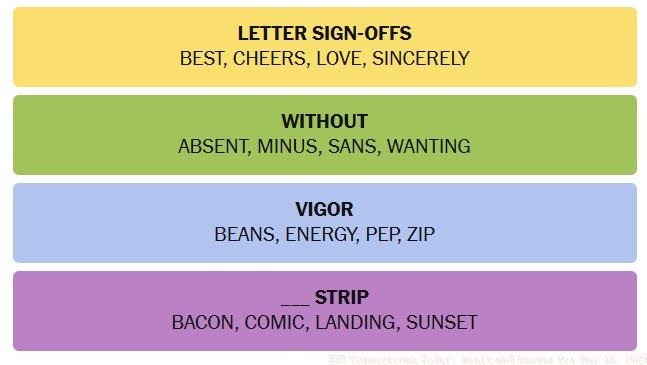
Today’s puzzle demands particular attention to linguistic nuances and contextual word usage. The Yellow category specifically references formal correspondence conclusions, while Green combines typography with vocabulary. Blue focuses on fundamental human requirements, and Purple challenges players to identify a single term encompassing multiple meanings.
Successful Connections solving requires understanding how today’s specific categories interconnect and influence solving strategy. The progression from simplest to most complex groupings follows a deliberate design that rewards systematic thinking.
Yellow Category Strategy: Focus on common email and letter sign-offs. Look for terms like “Sincerely,” “Best regards,” or “Yours truly” that typically conclude formal written communications. This category generally contains the most straightforward word relationships.
Green Category Approach: This dual-theme category combines typographical terminology with vocabulary elements. Consider font styles like “Bold” or “Italic” that also function as descriptive words in other contexts.
Blue Category Insight: These words represent fundamental necessities for human existence or wellbeing. Think broadly about physical, emotional, or social requirements that are universally recognized as essential components of life.
Purple Category Challenge: The most complex grouping requires identifying a single word that conceptually encompasses all four terms. This often involves abstract thinking and considering multiple definitions of common words.
Mastering NYT Connections involves developing systematic approaches that significantly improve solving efficiency and accuracy. Here are expert-level techniques used by seasoned puzzle solvers:
Systematic Elimination Method: Begin by identifying obvious connections for the easiest category, then remove those words from consideration. This narrowing process simplifies identifying relationships in more challenging groupings.
Cross-Category Analysis: Sometimes words might seem to fit multiple categories. Analyze potential overlaps carefully before committing to a grouping, as premature categorization often leads to unnecessary mistakes.
Pattern Recognition Development: Regular players should note recurring category types, including wordplay, homophones, compound terms, and conceptual groupings. This pattern awareness dramatically reduces solving time.
Strategic Mistake Management:
- Limit initial guesses to categories you’re highly confident about
- Use the four-mistake limit strategically rather than randomly
- When uncertain, test potential groupings mentally before submitting
Time Optimization Techniques: Advanced solvers typically complete puzzles in 5-8 minutes through methodical approaches. For those seeking comprehensive gaming guidance, our Complete Guide offers detailed strategic frameworks.
For weapon-specific strategies that parallel the systematic thinking required in Connections, explore our Weapons Unlock resource. Similarly, understanding class selection methodologies in our Class Guide can enhance your analytical skills for pattern recognition challenges.
Action Checklist
- Scan all 16 words for obvious thematic connections and note potential category overlaps
- Identify and solve the Yellow category first to reduce complexity
- Systematically eliminate solved words and focus on remaining groupings
- Analyze Green and Blue categories for dual-meaning words and essential concepts
- Tackle Purple category last using abstract thinking and multiple definition analysis
No reproduction without permission:Tsp Game Club » NYT Connections Today: Hints and Answer for May 10, 2025 Master NYT Connections with expert strategies, daily hints, and actionable solving techniques for puzzle success