
TL;DR
- NYT Connections challenges players to group 16 words into four color-coded categories by theme association
- Today’s puzzle #698 features television adjustments, memory types, numerical operations, and window actions
- Strategic solving involves identifying outlier words and working from easiest to hardest categories
- Common mistakes include forcing connections and overlooking subtle thematic relationships
- Advanced techniques include cross-category verification and systematic elimination processes
The New York Times Connections represents a sophisticated word association challenge that has captivated puzzle enthusiasts worldwide. Following the monumental achievement of Wordle, this intellectually stimulating game offers a fresh approach to linguistic problem-solving that tests both vocabulary breadth and cognitive flexibility.
Available at no cost across mobile and desktop platforms, Connections delivers daily mental exercise through its elegantly simple yet deeply complex gameplay structure. The experience combines the satisfaction of pattern recognition with the thrill of discovery.
Gameplay unfolds across a meticulously arranged 4×4 grid containing sixteen carefully selected terms. Your objective involves discerning the hidden thematic relationships that bind these words together, then organizing them into four distinct groups. Each category receives a color designation—yellow, green, blue, and purple—that corresponds directly to its complexity level, with yellow representing the most accessible connections and purple demanding the highest cognitive effort.
Understanding the difficulty progression proves essential for strategic success. The yellow category typically features straightforward associations, while green introduces moderate complexity. Blue demands nuanced thinking, and purple challenges even seasoned players with abstract or multifaceted connections that require lateral thinking.
Navigating today’s Connections puzzle #698 requires a blend of observational acuity and associative reasoning. The color-coded hint system provides graduated assistance while preserving the satisfaction of independent discovery.
Strategic puzzle solving begins with scanning all sixteen terms to identify obvious relationships. Seasoned players recommend starting with the yellow category, as these connections typically involve the most direct word associations. Today’s yellow group relates to television adjustments—think about the various settings and controls you might manipulate on your TV interface.
The green category today explores memory characteristics, specifically focusing on adjectives that describe different types of recollection. Avoid the common mistake of assuming all memory-related terms belong together; instead, look for the specific quality being highlighted.
Blue category connections emerge from numerical operations—consider what happens mathematically when you combine, separate, or transform numbers through various processes.
Purple category terms all share a common action performed on windows. This might involve physical manipulation, digital interactions, or metaphorical applications of the concept.
Critical error prevention involves resisting the temptation to force connections between words that share superficial similarities. Always verify that all four terms in a proposed group genuinely share the same core connection before submitting your selection.
Today’s Connections categories present an intriguing blend of practical, psychological, mathematical, and physical themes that will challenge your ability to think across multiple domains simultaneously.
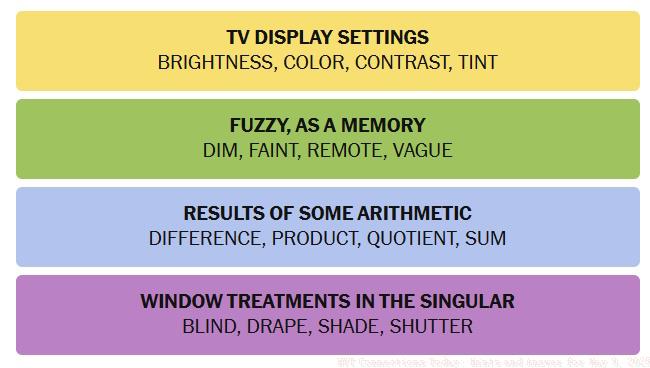
Yellow Category – Television Adjustments: This group encompasses terms related to modifying your viewing experience. Think beyond basic controls to include both technical settings and content customization options that modern televisions offer.
Green Category – Memory Types: These words describe varying strengths and qualities of recollection. Consider the entire spectrum from vivid, enduring memories to those that are fleeting or unreliable.
Blue Category – Numerical Operations: These terms represent fundamental mathematical processes that occur when manipulating numbers. The connections involve both basic arithmetic and more complex computational concepts.
Purple Category – Window Actions: This challenging category involves verbs describing what you can do to windows in various contexts—physical, digital, and metaphorical applications all come into play.
Advanced solving technique: When tackling today’s puzzle, begin by identifying outlier words that don’t obviously fit multiple categories. This elimination strategy helps narrow your focus to the genuine connections. Also, consider that some terms might fit multiple thematic groups initially, requiring you to determine which connection represents the primary relationship.
Mastering NYT Connections requires developing systematic approaches that leverage both linguistic knowledge and logical deduction. Here are comprehensive strategies used by top performers to consistently solve even the most challenging puzzles.
Pattern Recognition Development: Train yourself to spot various connection types including synonyms, word families, shared prefixes/suffixes, common phrases, and cultural references. Document recurring theme patterns to build your solving toolkit.
Word Association Tactics: When examining the grid, quickly note all possible associations for each term. Words with multiple strong connections often serve as keystones that help unlock multiple categories.
Time Management Protocol: Allocate your solving time strategically—spend initial minutes scanning for obvious groups, then methodically work through less apparent connections. Set a mental timer to avoid frustration on particularly difficult puzzles.
Error Prevention Systems: Before submitting any group, verbally articulate the precise connection linking all four terms. If you cannot clearly define the commonality, reconsider your grouping. This simple verification step prevents wasted attempts.
Cross-Category Verification: Ensure your proposed groups don’t contain overlapping thematic elements. Each category should represent a distinct conceptual domain without significant crossover.
Pro tip: Maintain a solving journal where you document particularly clever connections and challenging categories. Reviewing these notes helps develop intuition for the puzzle creators’ design patterns and thematic preferences over time.
Action Checklist
- Scan all 16 words for immediate obvious connections and note potential thematic domains
- Identify and solve the yellow category first using direct word associations
- Work through green and blue categories using associative reasoning and elimination
- Tackle purple category last, employing lateral thinking and cross-verification
- Verify each group by articulating the precise connection before submission
No reproduction without permission:Tsp Game Club » NYT Connections Today: Hints and Answer for May 9, 2025 Master NYT Connections with expert strategies, daily hints, and actionable solving techniques for puzzle success