
TL;DR
- Master timing and angles for pop flashes that explode within 0.2 seconds of enemy visibility
- Learn to recognize and counter enemy flash setups through audio and visual cues
- Practice map-specific lineups for Inferno banana, Mirage sites, and Overpass control
- Coordinate with teammates for maximum impact and avoid friendly blinding
- Develop counter-flash strategies including pre-aiming and bait techniques
While basic pop flashes provide consistent value, the truly game-changing plays often come from calculated risk-taking. These advanced techniques require exceptional timing and team coordination but can single-handedly win rounds when executed properly.
Aggressive pop flash strategies excel in specific high-leverage situations:
- Breaking stalemates when standard approaches fail to gain map control
- Surprising default setups that catch opponents during their standard positioning phase
- Clutch situations where you need every edge available
However, these high-reward plays demand significant preparation. Attempting them without proper warm-up or team coordination often results in wasted utility or, worse, giving enemies free kills.
Remember—they need coordination and practice. Don’t pull out these tricks cold in a match without adequate preparation.
Here’s where it gets spicy.
Just like you use pop flashes, enemies do too. Developing defensive awareness against enemy utility is equally important as mastering your own throws.
Advanced defensive players learn to recognize setups, anticipate common throw spots, and listen for audio cues can save your life during critical moments.
Effective counter-flash strategies include:
- Pre-aim the ground and quick-turn when flashes are expected—this minimizes blind time by reducing the flash’s effective angle.
- Use anti-flash positions like behind boxes or walls that provide natural cover from common flash trajectories.
- Bait the flash—peek quickly to draw a throw, then re-peek while they’re mid-animation, catching them during their utility deployment vulnerability window.
Countering pop flashes requires understanding enemy tendencies as thoroughly as you know the maps yourself.
Mastering pop flashes doesn’t mean throwing random flashes around the map. It’s about tailoring your flashes to each map’s layout and meta. Every competitive map has angles, choke points, and common hideouts that can be exploited with perfect flash timings.
Let’s break down some of the most effective pop flash setups across key maps:
Inferno – Banana and Mid Control
Banana on Inferno is one of the most contested areas in the game, and having good pop flashes here is non-negotiable. On the T side, a simple flash thrown off the skybox into close car blinds any CTs holding logs or half-wall. Combine that with a peek from second mid or ramp, and you can snatch control before they even know what hit them.
For CTs, a deep pop flash from CT spawn or behind sandbags can completely dismantle a banana rush. The key is throwing it as your teammate swings, ensuring maximum impact.
Mid control also benefits from flashes off the wall near second mid stairs. A quick underhand bounce sends a flash popping just behind arch or short, blinding both AWPers and riflers trying to hold passive angles.
Mirage – A Site Entry and Mid Pushes
Mirage offers a playground of pop flash options. The most iconic is the palace pop flash—a teammate throws a high flash over A site from Tetris or ramp, and the palace player swings out while defenders are fully blind. Executed properly, it’s free real estate.
Mid is another prime spot. Throwing a flash from top mid off the right wall near the boxes blinds short players perfectly. If your teammates are pushing connector, time it just before they peek—this flash explodes directly in the face of anyone holding from jungle or stairs.
Even B site has options. A jump throw flash from B apps lands deep onto the site, blinding anyone playing bench or van, especially if they’re holding a close angle.
Overpass – B Short and Monster Control
Overpass is utility heaven. Controlling B short is all about pushing through the connector or water area with well-timed pop flashes. From connector, a teammate can throw a flash that bounces off the left wall of short, blinding barrels and pillar players just before the push.
Monster control on the T side needs precision. A jump throw flash from near T spawn can land just outside the monster tunnel, popping right in front of the CTs holding from graffiti or barrels. It’s one of the best early-round pop flashes in the game.
When you’re pushing through the ranks in Counter-Strike 2, understanding that mechanical skill alone won’t secure victories is crucial. The differentiator between competent players and elite competitors lies in their systematic utility deployment. Flashbangs, particularly pop flashes combined with Molotovs, serve as instruments of tactical supremacy in professional gameplay. While inexperienced competitors often hurl grenades randomly, seasoned veterans employ them to manipulate territory, compel repositioning, and establish game-winning engagements.
Contemporary CS2 transcends pure mechanical proficiency. At elevated skill tiers, it becomes a psychological battlefield. A single strategically placed flashbang or incendiary can entirely reverse a round’s momentum. Ever questioned why certain opponents consistently secure effortless eliminations or appear to sweep angles with clairvoyant precision? It’s typically not fortune—it’s calculated utility implementation.
This comprehensive guide deconstructs advanced pop flash and Molotov methodologies, guiding you through the technical mechanics, practical application, environment-specific configurations, and squad synchronization that transitions you from utility squanderer to tactical master.
Why Utility Matters More Than Aim
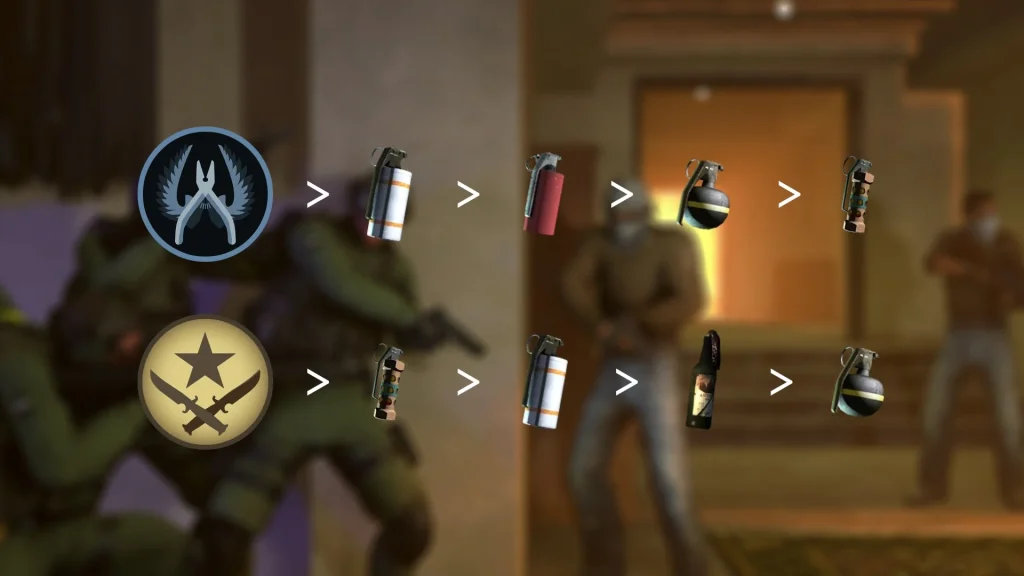
Here’s the fundamental truth: precision aiming secures individual confrontations, but tactical utility wins matches. You might possess deity-level crosshair control, but if you’re exposing yourself to angles without support, you’re one unfavorable engagement from defeat. Conversely, deploy a flashbang correctly, and combat becomes unnecessary—you’ll intercept adversaries visually impaired and eliminate them uncontested.
Elite squads dedicate countless hours perfecting flash synchronization, Molotov trajectories, and smoke pathways. This investment isn’t for aesthetic appreciation. It’s because intelligent utility transforms chaotic gameplay into executable strategy.
Consider these economic realities:
- A $200 flashbang can secure an initial elimination valued at $5000+ in primary weapons and equipment.
- One incendiary can impede aggressive pushes, separate opponents, or compel repositioning from unconventional hiding spots.
That represents substantial return on investment.
Transition from Basic to Advanced Tactics
You’ve acquired fundamental flashbang and Molotov positions. Excellent. But do you comprehend how to execute pop flashes without alerting enemies? Or how to deploy Molotovs that compel adversaries into your squadmate’s line of fire? That’s where strategic depth emerges.
Advanced utility application encompasses:
- Perfecting flash timing so they detonate immediately upon entering enemy visibility.
- Launching Molotovs against surfaces or through smoke to reach difficult corners.
- Layering utility to restrict intelligence or establish decoy maneuvers.
- Cycling configurations so your utility remains unpredictable.
The remainder of this guide will deconstruct precisely how to elevate your gameplay utilizing just two grenade types: the pop flash and the Molotov.
Perfecting Molotov Lineups
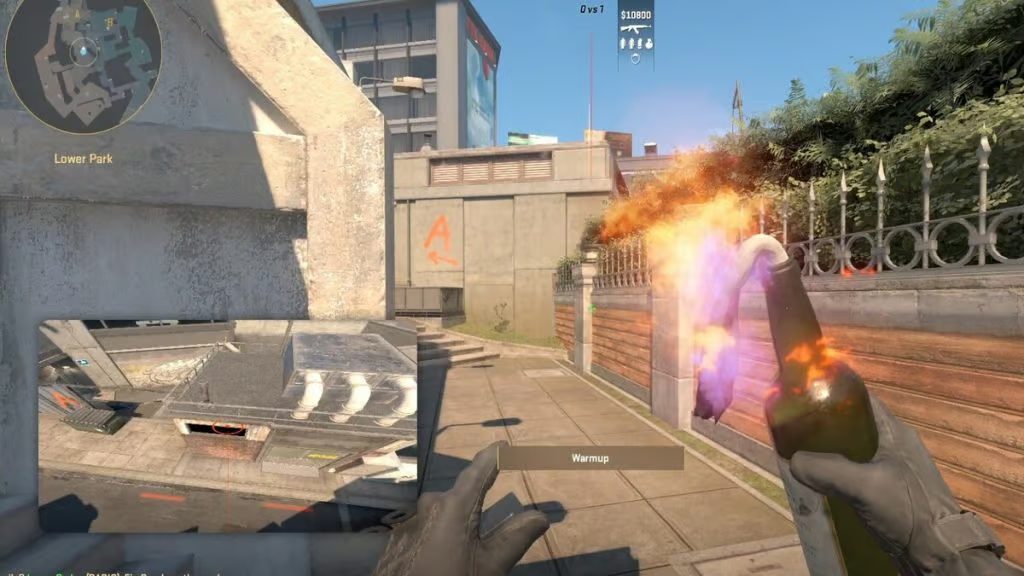
This is where technical precision delivers tangible results. To achieve true dominance through Molotov deployment, you require reproducible, accurate, and rapid lineups. The era of estimation-based throws and hopeful outcomes has concluded. If you aspire to become the competitor your team depends upon to sweep angles and halt advances, you need crystal-clear lineups.
The initial phase involves map selection. Consider Mirage as an example. You can position yourself in T spawn and align a Molotov that positions exactly behind triple containers or beneath balcony on A bombsite. These aren’t speculative—they’re pixel-perfect trajectories.
Upon mastering these lineups, you gain:
- Absolute confidence in your utility arriving at its intended destination.
- Unwavering consistency across consecutive rounds.
- The capacity to perform rapid assaults or methodical defaults with complete command.
Critical guidelines for perfecting your lineups:
- Train in isolated servers with unlimited grenades and disabled AI opponents.
- Utilize training environments like Yprac or community-developed workshop utilities to develop muscle memory.
- Document your personal recordings or employ screenshots for visual lineup retention.
- Maintain currency—updates alter terrain architecture, and positions that functioned before revisions might now deflect from anomalous pixels.
On Dust2, for instance, an elite-tier Molotov involves the projectile launched from extended doors that positions on vehicle, entirely prohibiting that precision engagement angle. On Nuke, incendiaries deployed from heaven toward the B bombsite prevent planting completly. Each competitive environment contains minimum five essential Molotov placements that simplify gameplay.
Additionally, adjust to the competitive environment. If opponents initiate countermeasures against your standard incendiary with smoke, commence deception tactics. Activate the primer, generate auditory signals, and rather than deploying it, advance while they’re diverted.
Lineups transcend mere utility—they concern synchronization, psychological warfare, and complete territorial dominance.
Combining Pop Flashes and Molotovs
Pop flashes and Molotovs demonstrate individual strength, but combined they become invincible. This fusion represents the core foundation of bombsite assaults, post-plant scenarios, and retake operations across all competitive tiers. One impairs vision, the other inflicts damage—it resembles an strategic partnership engineered to create devastation.
Visualize this scenario: you’re operating on T side Mirage, preparing to assault A. Your squadmate deploys an incendiary at default position while you launch a flash across ramp. The defenders positioned at triple encounter either incineration or visual impairment. That variety of utility stratification generates confusion and facilitates straightforward entries.
Let’s analyze how to effectively integrate both utilities:
- Clear positions using Molotovs, then follow with flashes to intercept rotating opponents or adjacent competitors advancing.
- Employ pop flashes to compel adversaries into incendiaries. This proves particularly effective near constricted passages like B short on Overpass or tunnel systems on Dust2.
- During post-plant situations, deploy incendiaries on the explosive device and utilize pop flashes against any opponents attempting to initiate defusal. It represents nearly certain round victory when synchronized correctly.
Integrating these grenade types additionally induces panic reactions. An isolated Molotov might encounter smoke countermeasures. A solitary flash might be avoided. But when deployed simultaneously—the flash creates disorientation, and the Molotov delivers punishment. No secure positioning. No opportunity for response.
On CT side, this partnership proves extraordinary for recapturing critical territories. Flashing into pit on Inferno while deploying incendiaries behind vehicle clears space rapidly. Or on Nuke, placing a molotov into squeaky followed by a flash from hut renders advancing on A nearly impossible.
Synchronization represents everything. Communication provides additional advantage. You don’t desire your teammate advancing while you’re still positioning the flash. Or more severe—your incendiary striking your squadmate because you hastened the combination.
Executed properly, pop flashes and Molotovs generate managed devastation, transforming any bombsite or engagement angle into your tactical domain.
Pro-Level Utility Usage Examples
If you want to comprehend the complete potential of pop flashes and Molotovs, simply observe professional competitors. At the pinnacle of competition, utility application isn’t merely effective—it’s precisely targeted. Every projectile serves intentional purpose. Every flash receives timed deployment. Every Molotov contains contingency planning.
Let’s examine several legendary instances.
Recall when s1mple and electronic competing with Na’Vi would coordinate a Molotov beneath balcony on Mirage accompanied by a pop flash across A ramp? That configuration dismantled Astralis’s A defensive setup during multiple professional tournaments. It didn’t represent spectacular conventional methodology—but the utility perfectly separated, visually impaired, and eliminated the opposition.
Additionally there exists Team Vitality, recognized for their late-round executions where ZywOo utilizes Molotovs not for inflicting harm, but to block retreat pathways. He’ll deploy one toward short, then advance accompanied by a flash from supporting personnel. The CT possesses no escape route—and more frequently than not, Vitality secures the elimination.
On Overpass, Heroic’s CT utility demonstrates master-tier proficiency. They’ll postpone B advances using Molotovs, then flash advances through short conduit that intercepts T competitors unexpectedly each instance. It’s not exclusively the deployments—it’s the coordination.
Observing professional recordings educates you regarding:
- Ideal utility synchronization
- Standard professional-level lineups
- How to sequence utility for maximum effectiveness
- When to conserve versus compel utility exchanges
You’ll perceive something additional: professionals seldom misallocate grenades. Even during disorderly rounds, their flashes demonstrate deliberate intention, their Molotovs receive timed deployment with purpose. That mental framework requires absorption and implementation within your competitive matches.
Practice Routines for Utility Mastery
Desire to advance rapidly? Initiate approaching utility training similarly to aim development. You don’t achieve precision eliminations without preparation, so don’t anticipate exact utility without dedicated effort. The positive information? You don’t require complete squad participation or even networked servers to refine your deployments—simply limited duration, local server access, and structured planning.
One of the most straightforward methods to practice utility involves isolated servers with unlimited grenades and noclip functionality. Here’s a rapid configuration sequence:
- Initiate CS2
- Access console:
map de_mirage(or any environment) - Activate commands:
sv_cheats 1,sv_infinite_ammo 1,bind v noclip - Train lineups employing
sv_grenade_trajectory 1andsv_grenade_trajectory_time 10
Now you can visualize where each flash or Molotov lands. Modify angles. Experiment with alternative variations. You can even utilize AI opponents to simulate timing and positioning scenarios.
Watching Demos and Strategic Analysis
You can acquire significant knowledge from professionals—not exclusively from impressive plays but from their decision-making processes. Observe how competitors like NiKo or KSCERATO deploy utility. Note the synchronization, the activation triggers, and how they coordinate grenades with squadmates.
Review your personal recordings additionally. Observe:
- Did your flash actually visually impair anyone?
- Was your Molotov influential or wasted?
- Could you have preserved a teammate through utility deployment?
These represent fundamental inquiries that reveal substantial enhancements.
Utilizing Community Workshop Training Tools
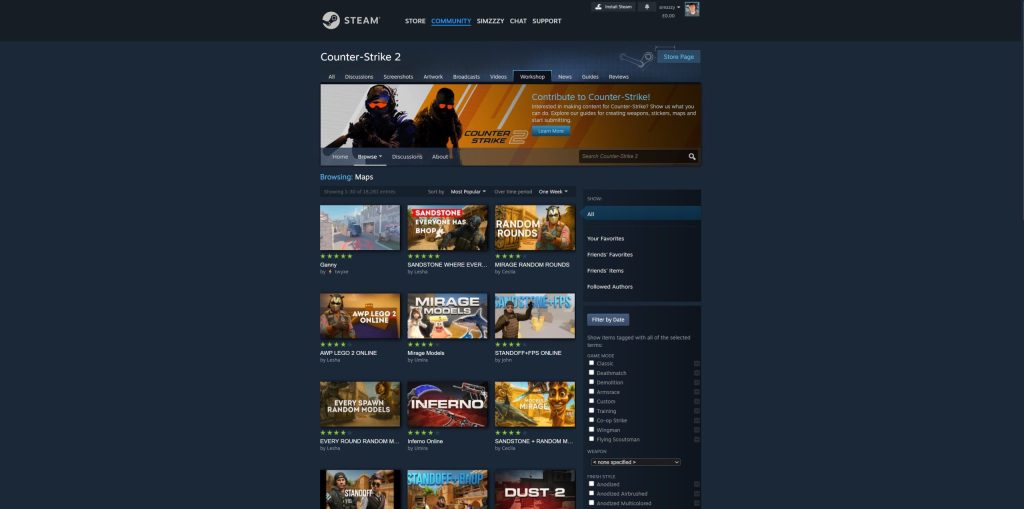
The CS community has constructed exceptional utility training environments, like Yprac’s collection. They incorporate:
- Integrated utility challenges
- Lineup retention examinations
- AI opponent simulations for flash and incendiary training
These resources represent invaluable assets for competitors seeking to memorize configurations for every bombsite and position.
Incorporate 10–15 minutes of utility training into your daily CS regimen. The outcome? You’ll progress from estimation-based approaches to precisely execution, and your assurance during critical rounds will increase dramatically.
When facing multiple opponents alone, your utility becomes a psychological weapon rather than just a damage tool. The key is creating uncertainty and forcing defenders to make mistakes through calculated deception rather than brute force.
Fake utility deployment represents one of the most sophisticated skills in Counter-Strike. By throwing a flashbang toward one bombsite while stealthily moving to another, you exploit human psychology and defensive patterns. This approach transforms your limited resources into tools for mind games that can secure rounds even when outnumbered.
Fake Utility Deployment
Effective fake utility requires understanding defender psychology. Most players instinctively react to sound cues and visual indicators, making them vulnerable to well-executed deception plays.
The most successful clutch players understand that utility in these moments prioritizes timing precision, deceptive positioning, and psychological pressure application over pure damage output. When executed properly, you can force entire rotations without firing a single shot.
Advanced techniques include:
- Auditory Misdirection – Using grenade sounds to suggest aggression where none exists.
- Silent Movement Coordination – Dropping smoke grenades then immediately going silent to create confusion about your actual position and intentions.
Common mistakes in fake utility deployment include predictable patterns and insufficient commitment to the deception. Players often reveal their true intentions through timing inconsistencies or failing to sell the fake convincingly.
Execution timing is critical – throwing utility too early gives defenders time to verify the fake, while delaying too long wastes the tactical advantage.
Mind Game Execution
Successful mind games rely on understanding opponent tendencies. Do they aggressively push through smoke? Do they rotate quickly on sound cues? These behavioral patterns become your primary targets for exploitation.
Utility mastery in Counter-Strike represents a constantly evolving skillset that demands ongoing adaptation. As new game patches introduce mechanical changes, professional teams develop innovative strategies, and community meta shifts, players who fail to evolve quickly find their previously effective tactics becoming liabilities.
Valve’s frequent updates to grenade trajectory physics and map geometry can completely render obsolete previously reliable lineups or conversely unlock previously impossible utility paths. Understanding this dynamic separates temporary success from sustained competitive advantage.
Patch Impact Analysis
Recent examples demonstrate how significant even minor changes can be. When developers removed skybox limitations on Mirage and Vertigo, it fundamentally altered how players approach site executes and defensive setups.
Molotov mechanics have undergone multiple revisions affecting spread patterns, burn duration, and damage output. A Molotov that previously denied plant attempts for full duration might now extinguish prematurely, requiring complete retiming of executes.
Critical adaptation areas include:
- Trajectory Adjustment Requirements – Even slight alterations to throw arcs demand recalibration of muscle memory for consistent execution under pressure.
Optimization for advanced players involves developing systematic approaches to identifying and integrating patch changes into existing utility arsenals.
Community Innovation Sources
Some of the most revolutionary utility applications originate not from professional players but from dedicated community members who experiment extensively in custom servers.
These innovators discover obscure wallbang mollies or develop pop flashes that precisely avoid enemy vision cones while maintaining maximum blind effectiveness.
Essential platforms for staying current include:
- YouTube content from channels like VooCSGO, WarOwl, or 3kliksphilip that provide detailed breakdowns of new opportunities.
- Reddit communities including /r/GlobalOffensive and /r/learncsgo where players rapidly disseminate and analyze meta-shifting discoveries.
- Twitch streams of professional competitors demonstrating adapted utility in live tournament environments.
The Counter-Strike community maintains constant innovation cycles – strategically leverage these resources to maintain competitive edge.
You don’t need to completely overhaul your utility knowledge with every update, but establishing consistent routines for systematic utility play refinement proves essential for sustained success.
Implementation strategies should focus on incremental improvement rather than complete reconstruction. Adding just one new verified lineup to your arsenal each week creates sustainable growth without overwhelming complexity.
Professional match analysis provides invaluable insights into adaptation timing and execution precision. Watching how elite players immediately integrate new utility possibilities into their existing frameworks demonstrates the mindset required for top-level play.
Game intelligence development involves more than mechanical skill – it requires understanding why certain utility applications work in new contexts and how to counter emerging strategies.
Time estimates for related adaptation challenges typically range from 15-30 minutes daily for effective integration of new techniques into competitive play.
Practical implementation tips:
- Proactive Learning Cycles – Dedicate specific practice sessions to testing new utility paths identified through patch notes or community discoveries.
Keeping your tactical approach fresh ensures you maintain advantage not just through mechanical execution but through superior game intelligence and adaptive thinking, where true Counter-Strike mastery resides.
Utility forms the fundamental circulatory system of high-level Counter-Strike. While spectacular AWP flicks and precise headshots capture highlight attention, it’s the strategic deployment of flashbangs, incendaries, and smoke grenades operating behind the scenes actually determine round outcomes. If you’ve progressed this far, you recognize that advanced pop flash techniques and Molotov applications transcend simple tools – they become comprehensive strategic frameworks, psychological manipulation instruments, and power projections condensed into inexpensive grenade investments.
We’ve explored comprehensive concepts ranging from basic pop flash mechanics to sophisticated setups, map-specific lineups, dedicated practice methodologies, and real-world professional examples. By this point, you should comprehend that precise timing, team synergy development, and execution consistency significantly outweigh the benefits of memorizing numerous disconnected utility throws.
Your essential takeaways should include:
- Approach utility learning with the same systematic methodology as aim training development.
- Maintain clear communication channels with your teammates throughout utility deployment phases.
- Consistently observe professional players and adapt their successful approaches.
- Implement intelligent practice structures rather than repetitive drilling alone.
Action Checklist
- Practice 3-5 high-risk pop flashes in offline servers before attempting in competitive matches
- Study common enemy flash setups through demo review and develop counter-strategies
- Coordinate with teammates on flash timing calls during practice sessions
- Memorize at least 2 map-specific pop flashes for each competitive map in your rotation
- Implement counter-flash techniques including ground pre-aiming and bait peeks
- Master 3 essential Molotov lineups for your primary competitive maps
- Practice pop flash and Molotov combinations in offline servers with trajectory visualization
- Watch professional demos focusing on utility timing and coordination
- Coordinate with teammates to develop synchronized utility execution timing
- Practice one new pop flash or Molotov lineup weekly in offline servers
- Analyze professional match demos weekly to identify new utility applications
- Review patch notes immediately after release and test affected lineups
- Develop and execute fake utility plays in casual matches before implementing in competitive play
No reproduction without permission:Tsp Game Club » Advanced Utility Usage: Pop Flashes and Molotovs