
TL;DR
- CS2 replaces CS:GO’s hidden Elo with transparent CS Rating and Premier Mode
- Map-specific ranks in regular matchmaking encourage mastery across different environments
- Winning matches remains the primary factor, but round differential and utility usage significantly impact rating changes
- Premier Mode features professional map veto system and active duty pool only
- Team coordination and strategic play outperform individual fragging for consistent ranking
Counter-Strike 2 represents Valve’s comprehensive overhaul of the competitive FPS landscape, building upon CS:GO’s foundation with the powerful Source 2 engine. This transition extends far beyond visual enhancements, introducing revolutionary gameplay mechanics and completely restructuring the ranked infrastructure. Released in 2023, CS2 preserves the tactical core that defines Counter-Strike while implementing cutting-edge technical improvements including volumetric smoke dynamics, sub-tick precision updates, and dramatically improved input responsiveness.
The essence of CS2 revolves around strategic team-based engagements where Terrorists and Counter-Terrorists compete in objective-driven rounds. This proven formula has maintained player engagement for generations and continues to attract dedicated competitive communities worldwide.
What distinguishes CS2 from casual shooter experiences is its exceptionally high skill ceiling. Every tactical decision, movement execution, and weapon discharge carries significant weight. Consequently, implementing a balanced and transparent ranking system becomes essential for player retention and progression tracking.
The migration from CS:GO to CS2 constitutes more than a graphical refresh. Valve implemented systemic changes that fundamentally altered competitive operations. The era of ambiguous ranking fluctuations has ended—CS2 delivers contemporary ranking mechanics influenced by titles like Valorant and Overwatch, while preserving the distinctive tactical identity that defines Counter-Strike.
Among the most significant transformations was the implementation of CS Rating alongside Premier Mode, which we’ll examine comprehensively later. These innovations render ranking more observable, meaningful, and intensely competitive. While CS:GO depended on concealed Elo calculations with 18 visible tiers, CS2 now provides precise numerical ratings and regional leaderboards, enabling players to monitor advancement and intensify competitive drive.
What is the CS2 Ranking System?
Definition and Purpose of the Ranking System
The CS2 ranking system constitutes Valve’s methodology for assessing player capability and facilitating matches against similarly skilled opponents. This framework aims to guarantee equitable, competitive, and challenging matches for all participants. The ranking mechanism determines opposition matchups, victory rewards, and defeat consequences.
Fundamentally, the ranking architecture pursues two primary objectives:
- Matchmaking Balance: Generating closely contested, competitive encounters.
- Player Progression: Providing tangible advancement recognition as skills develop.
Unlike recreational gameplay modes, ranked competition in CS2 emphasizes structure, stakes, and competitive recognition. Successful matches elevate standing; unsuccessful engagements result in regression. However, the evaluation extends beyond simple win/loss records—it incorporates individual performance metrics, opponent strength assessment, and consistency evaluation over extended periods.
Key Differences from CS:GO Ranking
For veterans transitioning from CS:GO, several substantial modifications require adaptation. Here’s a comprehensive breakdown:
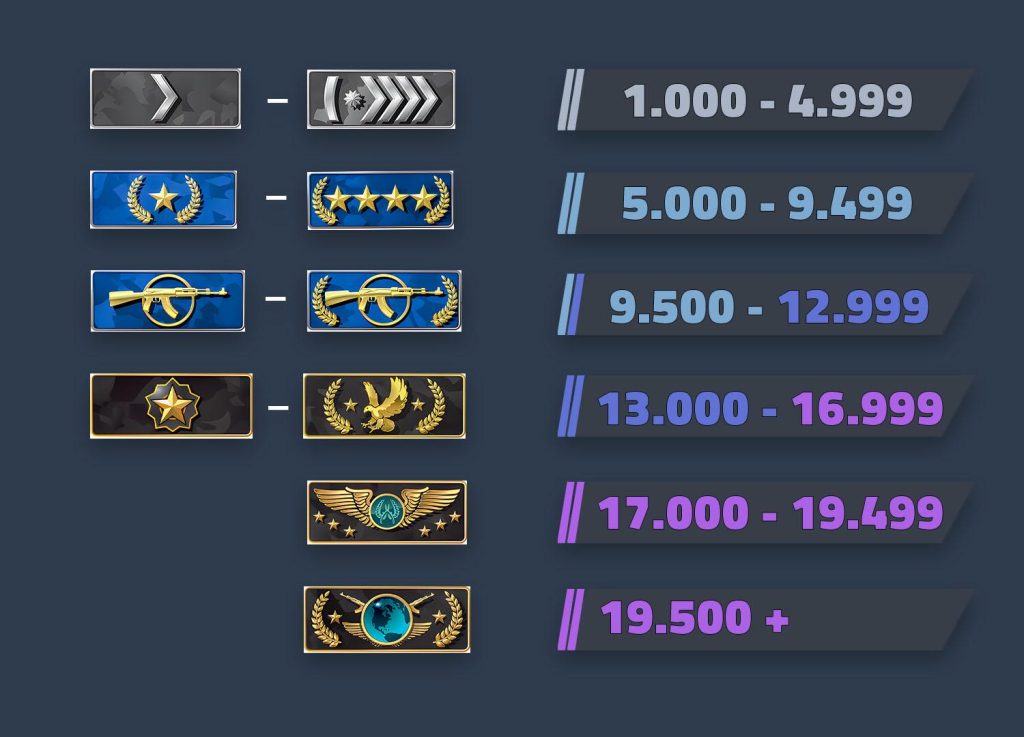
- Visible Rating (CS Rating): Within CS2 Premier Mode, your competitive standing transcends concealed badges—your actual CS Rating (numerical values like 10,000-35,000+) display prominently, resembling Elo or MMR implementations in alternative competitive titles.
- Map-Specific Ranks in Regular MM: Contrasting with CS:GO’s unified global rank, CS2 allocates distinct rankings for individual maps in standard competitive matchmaking.
- Premier Mode Focus: CS2 establishes Premier Mode as the principal competitive framework featuring dedicated CS Rating and comprehensive map selection systems.
- Leaderboard System: High-performing competitors appear on regional and international competitive rankings.
- No More Wingman or Danger Zone Ranks: These gameplay variants currently lack independent ranking infrastructures.
This structural evolution indicates that dedicated competitive climbers should concentrate on Premier Mode where CS Rating serves as authentic skill measurement across competitive environments.
How the CS2 Rank System Works
Overview of the Matchmaking System
The CS2 matchmaking infrastructure utilizes your ranking or CS Rating to match you against similarly capable opponents. The underlying principle remains straightforward: equitable engagements produce superior gameplay experiences. During matchmaking queue activation, the system evaluates:
- Current rating or rank positioning
- Recent performance patterns and historical data
- Teammate and opposition skill calibrations
Within Premier Mode, this matching process operates through your CS Rating. In standard Competitive modes, matching relies on map-specific ranks.
The matching algorithm dynamically adjusts opponent selection according to performance consistency. For instance, consecutive victories against formidable opposition accelerate rating advancement. Conversely, extended losing sequences—particularly against inferior ranked teams—can rapidly diminish standing.
Factors That Influence Your Rank
Although match outcomes represent the predominant influencing element, the CS2 ranking calculus incorporates multiple variables:
- Round Wins: Decisive victory margins (e.g., 13-3 versus 13-11) substantially impact ranking progression.
- Individual Performance: While secondary to team success, personal contributions (eliminations, MVP designations, tactical utility deployment) influence rating adjustments.
- Match Difficulty: Overcoming opponents with superior ratings generates greater advancement than defeating weaker competition.
- Consistency: Sporadic exceptional performances won’t sustain advancement. The system recognizes sustained high-level performance.
Valve maintains confidentiality regarding precise algorithmic calculations, though community investigation and gameplay observation indicate Glicko-2 inspired implementation with custom modifications.
Role of Premier Mode and CS Rating
Premier Mode functions as Valve’s premier competitive environment in CS2 and exclusively employs CS Rating. Within Premier:
- Competitors experience map veto phases mirroring professional tournament structures.
- Gameplay occurs exclusively within the active duty map rotation.
- Participants receive numerical ratings instead of generic rank designations.
This competitive framework provides precise skill quantification and progression pathways toward regional and global leaderboards. Currently, this represents the most accurate depiction of competitive capability within CS2.
Understanding CS Rating in CS2
What is CS Rating?
CS Rating constitutes a numerical ranking implementation utilized within CS2’s Premier Mode. Each competitor receives a baseline numerical value commencing around 0, extending beyond 35,000+. This system operates comparably to MMR (Matchmaking Rating) in titles like League of Legends or Elo in chess competitions.
During Premier match participation:
- Successful match outcomes increase CS Rating valuations
- Unsuccessful engagements decrease CS Rating standings
- Adjustment magnitudes depend upon opponent difficulty calibration, round score differentials, and performance consistency metrics.
This numerical representation not only reflects competitive capability but also determines positioning within regional leaderboards. Elevated CS Ratings potentially unlock competitive recognition, community prestige, and esports organizational consideration for exceptional performers.
The CS2 Premier Mode Explained
What is Premier Mode?
Premier Mode in CS2 represents Valve’s enhanced competitive ecosystem, engineered as the central hub for ranked competition. Unlike conventional matchmaking, Premier Mode emulates professional esports formats, delivering structured, serious competitive environments.
Distinguishing characteristics of Premier Mode include:
- Map Pick/Ban System: Before match commencement, both squads undergo ban/pick procedures to determine battlefield selection.
- CS Rating Instead of Traditional Ranks: Competitors observe precise CS Rating valuations rather than generic badge representations.
- Leaderboard Eligibility: Performance metrics in Premier Mode enable qualification for regional or international competitive rankings.
This competitive structure imbues every match with heightened significance. You’re not merely participating recreationally—you’re constructing competitive identity. Each victory advances leaderboard positioning; every defeat produces regression.
Premier Mode proves ideal for competitors seeking enhanced gameplay control, particularly regarding map selection preferences. If repetitive Mirage or Inferno matches generate fatigue, the map veto mechanism empowers teams to direct engagements toward strategic strengths.
Pick/Ban System & Competitive Integrity
Among the most transformative innovations within CS2’s Premier Mode is the comprehensive map selection system. Before match initiation, each roster alternately prohibits maps from the available rotation. Ultimately, one battlefield remains, becoming the competitive arena.
This functionality, commonplace in professional esports but infrequent in casual matchmaking, delivers substantial competitive advantages:
- Enhanced Strategic Depth: Squads can eliminate maps demonstrating weakness while selecting mastered environments.
- Enhanced Match Equity: Reduces probability of competing on disliked or unfamiliar battlegrounds.
- Team Coordination Enhancement: Promotes strategic discussion and preparation before gameplay initiation.
This structural enhancement introduces preparatory psychological warfare layers before initial engagement exchanges.
Differences Between Premier and Regular Matchmaking
Let’s examine core differentiating elements:
| Feature | Premier Mode | Regular Competitive Matchmaking |
|---|---|---|
| Ranking System | CS Rating (numeric value) | Map-specific visual rank |
| Map Selection | Pick/Ban phase | Random map selection |
| Leaderboard | Yes | No |
| Match Format | Tournament-style | Standard format |
| Focus | Highly competitive players | Casual to intermediate players |
In summary: recreational participants exploring diverse maps for entertainment purposes find traditional matchmaking adequate. However, dedicated competitors focused on ranking advancement and skill development should prioritize Premier Mode engagement.
How to Get Your First Rank in CS2
Requirements to Get Ranked
To obtain initial ranking in CS2 Competitive mode, competitors must achieve 10 competitive match victories on specific maps. Unlike CS:GO, CS2 implements map-specific ranking, necessitating 10 victories on each individual map to receive specific environmental rankings.
Premier Mode operates differently. Required actions include:
- Achieve match victories in Premier Mode (5-10 matches recommended)
- Following completion, your CS Rating becomes visible.
Until these foundational matches conclude, player profiles display no ranking or rating information.
This initial calibration phase proves critical—providing sufficient data for accurate skill assessment and appropriate matchmaking. Therefore, avoid rushing through placement; participate with focused, consistent performance.
Placement Matches: What to Expect
Placement matches typically demonstrate heightened rating volatility. This occurs because the matching algorithm continues calibrating player capability. Strategic recommendations:
- Treat these engagements seriously: They influence ranking placement more significantly than standard matches.
- Coordinate with teams when possible: Minimizes random performance variables.
- Concentrate on familiar maps: Enhances performance consistency and victory frequency.
- Maintain clear communication: Effective team coordination can compensate for mechanical deficiencies.
Following placement completion, anticipate potential ranking placement below expected levels. Valve typically initiates players marginally beneath actual capability to encourage progressive improvement.
How Long it Takes to Get a Rank
Estimated time requirements breakdown:
- Competitive Maps: 10 victories per map = approximately 90–120 minutes per victory depending on match duration.
- Premier Mode: Roughly 5–10 matches before CS Rating visibility.
Total investment expectation approximates 10–15 hours for comprehensive placement across Premier and Competitive modes. Strategic focus on limited maps with intelligent gameplay accelerates this process significantly.
How to Rank Up in CS2
Performance Metrics That Matter Most
Ranking advancement in CS2 transcends simple elimination metrics—it emphasizes match impact. The ranking algorithm evaluates multiple variables, though match victory remains paramount.
Critical influencing elements include:
- Match Victories: The primary determinant of ranking progression.
Here’s what demonstrates significance:
- Match Wins: The predominant driver of rating movement.
- Round Differential: Decisive victories (13-3) influence rating more substantially than narrow triumphs (13-12).
- MVP Designations and Clutch Round Success: Individual influence during critical rounds carries weight.
- K/D Ratio: Provides assistance, but only when complementing team success.
- Tactical Utility Deployment: Smoke screens, flash grenades, and incendiary devices facilitate team victories—Valve recognizes this contribution.
Consistent top-fragging performances without corresponding match victories may not substantially improve CS Rating standings. Team coordination proves essential.
Winning vs Individual Performance
This represents where numerous competitors misunderstand ranking mechanics. They concentrate exclusively on K/D ratios while questioning ranking stagnation. However, CS2, similar to quality tactical shooters, represents a team-oriented competition.
- Victory 13–4 with average statistics benefits rating more than defeat 12–13 with 30 eliminations.
- Clutch round execution and team preservation through effective utility deployment outperforms statistical padding.
- Playing strategically for victory (e.g., tactical sacrifices for objective completion or trade eliminations) generates greater invisible credit than kill pursuit.
- Engage Premier Mode: CS Rating delivers enhanced accuracy and consistency.
- Focus on Comprehensive Map Mastery: Master communication terminology, grenade trajectories, and timing coordination.
- Coordinate with Trusted Teammates: Diminishes random performance variables.
- Analyze Match Recordings: Correct errors before they become habitual patterns.
- Perform Pre-match Warmups: Utilize Aim Botz, deathmatch, and community workshop maps daily.
- Communicate & Support: You needn’t lead elimination statistics every match—maintain team-oriented approach.
- Global Leaderboard: Displays premier competitors worldwide.
- Regional Leaderboards: Segmented by geographical locations (e.g., North America, Europe, Asia).
- Social Leaderboards: Compare CS Rating standings with connected friends.
- Enhanced Streaming/Viewership: Numerous leaderboard competitors broadcast gameplay, rapidly accumulating followers.
- Sponsorship/Team Trial Considerations: Esports talent scouts frequently utilize leaderboards for emerging talent identification.
- Competitive Recognition Rights: Realistically—achieving top 100 regional positioning constitutes substantial accomplishment.
- Verified Mobile Number associated with Steam account.
- Consistent Premier Matchmaking Participation
- CS Rating exceeding 15,000 (regional variations apply)
- VAC/Game Ban Avoidance
- Elo System: Utilized in games like chess. Considers only victory/defeat outcomes and opposition capability assessment.
- Glicko System: Incorporates rating deviation metrics—confidence measurements regarding ranking accuracy. Accounts for inactivity periods, performance volatility, and consistency measurements.
- Victory dominance characteristics
- Performance result consistency patterns
- Inactivity duration tracking
- Opposition capability differentials (victories and defeats)
- The matching infrastructure compares your CS Rating (or concealed Elo in standard Competitive) against opposition ratings.
- Calculates anticipated outcome probabilities.
- Based on performance versus expectations, CS Rating experiences advancement or regression.
Additional influencing elements include:
- Round victory differentials: Triumph 13-5 generates greater value than 13-11.
- Team composition considerations: Competing against complete five-stack formations may generate bonus rating for solo victory achievements.
- MMR volatility factors: Recently created accounts or accounts with limited match history experience heightened rating fluctuation.
Valve maintains algorithmic confidentiality to prevent exploitation, though clearly match contextual elements carry equivalent importance to match outcomes.
Transparency and Player Feedback
Principal criticism within CS:GO involved transparency deficiencies. Competitors lacked understanding regarding ranking advancement or regression triggers. CS2 addresses this through:
- Visible CS Rating: Enables match-to-match numerical tracking.
- Match History Documentation: Displays round victory/defeat differentials and fundamental performance statistics.
- Leaderboard Implementations: Render skill tier distinctions more tangible and measurable.
Nevertheless, community members request additional transparency enhancements—such as precise CS Rating modifications following each match or rating movement breakdowns. Valve potentially implements these features in subsequent updates.
Counter-Strike 2 represents Valve’s comprehensive overhaul of competitive gaming infrastructure, moving beyond CS:GO’s legacy system with fundamental changes to ranking mechanics and player evaluation. Built on the Source 2 engine, CS2 maintains the tactical core that defines Counter-Strike while introducing revolutionary features like volumetric smokes, sub-tick precision, and completely redesigned matchmaking architecture that launched in 2023.
The essence of CS2 remains rooted in objective-based team combat between Terrorists and Counter-Terrorists, a formula that has sustained the franchise’s dedicated community for decades. What distinguishes CS2 from casual shooters is its exceptionally high skill ceiling where every tactical decision, movement choice, and shot placement carries significant weight. This elevated skill requirement makes having a transparent, well-calibrated ranking system absolutely essential for player development and competitive integrity.
Evolution from CS:GO to CS2
The transition between games extends far beyond visual enhancements. Valve implemented structural changes that completely redefined how competitive progression functions. The era of ambiguous rank movements has ended—CS2 delivers a contemporary ranking experience influenced by titles like Valorant and Overwatch, while preserving the competitive DNA that makes Counter-Strike unique.
One of the most significant transformations was the introduction of CS Rating alongside Premier Mode, which we’ll examine in greater detail shortly. These innovations make ranking more transparent, meaningful, and intensely competitive. While CS:GO depended on concealed Elo calculations with 18 visible tiers, CS2 now provides precise numerical ratings and regional leaderboards, enabling players to clearly track their advancement and push their limits further.
What is the CS2 Ranking System?
Definition and Purpose of the Ranking System
The CS2 ranking system constitutes Valve’s methodology for assessing player skill and ensuring balanced matchmaking. This system guarantees that competitive encounters remain fair, challenging, and appropriately matched for all participants involved.
At its foundation, the ranking mechanism serves two critical objectives:
- Matchmaking Balance: To generate competitive, closely-matched games.
- Player Progression: To provide tangible advancement feedback as players enhance their capabilities.
Unlike casual gameplay variations, ranked competition in CS2 revolves around structure, stakes, and competitive recognition. Successful match outcomes elevate your standing; defeats diminish it. However, the evaluation extends beyond simple victory/defeat records—it analyzes individual contributions, opponent strength differentials, and performance consistency across multiple sessions.
Key Differences from CS:GO Ranking
For veterans transitioning from CS:GO, several substantial modifications require adjustment. Here’s a comprehensive comparison:
- Visible Rating (CS Rating): Within CS2 Premier Mode, your competitive standing isn’t merely a concealed emblem—your actual CS Rating (numerical values such as 10,000) becomes visible, comparable to Elo or MMR implementations in alternative competitive titles.
- Map-Specific Ranks in Regular MM: Contrasting with CS:GO’s unified global rank, CS2 allocates distinct per-map rankings in non-premier matchmaking environments.
- Premier Mode Focus: CS2 establishes Premier Mode as the primary competitive format featuring dedicated CS Rating measurements and integrated pick/ban procedures.
- Leaderboard System: Elevated CS Rating performers gain visibility on regional and global competitive standings.
- No More Wingman or Danger Zone Ranks: These gameplay modes presently lack independent ranking infrastructures.
This structural shift means that dedicated competitive climbers should concentrate on Premier Mode where their CS Rating constitutes the authentic cross-map skill measurement standard.
How the CS2 Rank System Works
Overview of the Matchmaking System
The CS2 matchmaking infrastructure leverages your current rank or CS Rating to match you against similarly-skilled opposition. The underlying principle remains straightforward: equitable confrontations generate superior gameplay experiences. When entering match queues, the algorithm evaluates:
- Your present rating or rank position
- Your recent performance patterns and historical data
- Your teammates’ and opponents’ comparative skill calibrations
Within Premier Mode, this matchmaking process operates through your CS Rating. In alternative Competitive formats, matching derives from map-specific ranks.
The system continuously recalibrates match pairings according to performance consistency metrics. For instance, consecutive victories against formidable opponents can accelerate rating advancement. Conversely, excessive consecutive defeats—particularly against lower-rated squads—can rapidly diminish your competitive standing.
Factors That Influence Your Rank
Although match outcomes represent the predominant influence, the CS2 ranking algorithm incorporates multiple performance variables:
- Round Wins: Achieving substantial victory margins positively impacts rank progression.
- Individual Performance: While secondary to team success, your personal contributions (eliminations, MVP designations, tactical utility deployment) do affect rating calculations.
- Match Difficulty: Defeating teams possessing superior ratings yields greater rewards than overcoming weaker opposition.
- Consistency: Isolated exceptional performances provide limited advancement momentum. The system incentivizes sustained high-level performance across multiple sessions.
Valve maintains confidentiality regarding the precise mathematical formulas, but community investigation and empirical observations indicate strong similarities to Elo-derived systems with proprietary modifications.
Role of Premier Mode and CS Rating
Premier Mode functions as Valve’s premier competitive experience in CS2 and represents the exclusive mode utilizing CS Rating. Within Premier:
- Participants undergo pick/ban phases mirroring professional tournament structures.
- Gameplay occurs exclusively within the active duty map rotation.
- Competitors receive numerical ratings instead of conventional rank designations.
This format delivers precise skill quantification and pathways toward regional and global leaderboards. Currently, this represents the most accurate depiction of your competitive proficiency within CS2.
Understanding CS Rating in CS2
What is CS Rating?
CS Rating constitutes a numerical ranking framework employed within CS2’s Premier Mode. Each participant receives a numerical designation commencing approximately at 0, extending beyond 35,000+. This system operates analogously to MMR (Matchmaking Rating) in titles like League of Legends or Elo implementations in chess.
When engaging in Premier matches:
- Victories elevate your CS Rating
- Defeats diminish your CS Rating
- The magnitude of rating adjustments depends on opponent difficulty calibrations, round score differentials, and performance consistency metrics.
This numerical representation not only reflects your skill proficiency but also determines positioning on regional leaderboards. Enhanced CS Ratings create opportunities for competitive recognition, community prestige, and potential esports organization visibility for exceptional performers.
The CS2 Premier Mode Explained
What is Premier Mode?
Premier Mode within CS2 represents Valve’s enhanced competitive environment, engineered as the central ecosystem for ranked gameplay. Diverging from conventional matchmaking, Premier Mode emulates professional esports structural paradigms. This framework provides participants with more organized, serious competitive surroundings.
Distinguishing characteristics of Premier Mode include:
- Map Pick/Ban System: Before match commencement, competing teams engage in ban/pick procedures to determine the selected battleground.
- CS Rating Instead of Traditional Ranks: Participants observe precise CS Rating values rather than generic rank indicators.
- Leaderboard Eligibility: Your Premier Mode performance enables qualification for regional or global competitive standings.
This systematic approach enhances match significance perception. You’re not merely participating recreationally—you’re constructing your competitive identity. Each triumph advances your leaderboard positioning, while every setback creates regression pressure.
Premier Mode proves ideal for players desiring enhanced gameplay control, particularly regarding map selection. If experiencing fatigue from repetitive Mirage or Inferno matches, the map veto mechanism empowers your squad to direct encounters toward your strategic strengths.
Pick/Ban System & Competitive Integrity
Among the most transformative innovations within CS2’s Premier Mode is the integrated map veto infrastructure. Prior to match initiation, alternating teams sequentially eliminate maps from the available pool. Ultimately, one map persists, becoming the designated combat arena.
This functionality, commonplace within professional esports but infrequently encountered in casual matchmaking, represents substantial competitive advancement. Why does this innovation carry such significance?
- Enhanced Strategic Depth: Squads can eliminate maps representing their vulnerabilities while selecting those they’ve mastered.
- Enhanced Match Equity: This system minimizes probabilities of playing on disliked or unfamiliar maps.
- Improved Team Coordination: Stimulates strategic discussion among participants before gameplay initiation.
This modification introduces preparatory layers and psychological warfare elements, commencing before initial engagement.
Differences Between Premier and Regular Matchmaking
Let’s examine the fundamental distinctions:
Feature Premier Mode Regular Competitive Matchmaking Ranking System CS Rating (numeric value) Map-specific visual rank Map Selection Pick/Ban phase Random map selection Leaderboard Yes No Match Format Tournament-style Standard format Focus Highly competitive players Casual to intermediate players In summary: if you represent a recreational player interested in exploring diverse maps and enjoying casual gameplay, traditional matchmaking suffices. However, if you’re seriously committed to rank advancement and skill improvement, Premier Mode constitutes the primary competitive arena.
All CS2 Ranks Explained
Full List of CS2 Ranks
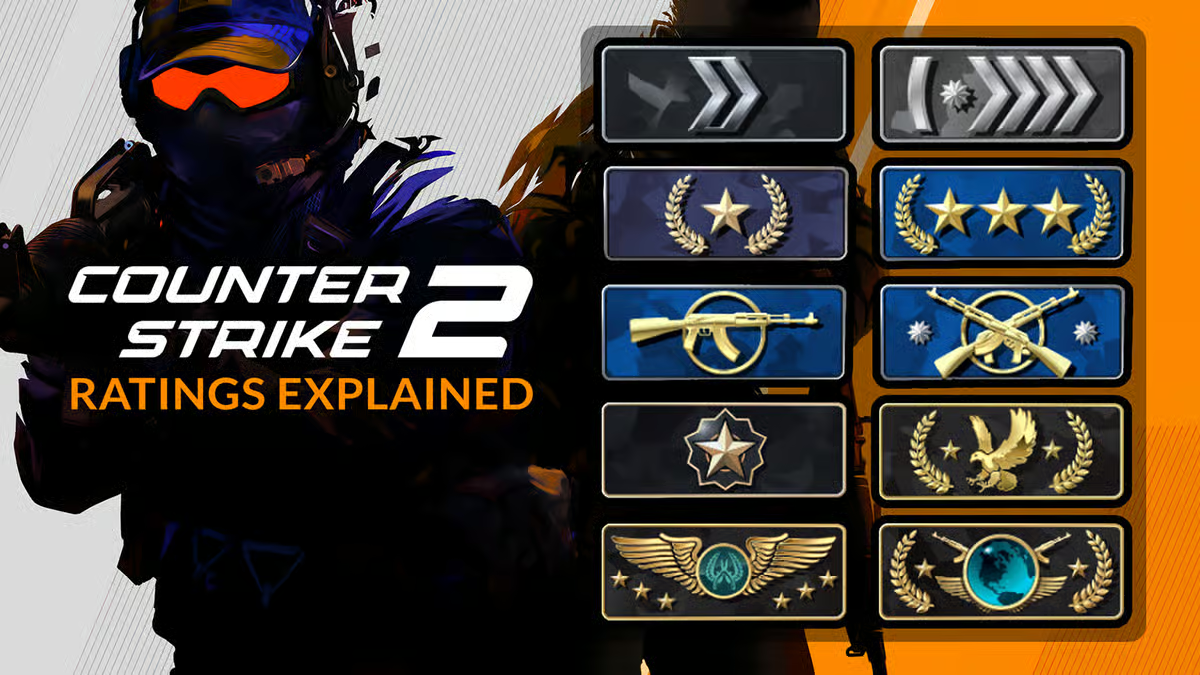
Within conventional matchmaking (non-Premier), CS2 continues utilizing the familiar 18-rank hierarchy inherited from CS:GO. These competitive tiers include:
- Silver I (S1)
- Silver II (S2)
- Silver III (S3)
- Silver IV (S4)
- Silver Elite (SE)
- Silver Elite Master (SEM)
- Gold Nova I (GN1)
- Gold Nova II (GN2)
- Gold Nova III (GN3)
- Gold Nova Master (GNM)
- Master Guardian I (MG1)
- Master Guardian II (MG2)
- Master Guardian Elite (MGE)
- Distinguished Master Guardian (DMG)
- Legendary Eagle (LE)
- Legendary Eagle Master (LEM)
- Supreme Master First Class (SMFC)
- Global Elite (GE)
These competitive designations are achieved individually for each map. Indeed, this signifies you could attain Gold Nova standing on Mirage while achieving Master Guardian status on Overpass. This structural alteration encourages participants to develop expertise across individual battlegrounds.
Conversely, Premier Mode doesn’t employ these traditional ranks. Instead, it utilizes CS Rating, a numerical framework originating at 0 and surpassing 30,000. Loose correlations exist with legacy ranking systems, though official labeling remains absent.
Visual Guide and Colors of Each Rank
Each of the 18 competitive tiers features distinctive iconography and chromatic schemes:
- Silvers: Gray tonal variations, fundamental icon designs
- Gold Novas: Golden coloration, stellar icon motifs
- Master Guardians: Azure and white combinations, wing and shield imagery
- LE to GE: More elaborate iconography, eagle wing and crown representations
Meanwhile, CS Rating within Premier Mode features color-coded rating ranges. Valve implements varied badge colorations representing different skill echelons (e.g., bronze for <5,000, azure for 10,000+, violet for elite tiers).
This visual architecture facilitates rapid player skill assessment and incorporates aesthetically satisfying progression elements.
Rank Distribution Among Players
Based on community statistical tracking, here’s an approximate breakdown of rank distribution patterns:
Rank Tier % of Player Base Silver I–Silver Elite Master ~20% Gold Nova I–Master ~35% MG1–DMG ~25% LE–LEM ~10% SMFC–Global Elite ~5% CS Rating (Premier Mode) Highly variable This distribution demonstrates that majority participant concentration exists between Gold Nova and Master Guardian tiers. Advancing into the top 10%—and particularly achieving Global Elite or 20,000+ CS Rating—represents a substantial competitive achievement.
How to Get Your First Rank in CS2
Requirements to Get Ranked
To obtain your inaugural rank within CS2 Competitive mode, you must achieve victory in 10 competitive matches on a specific map. Unlike CS:GO, your CS2 rank demonstrates map-specificity, meaning you’ll require 10 triumphs on each map to receive ranking designation for that particular battleground.
Premier Mode operates differently. You’ll need to:
- Achieve victories within Premier Mode (5-10 matches recommended)
- Subsequently, your CS Rating becomes visible
Until completing these initial qualification matches, your profile won’t display any rank or rating information.
This initial placement phase proves critically important—it provides the system sufficient data to determine your skill calibration and match you appropriately. Therefore, avoid rushing through this process. Participate with strategic focus and performance consistency.
Placement Matches: What to Expect
Your placement matches likely represent the most volatile gaming sessions you’ll experience. This volatility stems from the system’s ongoing calibration process. Some strategic recommendations:
- Treat these encounters seriously: They carry heightened weighting compared to standard matches.
- Participate with coordinated teams when feasible: Minimizes random performance variables.
- Concentrate on familiar maps: You’ll demonstrate superior performance and achieve victory more consistently.
- Communicate effectively: Superior communication can compensate for mechanical deficiencies.
Following placement completion, avoid surprise if you land below anticipated levels. Valve typically initiates participants slightly beneath their actual skill calibrations to encourage progressive improvement over extended periods.
How Long it Takes to Get a Rank
Here’s a concise breakdown:
- Competitive Maps: 10 victories per map = approximately 90–120 minutes per triumph depending on match duration
- Premier Mode: Roughly 5–10 matches before CS Rating visibility
Overall, anticipate investing approximately 10–15 hours to achieve complete placement across both Premier and Competitive formats. If concentrating on one or two maps and playing strategically, you can accelerate this procedural timeline significantly.
How to Rank Up in CS2
Performance Metrics That Matter Most
Advancing within CS2’s competitive hierarchy extends beyond mere elimination statistics—it revolves around strategic impact. The ranking algorithm incorporates multiple performance variables, though match victory consistently represents the paramount priority.
Here’s what carries greatest significance:
- Match Victories: The predominant driver of rank progression.
- Round Differential: Achieving 13-3 victory margins affects your rating more substantially than 13-12 triumphs.
- MVP Designations and Critical Round Performance: Individual impact during decisive rounds influences rating calculations.
- K/D Ratio: Provides benefits, but exclusively when contributing to team victories.
- Tactical Utility Deployment: Smoke screens, flash grenades, and incendiary devices facilitate team success—Valve’s system recognizes and rewards this behavior.
If you consistently achieve top elimination counts while suffering defeats, your CS Rating improvement may demonstrate limited progression. Collaborative teamplay proves essential.
Winning vs Individual Performance
This represents where numerous participants misunderstand ranking mechanics. They concentrate exclusively on K/D statistics and question their ranking stagnation. However, CS2, like all superior tactical shooters, represents a team-oriented game.
- Achieving 13–4 victory with median statistics benefits your rating more substantially than suffering 12–13 defeat with 30 eliminations.
- Successfully executing critical rounds and preserving team advantage through effective utility employment surpasses statistical padding strategies.
- Playing for objective success (e.g., sacrificing for bomb deployment or trade eliminations) accumulates greater “invisible” credit than pursuing individual kill counts.
Valve has transitioned toward incentivizing intelligent, collaborative gameplay approaches.
Tips to Improve Rank Fast
- Participate in Premier Mode: CS Rating demonstrates enhanced accuracy and consistency.
- Concentrate on Map Proficiency Development: Master callout terminology, grenade trajectory lineups, and timing coordination.
- Queue With Trusted Teammates: Diminishes matchmaking randomness factors.
- Analyze Match Recordings: Correct errors before they establish habitual patterns.
- Preparation Routines: Utilize Aim Botz training, deathmatch practice, and community workshop maps daily.
- Communicate & Provide Support: You don’t require top elimination counts every match—function as a collaborative team participant.
Rank advancement requires temporal investment and performance consistency. You won’t experience overnight meteoric rises, though steady improvement yields substantial returns over extended periods.
Why Did My Rank Drop in CS2?
Factors Behind Losing Rank
Observing your rank or CS Rating decline within CS2 can prove discouraging, particularly when perceiving consistent high-level performance. However, ranking infrastructures extend beyond individual metrics—they encompass results, consistency, and performance relative to competitive opposition.
Here are several primary reasons for potential rank deterioration:
- Frequent Match Defeats: This represents the predominant causation factor. Victory sequences facilitate climbing progression; defeat sequences generate ranking regression.
- Close Defeats Still Generate Losses: Even when suffering 11-13 defeats, you’re still forfeiting valuable rating points.
- Inactivity Periods: Extended gameplay absence may not reset your rank entirely, though the system potentially reduces rating slightly due to outdated performance data.
- Role Discrepancies: If typically performing as entry fragger but transitioning to support or lurking roles without tactical adaptation, your effectiveness may demonstrate decline.
- Toxic Behavior or Intentional Underperformance: Negative conduct patterns—including trolling, AFK behavior, or griefing—will nearly invariably conclude in defeat and subsequent de-ranking.
- Solo Queue Participation: Playing without reliable teammates increases probabilities of uncoordinated match outcomes.
The ranking infrastructure isn’t penalizing you individually—it reflects your current competitive output.
Demotion vs Inactivity
It’s critically important to differentiate between rank loss due to suboptimal performance (demotion) and rank visibility loss from inactivity periods.
- Demotion: If suffering sufficient consecutive defeats, the system automatically reduces your rank standing. Within Premier, this signifies forfeiting CS Rating points; within Competitive, this could indicate transition from DMG to MG2.
- Inactivity: In certain circumstances, Valve may conceal your rank following prolonged gameplay absence. You’ll require victory in one or two matches to restore visibility, though it may demonstrate reduced calibration compared to previous standings.
This represents Valve’s methodology for ensuring ranking accuracy and reflecting participants’ current skill proficiency, not their historical peak performance from previous periods.
How to Recover From a Rank Drop
Avoid panic responses. Nearly all participants experience performance fluctuations. Here’s the strategic approach for recovery:
- Participate with Coordinated Squads: Queuing alongside trusted teammates enhances communication quality and strategic execution.
- Switch Map Focus: If struggling on Mirage, experiment with Vertigo or Anubis for refreshed perspective.
- Analyze Personal Match Recordings: Identify consistent error patterns—excessive peeking, inefficient utility deployment, suboptimal crosshair positioning.
- Utilize Training Maps: Aim Botz, Recoil Master, and Smoke Practice constitute essential development tools.
- Preparation Before Ranked Sessions: Avoid entering high-stakes matches without proper warmup procedures. Deathmatch or Aim Training routines can prevent early-round tactical errors.
- Avoid Elimination Chasing: Play to achieve round victories. Even without top elimination statistics, playing intelligently and supporting your team will facilitate rank restoration.
Remember, your rank doesn’t represent a permanent designation—it functions as a dynamic indicator of your recent competitive form. Focus on performance consistency and collaborative teamplay, and the rank will demonstrate recovery progression.
Action Checklist
- Complete 10 victory placements on preferred maps to establish initial competitive standing
- Focus Premier Mode engagement for accurate CS Rating tracking and leaderboard qualification
- Utilize third-party analytics platforms (Leetify, Scope.gg) for detailed performance assessment
- Analyze match recordings weekly to identify recurring tactical errors and improvement opportunities
- Complete 15-minute Aim Botz and deathmatch warmup before competitive sessions
- Review at least one match demo weekly to identify tactical errors
- Queue Premier Mode with 2-3 trusted teammates
- Analyze utility usage statistics using third-party trackers weekly
- Implement one strategic improvement identified from demo analysis each session
Valve has progressed toward rewarding intelligent, team-focused gameplay approaches.
Tips to Improve Rank Fast
Ranking advancement demands temporal investment and performance consistency. Dramatic overnight progression remains unrealistic; however, steady improvement yields substantial returns.
CS2 Leaderboards and Competitive Incentives
Regional and Global Rankings
Among the most compelling innovations within CS2 is the leaderboard infrastructure. This introduces additional competitive dimensions, providing elite performers with distinction beyond Global Elite or 30,000 CS Rating achievements.
Leaderboard implementations exist across multiple tiers:
Each ranking board displays your CS Rating, competitive standing, and occasionally victory/defeat ratios, delivering comprehensive competitive journey visualization.
Leaderboard inclusion transcends mere vanity—it signifies elite competitive capability. For ambitious participants, this represents progression toward potential esports participation or content creation opportunities.
Leaderboard Rewards and Prestige
Valve hasn’t implemented direct in-game rewards (currently) for leaderboard achievement, though the prestige component carries substantial weight. Displaying top 100 designation constitutes significant community recognition.
Leaderboard visibility benefits include:
Substantial probability exists that Valve may introduce future leaderboard-centric events, exclusive cosmetic items, or seasonal achievements. Therefore, maintaining elite positioning potentially yields benefits beyond community recognition.
How to Get on the Leaderboard
Leaderboard qualification typically requires:
If qualification criteria are satisfied and performance meets standards, automatic regional leaderboard inclusion occurs. Qualification thresholds fluctuate weekly according to elite competitor activity levels.
CS2 Elo System: Behind the Scenes
Is CS2 Using Elo or Glicko?
Valve hasn’t officially disclosed precise algorithmic calculations underlying CS2’s ranking implementation, though community specialists strongly suspect CS2 employs modified Glicko-2 system, rather than pure Elo methodology.
Fundamental differentiations explained simply:
This indicates CS2 monitors:
This hybrid implementation delivers enhanced accuracy while maintaining increased operational mystery. This explains occasional anomalous rating adjustments despite consistent performance perception.
How the Backend Ranking Algorithms Work
During every Premier or Competitive match participation:
No reproduction without permission:Tsp Game Club » CS2 Ranking System Explained