
TL;DR
- CS2’s economy rewards strategic thinking over mechanical skill alone
- Team coordination during buy phases prevents economic mismatches and maximizes round potential
- Loss bonuses create comeback opportunities when strategically managed
- Utility investments often provide better ROI than weapon upgrades in many situations
- Advanced players use opponent economy reading to predict and counter buy decisions
Your financial strategy in Counter-Strike 2 carries equal weight to your shooting precision. Unlike many first-person shooters that reset player inventories each round, CS2 features a sophisticated economic framework that directly controls your access to firearms, protective gear, and tactical equipment. Consider it a high-stakes chess game where every tactical move, monetary allocation, and strategic choice has significant consequences.
Whether you’re transitioning from CS:GO or completely new to the franchise, comprehending CS2’s economic mechanics is essential for boosting your victory percentage. Intelligent financial planning can create momentum leading to consecutive round successes, whereas reckless expenditure might eliminate your squad’s chances before the action even begins.
Fundamentally, the CS2 economic system compensates players based on round outcomes. Victorious rounds generate higher income than defeats, but even unsuccessful rounds provide compensatory payments through escalating loss bonuses. The key lies in understanding how to leverage this framework strategically—determining optimal moments to invest, conserve resources, or commit fully.
Let’s examine the foundational elements of CS2’s economy so you can begin competing more intelligently.
Why Economy Matters in CS2
Attempting to defeat an AK-47 wielder with a standard Glock pistol represents an almost impossible scenario. Your financial resources determine the equipment you carry onto the combat zone. It operates as the unseen influence governing match tempo and strategic options. Effective economic management ensures you consistently field rifles, body armor, and tactical equipment when it matters most. Poor financial planning? You’ll find yourself relying on pistols while hoping for improbable outcomes.
Squads demonstrating superior economic planning can purchase enhanced firepower and execute more sophisticated tactics. Consider tactical equipment: smoke grenades for vision obstruction, incendiary devices for area denial, flashbangs for tactical advantage. These items require monetary investment. Losing multiple initial rounds suddenly places your team in recovery mode, desperately attempting to finance purchases while opponents build unstoppable momentum.
Economic strategy extends beyond simple cash accumulation—it’s about strategic control. The team with financial superiority frequently dictates engagement pacing, selects advantageous confrontations, and restricts enemy access to necessary tools. It’s unsurprising that elite professional organizations emphasize financial preparation alongside mechanical shooting abilities.
Within CS2’s competitive environment, every action generates or reduces your financial resources:
- Round Win: +$3250 to $3500 depending on round number and objective completion
- Round Loss: Begins at +$1400, progressively increases to +$3400 following consecutive defeats
- Bomb Plant (Terrorist side): +$800 distributed to each surviving team member
- Kill Rewards:
- SMGs: $600+
- Rifles: $300
- Pistols: $300–$500
- Knife: $1500
Each match commencement provides $800 initial funding (following pistol round initiation). From this starting point, each round’s result either strengthens your economic position or diminishes it. Should your team experience three consecutive round losses, your squad receives enhanced loss compensation (+$2400, subsequently $2900, etc.). This indicates that even during disadvantageous situations, the game offers recovery opportunities through proper purchase planning.
A strategically timed conservation round can dramatically shift match momentum. Similarly, an ill-advised forced purchase might trigger economic deterioration. Therefore, let’s explore the various purchase categories and professional implementation methods.
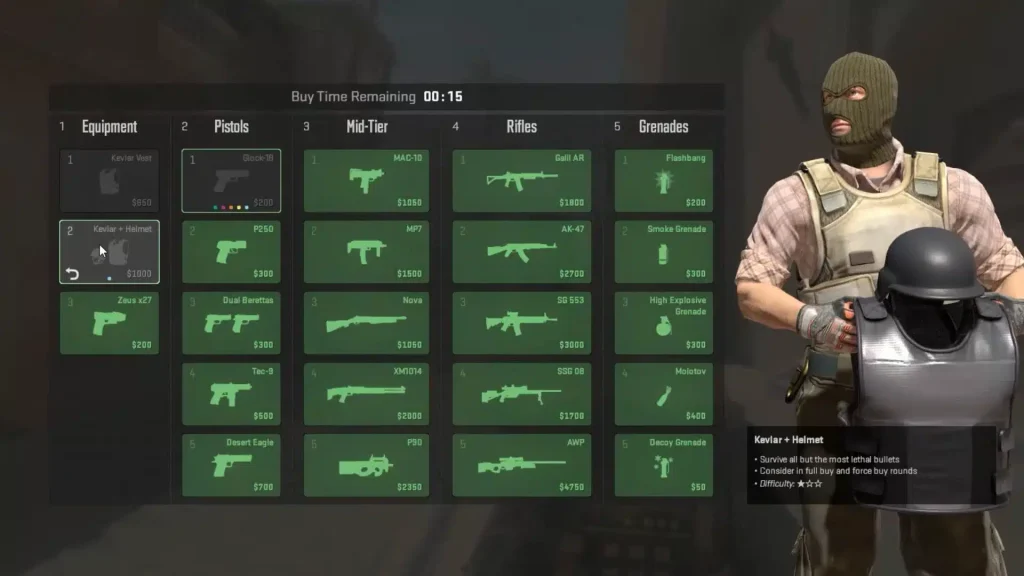
Every combat round (excluding initial pistol rounds) features a limited procurement window for acquiring weaponry and equipment—this constitutes the Buy Phase. This critical period determines economic outcomes. Some competitors thoughtlessly purchase available items. Strategic thinkers plan for long-term match progression.
You should consistently evaluate:
- Can our entire squad execute a coordinated full purchase?
- Do tactical equipment requirements outweigh raw firepower needs?
- Should we conserve resources for subsequent rounds?
Procurement strategy extends beyond individual decisions—it requires team synchronization. One team member acquiring an AWP sniper rifle while colleagues lack funds creates imbalanced engagements. This explains why veteran competitors communicate purchase plans and coordinate for optimal effectiveness.
What is the Buy Phase in CS2?
The Procurement Window in CS2 spans approximately 15 seconds at each round’s commencement. Throughout this interval, you can:
- Acquire firearms
- Purchase protective gear (Kevlar vest or Kevlar + Helmet combination)
- Obtain grenades (smoke canisters, flash devices, etc.)
- Transfer weapons to teammates
- Assess scoreboard information and economic status
Competitors should utilize this brief period not merely for purchasing, but also strategic planning. If three squad members cannot afford rifles, collective economic conservation or coordinated forced purchases might prove wiser than individual under-equipped participation.
Effective communication during this limited timeframe can determine round outcomes. Employ voice communication or text messaging to state:
- “Full purchase this round?”
- “Let’s conserve resources for one round and purchase subsequently.”
- “I can provide you with an AK-47.”
Let’s acknowledge reality—unstructured purchases generate confusion. Organized procurement wins matches.
How to Make Smart Purchase Decisions
Here represents a fundamental principle within CS2: Should your entire team lack purchase capability, abstain from buying.
Intelligent procurement planning initiates with your economic situation and expands to encompass the squad’s overall circumstances. Here’s how to determine appropriate actions:
- Full Purchase: All members possess $4500+ and can acquire rifles, armor, and minimum one grenade.
- Force Purchase: Squad maintains $2000–$4000 per player; obtains pistols, SMGs, and basic tactical equipment to challenge the round
- Economic Conservation Round: Team controls <$2000; minimizes expenditure to preserve funds for future full purchases
- Partial Purchase: Expend moderately—perhaps sidearms and protective gear—while maintaining savings for subsequent rounds
Procurement represents a team-based activity. Avoid becoming the isolated player who squanders $4700 on an AWP while remaining squad members utilize basic Glocks. If you maintain limited funds while your team conserves resources, conserve similarly. Should your squad prefer forcing, force collectively. Synchronized purchases maintain balanced playing conditions and optimize round-winning potential.
When to Go for a Full Buy
A full purchase represents when your squad completely invests in rifles, protective equipment, and tactical devices. This constitutes the optimal condition: properly equipped, adaptable, capable of executing prepared tactics or retaking positions. However, when should you commit to this strategy?
- Available financial resources — Typically by rounds 3 or 4, provided your team has secured minimum one round, you might accumulate sufficient funds for full purchasing.
- Momentum significance — Following a successful round, you want to capitalize on advantages rather than allow opponents recovery opportunities.
- To capitalize on opponent economic weakness — Should enemies maintain limited funds, a full purchase can decisively exploit their vulnerabilities.
- Mid-match stabilization — Occasionally after several defeats, you might establish equilibrium through full purchasing to prevent opponents from building excessive momentum.
- Map control requirements — On specific maps or bombsite locations, possessing comprehensive tactical equipment (smoke grenades, flash devices) proves essential—therefore partial purchases might demonstrate ineffective.
Commiting to full purchasing too early or during economically disadvantaged situations can produce negative consequences, therefore coordinate before committing.
Best Weapons and Utility in Full Buy Rounds
During full purchase scenarios, target balanced loadouts. You require firepower, survivability, and tactical capabilities. Standard weapon + equipment selections include:
| Combat Role | Prefered Firearm | Protective Gear & Tactical Equipment |
|---|---|---|
| Entry Fragger / Assault | AK‑47 (Terrorist faction) / M4A1 (Counter-Terrorist faction) | Complete armor configuration + flash devices, high-explosive grenades, or incendiary tools |
| Support Specialist | Primary rifle or SMG variant | Smoke canisters, molotov cocktails, flashbangs to facilitate site entries/retakes |
| Sniper / AWP Specialist | AWP or Scout sniper rifle | Armor protection + 1 flash / smoke device for tactical repositioning |
| Flanker / Lurker | Primary rifle or occasional SMG | Minimal tactical equipment; preserve some financial resources for subsequent rounds |
Tactical equipment frequently determines round outcomes more than pure firepower. Smoke grenades obstruct vision, flash devices disorient defenders, molotovs eliminate corner positions, and high-explosive grenades reduce health points or force positional changes. During full purchase scenarios, avoid economizing on 2–3 grenades per player when feasible.
For players seeking to elevate their economic gameplay beyond fundamental principles, consider these advanced competitive strategies:
Economic Forecasting: Track opponent purchase patterns across 3-4 rounds to predict their economic limitations and exploit accordingly.
Advanced Utility Techniques: Master “pop” flashes that detonate immediately upon reaching destination, preventing enemy reaction time.
Team Financial Synchronization: Designate one player as “banker” during economically disadvantaged rounds to ensure at least one team member maintains purchase capability.
Economic Pressure Application: Force opponents into unfavorable economic decisions through strategic round wins and utility denial.
Remember that in high-level competitive CS2, economic strategy often separates professional teams from amateur squads. The difference between consistently reaching major tournaments versus remaining in lower competitive tiers frequently hinges on economic mastery rather than pure mechanical skill.
Understanding when to deploy specific weapon types in Counter-Strike 2 separates casual players from strategic competitors. Each firearm category serves distinct economic purposes throughout a match.
Pistol Selection for Different Scenarios
- Glock / USP: Standard issue sidearms—cost-free but limited in effectiveness. Primarily utilized during initial pistol engagements.
- P250 / Five-Seven / Tec-9 / CZ75: Excellent choices during economic pressure rounds or coordinated force purchases.
- Deagle: Perfect for precision long-distance head eliminations and high-pressure solo situations.
SMG Utilization for Economic Advantage
Submachine guns including the MP9, MAC-10, and UMP-45 provide:
- Substantial elimination bonuses (+$600 per takedown!)
- Effective close-quarters combat performance
Deploy these weapons strategically:
- Following pistol round victories—ideal for economic accumulation.
- During anti-economic rounds—when adversaries utilize pistols.
- When financial resources are constrained, but you need competitive capabilities.
Tactical Insight: Combining an MP9 with protective gear and disorientation devices can shift momentum when employed aggressively, particularly in confined spaces such as Dust II’s B passageways or Inferno’s residential complexes.
When to Transition to Rifles
Once economic momentum builds, advancing to rifles becomes logical—but precise timing proves crucial.
Primary rifles including the AK-47, M4A1-S, and M4A4 form the foundation of most purchase rounds. Their precision, damage capacity, and adaptability make them optimal for medium to extended range confrontations.
Moving from secondary and compact firearms to primary rifles represents a critical juncture in CS2 matches. Premature upgrades can waste economic resources, while delayed transitions surrender tactical advantages.
Opponent Economy Assessment
- Analyze adversary purchasing patterns — If opponents maintain economic constraints or partial investments, SMGs might remain sufficient for additional rounds.
Utility Integration with Rifles
Never deploy rifles without supporting equipment. The combination of primary firearms and tactical grenades typically determines match outcomes.
Team Synchronization for Weapon Upgrades
Avoid situations where individual players possess rifles while teammates operate with inferior equipment.
Weapon Conservation Considerations
Periodically retaining previous firearms proves advantageous when anticipating additional anti-economic engagements.
Remember, advancing from pistols and SMGs to rifles should involve collective team planning and tactical reasoning—not merely reflexive spending when finances permit.
The in-game leadership role demands investigative thinking. Interpreting enemy economic situations provides your squad with superior positioning for making intelligent purchase determinations.
Reading Enemy Financial Patterns
How to decipher adversary economic status:
- Examine round progression history — If opponents secured two rounds then suffered one defeat, they might operate under force-purchase conditions.
Predictive Economic Planning enables:
- Implementation of anti-economic tactics (maintain defensive positioning, avoid constricted areas).
- Extension of bonus round strategies (maintain SMG utilization longer).
- Tempo control and economic pressure denial against opponents.
Coordinated Team Buy Strategies
Random purchasing creates predictable failures. The in-game leader must orchestrate:
- Individual purchase responsibilities — Identify teammates requiring weapon contributions, preservation participants, utility investors.
- Strategic resource distribution — When one competitor possesses $7000 while others maintain $2000, superior strategy involves weapon distribution rather than unbalanced investments.
The IGL’s responsibility extends beyond tactical execution to include financial management resembling budget analysis. Proper execution frequently outperforms superior aiming through correct decision-making.
- Practice identifying full buy thresholds ($4500+ per player with team coordination)
- Master communication protocols during buy phases (voice commands for drops, save calls, force decisions)
- Implement loss bonus tracking system to optimize save round timing
- Develop opponent economy reading skills through demo analysis and round pattern recognition
- Analyze opponent’s previous round purchases and economic patterns before transitioning weapons
- Coordinate team SMG utilization for 1-2 rounds following pistol victories
- Ensure full utility complement when advancing to rifles
- Synchronize rifle transitions across the entire team
For comprehensive strategic development, consult our Complete Guide to advanced competitive techniques.
Action Checklist
- Examine round progression history — If opponents secured two rounds then suffered one defeat, they might operate under force-purchase conditions.
No reproduction without permission:Tsp Game Club » CS2 Economy Basics: Buy, Save, and Force Explained