
TL;DR
- Crosshair placement at head level reduces required mouse movement by up to 80% in common engagements
- Pre-aiming combines map knowledge with predictive positioning for first-shot advantage
- CS2’s movement mechanics require perfect counter-strafing for accuracy
- Weapon-specific spray patterns demand controlled bursting over panic spraying
- Daily 30-minute warm-up routines build consistent muscle memory
Counter-Strike 2 represents a significant evolution in competitive FPS gaming, delivering enhanced visual clarity and more reliable hit registration through the upgraded Source 2 engine. These technical improvements have elevated the importance of raw mechanical aim to unprecedented levels within the CS2 competitive ecosystem. Your aiming proficiency directly determines whether you’ll experience consistent rank advancement or remain trapped in lower competitive tiers. Whether executing defensive holds or aggressive site entries, your capacity to deliver precise shots rapidly defines your round-to-round impact and overall team value.
Unlike contemporary tactical shooters that incorporate character abilities or equipment gimmicks, CS2 maintains its core identity where crosshair placement fundamentals, pre-aiming strategies, and crisp flick shots dictate engagement outcomes. Superior aiming isn’t merely about reaction time—it encompasses spatial anticipation, strategic positioning, and maintaining your crosshair precisely where opponent heads will materialize. Enhanced aiming translates directly to increased confidence during one-on-one duels, improved kill-to-death ratios, and accelerated progression through the ranking system.
As your aiming capabilities improve, complementary gameplay elements—movement mechanics, utility deployment, and positional awareness—begin to synergize effectively. Why does this occur? Because proficient aiming creates temporal advantages. It minimizes your exposure duration, secures victorious engagements, and transforms seemingly impossible clutch situations into winnable scenarios. The fundamental truth: if rapid improvement in CS2 is your objective, aiming mastery must become your primary focus area.
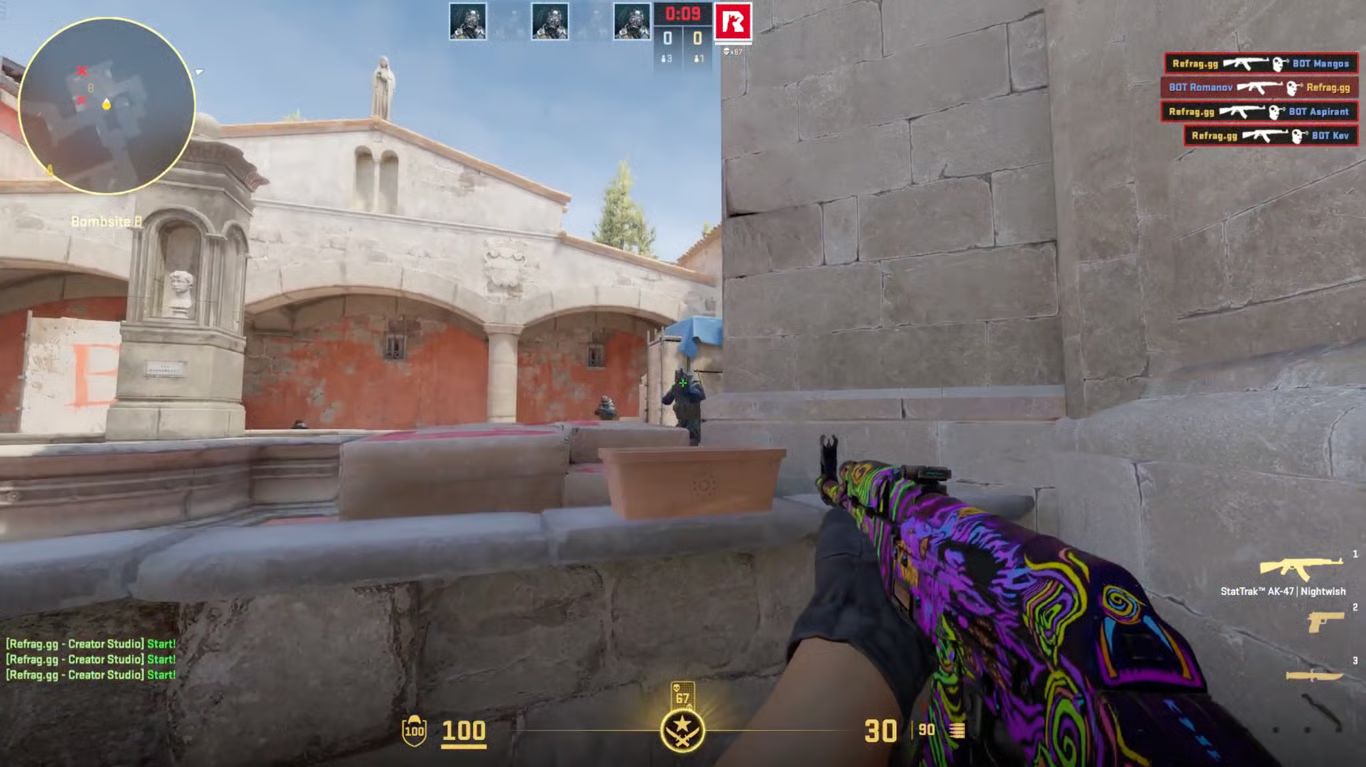
When discussing aim improvement, most intermediate players immediately gravitate toward flick shot training or raw reaction time exercises. However, the reality remains that exceptional aiming foundations originate from intelligent crosshair placement methodologies and consistent pre-aiming implementation. Crosshair placement refers to maintaining optimal aim positioning while navigating map environments. Your crosshair should consistently remain at head elevation level and directed toward probable enemy locations—corner positions, crate obstructions, entryways.
Pre-aiming, conversely, revolves around predictive positioning. It represents the skill of directing your crosshair toward specific locations before opponents become visible, based on game intelligence and cartographic knowledge. This methodology reduces dependency on extensive flick movements and enhances initial shot precision. Combined, these techniques enable high-probability engagements and domination of less-prepared adversaries.
These foundational skills may lack flashy appeal, but they constitute the bedrock of professional-level aiming capabilities. We will comprehensively explore both disciplines—providing understanding of underlying principles, implementation methodologies, and training regimens that transform crosshair placement and pre-aiming into instinctive behaviors.
Weapon Accuracy and Bullet Spread
CS2 introduces nuanced yet impactful modifications to firearm behavior compared to its predecessor. Projectile dispersion patterns, weapon precision characteristics, and initial shot accuracy have all received refinements in CS2—increasing your aiming significance substantially. Each weapon category possesses distinct spray trajectories and accuracy profiles. For primary rifles including the AK-47 and M4A4 models, the inaugural bullet typically maintains accuracy during stationary positioning. However, sustained firing increases dispersion magnitude unless compensated through meticulous spray control techniques.
During movement, even minimal displacement causes projectile deviation chaos. This is where movement mechanics like counter-strafing become critically important. A prevalent error among developing players involves attempting engagement while transitioning—resulting in missed shots despite perfect crosshair alignment. Achieving complete immobility (or rapid cessation) before initiating fire remains essential for accurate shot placement.
Close-quarters firearms and submachine guns demonstrate different behavioral characteristics—certain models maintain acceptable mobility accuracy, particularly the MP9 and MAC-10 variants. However, for rifles and sidearms, stationary precision becomes paramount. Once you comprehend your weapon’s behavioral patterns, you’ll initiate more deliberate crosshair positioning, translating to immediate eliminations rather than inconsistent misses.
Movement vs. Shooting Accuracy
CS2’s locomotion system provides zero tolerance regarding accuracy penalties. Unless completely motionless (or ideally counter-strafed), your projectiles will scatter unpredictably. Each movement step preceding engagement influences your aiming effectiveness, and understanding movement optimization represents a substantial component of developing into a precise shooter.
What constitutes counter-strafing? It represents the technique of rapidly depressing the opposing movement key (such as pressing “A” following rightward movement with “D”) to achieve immediate cessation and engage with perfect precision. Elite competitors utilize this methodology consistently during jiggle-peeking maneuvers or positional adjustments. Without counter-strafing proficiency, you’re simply firing during transition—and in CS2’s competitive environment, that equates to missed opportunities.
This principle interconnects with crosshair placement discipline. During angle verification, optimal strategy involves cessation, engagement, and re-peeking with precise timing synchronization. Superior movement enables your aiming capabilities to excel. Sloppy movement renders even flawless crosshair placement ineffective due to projectile deviation.
Recoil Patterns in CS2
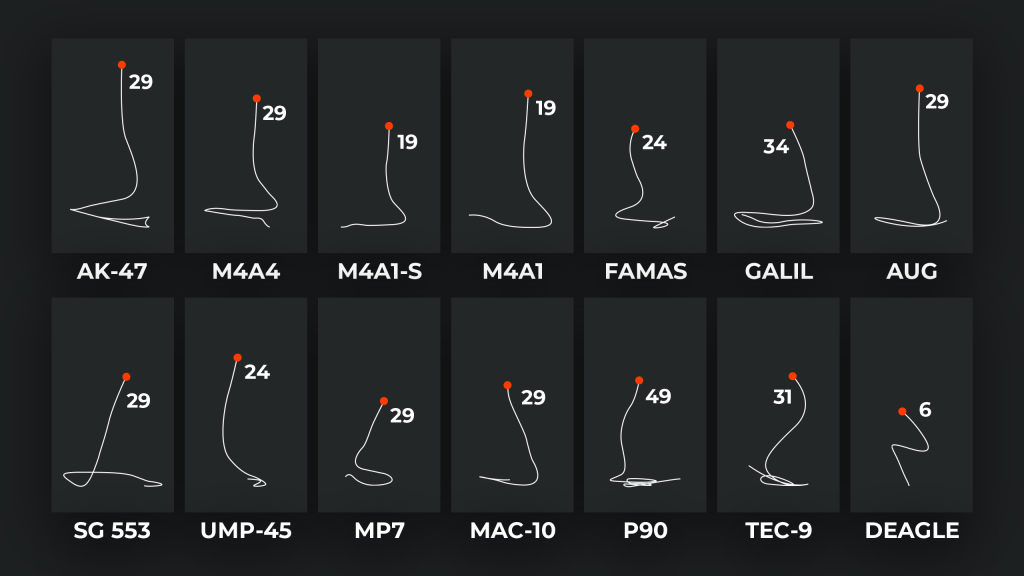
Every rifle classification within CS2 exhibits unique recoil patterns—specific trajectories that projectiles follow during sustained trigger depression. Mastering these patterns and their control methodologies represents a substantial advancement in aiming proficiency development. The AK-47 model, for example, demonstrates predictable lateral-vertical oscillation during initial projectile sequences. You can develop compensation techniques by directing your mouse in opposition to maintain shot grouping density.
However, proper crosshair placement simplifies recoil management significantly. If you maintain head-level positioning and optimal placement before opponent peeking, frequently spraying becomes unnecessary—you’ll achieve single-tap eliminations or controlled burst victories during engagements.
Some advanced techniques:
- Utilize community workshop maps including “Recoil Master” for spray control practice.
- Concentrate on bursting methodologies rather than complete spray patterns, particularly during extended-distance engagements.
- Observe professional player methodologies regarding aim resetting between bursts—they avoid panic-spraying behaviors.
Through recoil mastery combined with perfect pre-aiming techniques, you’ll transform into precision instruments with your rifle selections.
What is Crosshair Placement?
Crosshair placement represents the fundamental component of elite-level aiming proficiency. It constitutes the practice of maintaining your crosshair in optimal positioning thereby minimizing required mouse movement during opponent appearances. This means you’re aiming toward locations where adversaries most probably will materialize—typically at cranial elevation near frequent peeking locations.
Most novice competitors navigate environments with crosshair orientation toward ground surfaces or thoracic levels. This seemingly minor error becomes critical in environments where millisecond advantages determine engagement outcomes, adjusting crosshair elevation or lateral positioning to align with opponent cranial regions consumes temporal resources—and frequently, the confrontation.
Optimal crosshair placement:
- Anticipates adversary positioning before visual confirmation
- Minimizes crosshair adjustment requirements for engagement initiation
- Maintains aiming centering during angle clearance procedures
The objective involves accelerating reaction timing not through robotic transformation, but through reduced mouse movement distance requirements. If your crosshair already occupies positioning where opponents will materialize, the only remaining action involves trigger activation.
Eye Level and Common Angles
Let’s examine eye level principles. You consistently desire crosshair positioning at opponent cranial elevation. This demonstrates slight variation between cartographic environments and angular situations, but the core concept remains: if someone executes wide-swing maneuvers, your crosshair should already occupy facial positioning.
How do you determine cranial elevation? Straightforward—engage deathmatch modes and acclimate to visual indicators. Learn visual representations of “head level” near container obstructions, behind barrier elements, or within doorway structures. Additional technique? Observe professional competitors. You’ll notice they rarely adjust crosshair elevation or depression during panic scenarios—they maintain perfect pre-aiming.
Now, combine that understanding with knowledge of common angles. These represent locations players frequently occupy—such as:
- Positioned behind Double Doors on Dust2
- Close Ramp positioning on Mirage A bombsite
- Headshot container locations on Vertigo B site
If you consistently navigate with crosshair alignment toward these frequent positions, your aiming proficiency will naturally enhance. Enter bombsite environments anticipating opponent presence—because they frequently exist.
Keeping Your Crosshair Close to Enemy Models
Numerous players commit the fundamental error of centering crosshair positioning in screen center rather than placement based on cartographic geometry and adversary positioning. If your crosshair persistently “drifts” within random locations, you’ll expend valuable temporal resources readjusting during confrontation scenarios.
The core principle involves reducing “micro-adjustment” requirements. Let’s examine peeking corner scenarios. Rather than placing crosshair directly centered on wall surfaces, position it where opponent cranial regions would exist if they’re holding specific angles. This methodology is termed “cutting the pie”—a systematic approach to angle clearance through incremental crosshair movement between positions.
Some practical implementation strategies:
- During corner navigation, maintain crosshair proximity to edges. This guarantees you avoid situations where aiming positioning becomes excessively offset during opponent peeking maneuvers.
- If you’re executing bombsite entry procedures, position your crosshair toward initial probable angle—then immediately pre-aim subsequent positions.
Professional competitors including s1mple and NiKo demonstrate more than rapid aiming capabilities—they exhibit intelligent aiming proficiency. Their crosshair execution accomplishes majority of preparatory work before confrontation initiation.
What is Pre-aiming and How is it Different from Pre-firing?
Pre-aiming constitutes the practice of positioning your crosshair toward probable enemy locations before visual confirmation. Pre-firing, conversely, involves engagement initiation before visual opponent identification—typically to surprise angle-holding adversaries. While both methodologies demand game intelligence, they serve distinct tactical purposes.
Let’s examine A Short peeking scenarios on Mirage:
- Pre-aiming would involve directing your crosshair toward cranial elevation at Ticket Booth before peeking—prepared for immediate trigger activation upon opponent appearance.
- Pre-firing means you engage during peeking maneuvers, hoping to eliminate opponents maintaining angle control.
Pre-aiming demonstrates superior safety characteristics, enhanced intelligence, and improved consistency. It avoids ammunition wastage and positional disclosure. It represents the foundational component of elite aiming proficiency. Pre-firing represents more situational application—it functions when you know or strongly suspect adversary presence holding narrow angles.
Intelligent competitors depend extensively on pre-aiming methodologies and utilize pre-firing as specialized tactical instruments. It constitutes the differentiation between analytical aiming methodologies and spray-praying behaviors.
Predicting Enemy Positions Through Game Sense
Game intelligence represents the imperceptible sixth sense that elite players cultivate through extensive gameplay experience. It’s that intuitive sensation indicating, “Someone’s probably concealing behind that container,” or “He’ll execute wide-swing following this flash deployment.” When combined with pre-aiming techniques, game sense transforms into lethal tactical instruments.
So how do you develop this capability?
- Master timing sequences – Throughout every cartographic environment, consistent timing patterns exist regarding opponent arrival at specific positions. For example, during B site rushes on Inferno, counter-terrorist players might peek from CT spawn or Coffins positions following 10-second intervals. If you pre-aim these locations based on temporal understanding, you’ll frequently maintain strategic advantage.
- Analyze round progression – Consider: What utility resources have they deployed? Have I observed rotational movements? Did my teammate suffer elimination on alternative site? All these indicators assist in predicting probable adversary locations.
- Observe demonstration recordings – Reviewing personal gameplay archives or professional matches can illuminate behavioral patterns. Perhaps adversaries consistently push B applications during economic rounds. Perhaps identical individuals conceal behind Ninja positions on A site consistently.
Over temporal progression, your cognitive processes will initiate automatic connection establishment. This enables pre-aiming not simply randomly but with deliberate intention. That represents the authentic power of combining game intelligence with mechanical proficiency.
Pre-aiming Drill Techniques
If you’re committed toward improvement, you must isolate and train pre-aiming like athletic discipline. Numerous effective training methodologies exist for daily implementation toward instinctive behavior development.
Here are three high-impact pre-aiming training regimens:
- Cartographic Navigation Drills (Offline with Bot Opponents or Vacant Servers):
- Navigate through cartographic environments gradually.
- During entry into each novel area, position your crosshair precisely where cranial regions might materialize.
- Execute this methodology while transitioning at walking velocity to simulate authentic match conditions.
- Repetition until comprehensive coverage of every frequent angle within sequential order.
- Angle Training within Yprac Maps:
- Utilize maps including “Yprac Mirage A” or “Yprac Dust2 Mid.”
- Select “peek scenario” configurations and practice aiming toward bot opponents positioned within authentic adversary locations.
- The cartographic environment will even provide scoring metrics based on pre-aiming accuracy.
- Pre-aiming Challenge Routines:
- Establish objectives: achieve 20 precise headshot eliminations with minimal crosshair adjustment per cartographic environment.
- Concentrate on reduction of flicking or adjustment requirements—target zero movement between visual opponent identification and engagement initiation.
Through systematic repetition of these training methodologies, your cognitive processes construct libraries of pre-aiming positions. Eventually, it transforms into instinctive behavior to direct your crosshair toward optimal positioning during entry into novel areas.
Syncing Movement and Aim
One of the most significant secrets to elite-level aiming proficiency involves movement synchronization with crosshair placement. This means your physical movement and cognitive aiming processes cooperate—fluidly, confidently, and efficiently. Without this synergistic relationship, you’ll encounter missed straightforward engagements, panic during confrontations, or persistent over-correction behaviors.
Optimal synchronization manifests within practical scenarios:
- Peeking with deliberate intention: You avoid simple wide-swing corner navigation—you peek understanding your crosshair already occupies positioning where adversaries might materialize.
- Counter-strafing through instinctive execution: Immediately following movement cessation, you’re prepared for engagement initiation with complete precision. Zero delay, zero hesitation.
- Smooth transitional movements between angles: During angle clearance procedures, your crosshair transitions in harmony with your movement—never erratic, never delayed.
Most competitors either demonstrate excessive movement dependency (jiggle peeking erratically without aiming control) or maintain stationary positioning while aiming (transforming into easily eliminatable targets). The optimal balance? A controlled interaction between movement mechanics and precise crosshair placement.
Here’s a practical training methodology:
- Enter aim training environments.
- Practice lateral strafing maneuvers, achieving immediate cessation, and positioning your crosshair precisely where adversaries might appear.
- Avoid engagement initiation. Simply position and transition.
- Then, initiate engagement sequences when synchronization rhythm manifests.
This methodology constructs the muscle memory requirements for lethal performance under pressure conditions.
How to Clear Angles Efficiently
Angle clearance represents an essential competency within CS2’s competitive environment. Executed correctly, it minimizes risk exposure and maximizes engagement victory probabilities. Executed incorrectly, it represents formulaic preparation for immediate elimination.
Here’s the methodology for efficient execution:
- Single angle sequential clearance – Never execute “lazy clearance” of multiple angles simultaneously. You’re not executing Rambo-style maneuvers. Allocate temporal resources, isolate threats, and only expose positioning toward singular potential adversaries simultaneously.
- Execute pie-cutting methodologies – This represents a systematic approach to angle segmentation during transitional movement. Imagine bombsite clearance procedures resembling pie segmentation—each segment represents different potential adversary locations. Transition your crosshair and physical orientation incrementally during verification of each segment.
- Cranial elevation pre-aiming techniques – During each procedural step, position your crosshair before peeking execution. If adversary presence exists, the only remaining requirement involves trigger activation. Zero flicking requirements. Zero panic behaviors.
- Avoid excessive swing execution – During corner clearance procedures, particularly narrow configurations, utilize shoulder peeking or rapid jiggle maneuvers to bait engagement initiation. Then re-peek with confidence.
Professional technique: Observe how elite competitors execute bombsite clearance within demonstration recordings. Every movement demonstrates deliberate intention. Every pre-aiming execution demonstrates laser-focused precision. They rarely encounter surprise scenarios—because they’re clearing with deliberate purpose.
Real Match Scenarios Where Both Are Crucial
Let’s examine several scenarios where crosshair placement and pre-aiming combination secures round victories:
Scenario 1: Dust2 A Long Entry Procedures
- You’re executing terrorist-side A Long advancement.
- During blue container clearance, you pre-aim corner positioning at cranial elevation.
During corner transition, you execute slight adjustment for pit positioning, then for car location.
- Instantaneous—adversary peeks from car positioning. You avoid flicking execution. You simply activate trigger. Elimination.
Scenario 2: Inferno Banana Control (Counter-Terrorist Side)
- You’re maintaining Banana control with M4 configuration.
- You understand terrorist players prefer peeking from log obstructions or wide-swing sandbag locations.
- You position your crosshair toward initial log peeking position, then execute slight rightward adjustment.
- Adversary executes jiggle peek. Your aiming positioning already occupies optimal location—instantaneous headshot elimination.
Scenario 3: Mirage B Site Retake Execution
- You’re executing catwalk rotation toward B site assistance.
- During market transition, you pre-aim bench positioning, then van location, then default configuration.
- Adversary executes wide-swing from van—but your crosshair already occupied halfway positioning.
- You execute adjustment, trigger activation, and cleanup procedures.
Throughout these scenario examinations, the determining factor isn’t simply aiming proficiency that secures victory. It’s intelligent aiming—powered by proficient crosshair placement and robust pre-aiming behavioral patterns.
Understanding Head Level Positioning
Proper crosshair placement begins with consistent head-level positioning across all maps and angles. The fundamental principle is simple: your crosshair should always be positioned where an enemy’s head would appear if they were holding that position. Many intermediate players struggle because they understand the concept but fail to apply it consistently across different elevations and map geometries.
To master head level, you need to develop spatial awareness of character models relative to your viewpoint. This varies significantly between positions like standing behind boxes versus crouching behind lower cover. The key distinction between average and elite players lies in their ability to maintain perfect head height even when transitioning between different elevations and angles.
Critical mistake: Players often drop their crosshair when moving between areas with different floor heights. Always compensate for elevation changes by adjusting your crosshair height accordingly.
Common Angle Recognition and Positioning
Strategic crosshair placement requires intimate knowledge of common holding positions on each map. These aren’t random spots but statistically proven angles that provide cover and visibility advantages.
Essential common angles to master:
- Double Doors peek spots on Dust2
- Ramp control positions on Mirage A site
- Headshot boxes and elevated platforms on Vertigo
- Banana control points on Inferno
- Mid connector angles on Overpass
When you systematically align your crosshair with these high-probability positions, your reaction time decreases dramatically. Approach every entry with the expectation of contact—statistically, you’ll be correct more often than not.
Reducing Micro-Adjustments Through Smart Placement
A common tactical error involves centering the crosshair in screen middle rather than positioning it based on anticipated enemy locations. When your aim drifts randomly across open spaces, you sacrifice critical milliseconds during engagements that often determine the outcome.
The strategic objective is minimizing the distance your mouse must travel to acquire targets. Consider this: if your crosshair is already positioned where the enemy will appear, your only required action is clicking the mouse button.
Advanced technique: Implement the “cutting the pie” methodology—this involves clearing angles incrementally by exposing minimal body width while maintaining crosshair alignment with potential threat positions.
Practical implementation strategies:
- While navigating corners, maintain crosshair proximity to edges. This prevents situations where opponents catch you with misaligned aim during peeks.
When entering bomb sites, systematically transition your crosshair between multiple likely angles rather than fixating on single positions.
Elite competitors like s1mple and NiKo demonstrate that superior aim stems from intelligent positioning rather than pure reflex speed.
Pre-Aiming as Strategic Prediction
Pre-aiming represents the highest level of tactical foresight in CS2. This skill involves positioning your crosshair at anticipated enemy locations before visual confirmation. The distinction between pre-aiming and pre-firing is crucial: pre-aiming prepares you for engagement while pre-firing commits to action without confirmation.
Consider this tactical comparison:
- Pre-aiming: Crosshair placement at expected positions before peeking
- Pre-firing: Shooting at suspected positions during the peek itself
Pre-aiming provides superior consistency and ammo conservation while pre-firing serves situational purposes when intelligence confirms enemy presence.
Strategic pre-aiming scenarios:
- A Long approach on Dust2: pre-aim car, then corner, then pit positions
- Inferno Banana control: systematically pre-aim logs, sandbags, and coffin angles
- Mirage B apps entry: sequence through van, bench, and default plant spots
The core principle: transition from reactive to predictive aiming. This fundamental shift reduces flick requirements by approximately 70-80% in standard engagement scenarios.
Game Sense Integration for Enhanced Prediction
Advanced pre-aiming integrates deeply with game sense development. This involves understanding enemy tendencies, rotation patterns, and economic-based positioning decisions.
Building predictive capabilities:
- Master timing windows – Different maps have established timing benchmarks for when opponents reach specific positions. For instance, CTs rotating from A to B on Inferno typically arrive within specific time frames based on spawn positions.
Round analysis methodology:
- Analyze utility usage patterns to predict executes
- Track teammate deaths and information to anticipate rotations
Progression pathway: Begin with basic angle memorization, advance to timing-based predictions, then master full round context integration.
Audio cue utilization: CS2’s enhanced sound engine provides critical information for pre-aim positioning:
- Footstep audio reveals approaching enemies 2-3 seconds before visual contact
- Weapon and utility sounds indicate specific player actions and positions
Advanced Pre-Aiming Drill Systems
Structured practice regimens accelerate pre-aiming skill development. Implement these three drill categories systematically:
- Map Navigation Exercises (Offline Practice)
- Methodical site clearing with focus on angle sequence
- Timing-based prediction drills using Yprac scenario trainers
- Challenge-based routines focusing on minimal adjustment requirements
Systematic repetition builds neural pathways that transform conscious pre-aiming into subconscious positioning.
For comprehensive weapon mastery strategies, explore our detailed Weapons Unlock Guide which provides detailed progression systems for mechanical skill development.
Movement and Aim Synchronization
Elite-level aim emerges from perfect harmony between movement mechanics and crosshair positioning. This integration separates professional players from skilled amateurs.
Integration characteristics:
- Purposeful peeking: Every movement serves specific tactical purpose with corresponding crosshair alignment.
Counter-strafing integration: The moment you achieve stationary position, your crosshair should already be positioned at optimal engagement locations.
Practical integration drill:
- Practice strafe-stop-aim sequences in training maps
- Focus on fluid transitions between angles without aim disruption
Efficient Angle Clearing Methodology
Systematic angle clearing minimizes exposure while maximizing kill potential. Implement this four-phase approach:
- Systematic threat isolation – Never attempt to clear multiple angles simultaneously. This fundamental error increases vulnerability to multiple opponents.
Advanced clearing technique: The “cutting the pie” method involves exposing minimal body width while systematically checking each potential threat position.
Pro insight: Analyze professional demos to observe how elite players clear sites with deliberate precision and minimal risk exposure.
For comprehensive class selection strategies that complement your aiming development, check out our Class Guide which provides detailed role-specific positioning strategies.
Real Match Scenario Applications
Let’s examine critical in-game situations where integrated crosshair placement and pre-aiming determine round outcomes:
Scenario Analysis: Dust2 A Site Execute
- T-side Long push execution
- Systematic clearing: blue container → corner → pit positions
- Outcome: Enemy appears from expected position, requiring only mouse click response
Inferno Banana Defense (CT Perspective)
- Anticipate T-side peeks from logs and sandbag positions
Common integration error: Players successfully pre-aim first angle but fail to transition to secondary threat positions
- Systematic threat isolation – Never attempt to clear multiple angles simultaneously. This fundamental error increases vulnerability to multiple opponents.
For players seeking complete gameplay improvement systems, our Complete Guide provides additional context for integrating aiming skills with broader tactical understanding.
In all engagement scenarios, victory stems from intelligent aim preparation rather than reactive shooting mechanics.
Counter-Strike 2 elevates competitive FPS gameplay with Source 2 engine enhancements that demand superior mechanical skill. The game’s refined hit registration and visual clarity make precise aiming non-negotiable for ranking up. Whether holding angles as CT or executing site takes as T, your ability to land accurate shots determines round impact.
Unlike ability-driven shooters, CS2 remains fundamentally about crosshair discipline, predictive aiming, and controlled flicks. True aiming excellence combines anticipation, positioning, and crosshair alignment where enemy heads will appear.
Mastering CS2’s aiming mechanics creates a cascade effect throughout your gameplay. Confident aim reduces exposure time, wins crucial fights, and transforms impossible clutches into routine victories.
Weapon Accuracy and Movement Penalties
CS2 introduces nuanced weapon behavior changes from CS:GO. Bullet spread, first-shot precision, and accuracy profiles are all tightened significantly.
Rifles like the AK-47 and M4A4 offer perfect first-shot accuracy when stationary. However, sustained firing increases spread dramatically without proper spray control.
The critical mistake most newcomers commit involves shooting while moving. Even minimal movement causes bullet deviation, regardless of crosshair placement. Mastering counter-strafing becomes essential for eliminating movement-based inaccuracy.
Recoil Control Fundamentals
Every rifle in CS2 follows distinct recoil patterns when firing continuously. The AK-47 demonstrates predictable left-right-upward motion across its initial 10 rounds. Learning to counteract these movements through mouse control separates average players from elites.
However, exceptional crosshair placement minimizes reliance on spray control. When your crosshair already aligns with enemy head positions before engagements, single taps or controlled bursts often secure kills cleanly.
Essential recoil management techniques:
- Utilize workshop maps like “Recoil Master” for dedicated spray training
- Prioritize bursting over full spraying, particularly at longer distances
- Observe how professional gamers reset their aim between bursts
Combining recoil mastery with predictive pre-aiming transforms you into a laser-accurate threat.
Crosshair discipline forms the cornerstone of professional-level aiming. This skill involves maintaining your crosshair in optimal positioning so minimal mouse adjustment is required when enemies appear.
Most inexperienced players navigate maps with crosshairs positioned toward the ground or torso level. This seemingly minor error proves costly in milliseconds-critical engagements where upward crosshair movement determines fight outcomes.
Effective crosshair placement delivers three critical advantages:
- Predicts opponent locations before visual confirmation
- Reduces necessary mouse movement to acquire targets
- Maintains aim centering while systematically clearing angles
The objective isn’t becoming faster through robotic reflexes but reducing the distance your mouse must travel. When your crosshair already occupies the space where enemies will materialize, clicking becomes your only required action.
Head Level Positioning
Understanding head level proves fundamental. Your crosshair should consistently align with potential enemy head height. This positioning varies slightly across different maps and angles, but the core principle remains consistent: if an opponent swings into view, your crosshair should already cover their facial area.
How do you identify correct head height? Participate in deathmatch sessions to internalize visual reference points. Observe professional gamers’ crosshair behavior – they rarely panic-adjust vertically because their initial positioning already achieves perfection.
Now complement this awareness with recognizing common angles. These represent locations players frequently occupy for holding positions.
Common Angle Recognition
Strategic crosshair placement requires anticipating where opponents likely position themselves. Common holding spots include:
- Behind Double Doors on Dust2
- Close Ramp on Mirage A site
- Headshot box on Vertigo B
When you consistently navigate maps with crosshair alignment toward these frequent positions, your aiming proficiency naturally escalates. Approach every bombsite expecting opposition – because statistically, they’re often present.
Pre-aiming represents one of the most powerful habits competitive CS2 players cultivate. This practice involves positioning your crosshair precisely where adversaries will likely appear – before visual confirmation occurs.
Let’s examine practical applications:
- When advancing through A Long on Dust2, pre-aim the vehicle position.
The essential principle involves avoiding reactive responses to on-screen developments. Instead, guide your crosshair based on predictive expectations. This approach dramatically decreases necessary flick time while substantially improving first-shot connection probability.
Here’s a straightforward pre-aim exercise:
- Load into offline match with bots enabled
- Progress through bombsite areas methodically
- Pause and align crosshair with probable enemy locations
- Repeat this process until it transforms into muscular memory
Elite competitors consistently employ this methodology. They avoid random environmental scanning – instead pre-aiming multiple positions while clearing areas before opponents materialize.
Game Sense Integration
Game awareness functions as the invisible sixth sense top performers develop across thousands of gameplay hours. When integrated with pre-aiming, game sense evolves into a devastating competitive tool.
So how do you develop this capability?
- Master timings – Each map contains common timing windows for enemy arrivals at specific locations. For instance, when rushing B on Inferno, CT players might peek from CT spawn or Coffins approximately 10 seconds after round commencement. When you pre-aim these positions according to timing knowledge, you frequently gain tactical advantage.
- Analyze round developments – Consider: What utility have they deployed? Have I observed rotation patterns? Did teammates perish on alternative sites? These contextual clues facilitate predicting likely opponent positioning.
- Analyze match recordings – Reviewing personal replays or professional competitions can reveal behavioral patterns. Perhaps opponents consistently push B applications during economic rounds. Perhaps identical individuals conceal themselves behind Ninja on A site repeatedly.
Gradually, your cognitive processing begins connecting these informational dots autonomously. This enables you to pre-aim not randomly but with deliberate intentionality. That represents the authentic potency of merging game sense with mechanical skills.
Audio Cue Utilization
Sound constitutes a massive component of game awareness. CS2’s upgraded audio engine renders footsteps, reloading sounds, scope activations, and utility deployment more immersive – and strategically exploitable.
Critical audio indicators to master:
- Footstep patterns – Enable tracking opponent movement through solid structures
- Utility deployment sounds – Identify when opponents prepare executes
- Scope engagement audio – AWP or Scout users frequently reveal positioning through these cues
- Bomb planting and defusal – Time your peeks accordingly
Integrating auditory cues with crosshair discipline produces lethal outcomes. When you detect adversaries approaching Banana, avoid panic reactions – simply position your crosshair and await. Permit them to advance into your pre-established aiming zones.
For dedicated improvement, isolate and practice pre-aiming as a targeted training objective. Numerous impactful exercises exist for daily implementation to establish habitual proficiency.
Here are three high-impact pre-aiming drils:
- Map Navigation Drills (Offline with Bots or Empty Server):
- Progress through maps deliberately
- When entering unfamiliar zones, position crosshair precisely where enemy heads might materialize
- Execute these movements while maintaining walking velocity to replicate authentic match conditions
- Repeat until covering every conventional angle sequentially
- Angle Practice using Yprac Maps:
- Utilize maps such as “Yprac Mirage A” or “Yprac Dust2 Mid.”
- Choose the “peek scenario” option and train aiming against bots situated in realistic opponent positions
- The training environment will even evaluate performance according to pre-aim precision
- Pre-aim Challenge Exercises:
- Establish objectives: achieve 20 clean headshots with minimal crosshair recalibration per map
- Concentrate on diminishing flick frequency and adjustment magnitude—target absolute zero movement between target identification and engagement
Through consistent repetition, your neurological system constructs an extensive library of pre-aim positions. Ultimately, this process transforms into instinctive behavior to guide your crosshair toward optimal positioning when exploring unfamiliar territories.
Movement Synchronization
Among the most significant secrets to elite-level aiming involves synchronizing your physical movement with crosshair positioning. This signifies your physical navigation and cognitive aiming processes operating cohesively—fluently, confidently, and efficiently. Without this harmonious integration, you’ll discover yourself missing straightforward shots, experiencing anxiety during engagements, or perpetually over-compensating.
What synchronization manifests as during practical application:
- Purposeful peeking: You avoid indiscriminate wide-swinging around corners—instead peeking with certainty your crosshair already targets where opponents might exist.
Most competitors either excessively depend on movement (erratic jiggle peeking without aiming control) or remain stationary while aiming (becoming vulnerable targets). The optimal balance? A regulated interplay between navigation and pinpoint crosshair placement.
Here’s an effective training exercise:
- Enter an aiming practice environment
- Practice strafing laterally, halting instantaneously, and positioning your crosshair exactly where adversaries might materialize.
- Avoid shooting. Simply position and navigate.
- Subsequently, commence engaging targets when experiencing rhythmic synchronization.
This methodology builds the muscular memory essential for lethal performance under pressure.
Your crosshair functions as your directional compass. It guides every engagement attempt. If it proves excessively distracting, insufficiently visible, or blends into environmental backgrounds, you’re already creating competitive disadvantages.
Settings Configuration
In CS2, you maintain comprehensive control over crosshair configuration—shape, coloration, spacing, thickness, outlining, and even dynamic behavioral characteristics. Selecting appropriate configurations can substantially enhance aiming capability through improved visibility and concentration.
No universal solution exists, but these considerations prove valuable:
- Simplicity proves paramount – Avoid dense outlines or flamboyant styles. You desire minimalistic, static crosshairs that avoid screen clutter.
For novice players, static crosshairs with minimal spacing and sufficiently thick lines for accurate tracking represents an excellent starting point.
Common Mistake Identification
These represent two of the most prevalent aiming errors. You either flick excessively beyond opponents (over-flick), or insufficiently distant (under-flick). Both scenarios cost you engagements that should have resulted in straightforward victories.
Why do these issues occur?
- Over-flicking typically results from elevated sensitivity settings or panicked navigation.
Corrective strategies:
- Reduce sensitivity parameters to manageable levels (most professionals utilize between 1.5–2.5 at 400 DPI).
Train deliberate flicks within aiming practice environments. Concentrate on precision rather than velocity.
Enhance pre-aiming proficiency to minimize flicking necessity entirely.
Aiming excellence transcends mere speed—it’s fundamentally about control. Superior performance emerges from methodical accuracy rather than frantic wildness.
Consistency Building Through Repetition
Consistency in aiming resembles dental hygiene maintenance. It’s monotonous, daily, and absolutely indispensable.
Even veteran competitors develop detrimental aiming habits over extended periods:
- Hastily navigating corners without pre-aiming preparation
- Excessively wide swinging with inadequate crosshair alignment
- Excessive dependence on spraying rather than precision tapping
- Becoming complacent regarding warm-up routines
The resolution? Conduct self-assessment procedures. Review personal gameplay recordings. Document competitive sessions. Inquire: “Was my crosshair positioned where strategic necessity dictated?” This singular question can elevate your gameplay proficiency exponentially.
For comprehensive mastery of CS2 mechanics, explore our Class Guide for additional strategic insights.
Counter-Strike 2 represents a significant evolution in competitive shooting mechanics, delivering enhanced visual clarity and refined hit detection through the Source 2 engine. These technical improvements have elevated the importance of mechanical aiming precision to unprecedented levels. In the current CS2 meta, raw aiming capability frequently determines whether players ascend through the ranks or remain trapped in lower divisions. Your capacity to execute precise shots while entering bomb sites or holding defensive angles directly influences your round-to-round impact and overall match performance.
Unlike contemporary shooters that incorporate ability-based systems or gadget dependencies, CS2 maintains its traditional foundation—where crosshair positioning, predictive aiming, and crisp flick shots dictate engagement outcomes. Superior aiming transcends simple reaction speed—it encompasses strategic anticipation, optimal positioning, and maintaining your crosshair precisely where opponents’ heads will materialize. Enhanced aiming proficiency translates to increased confidence during duels, improved kill-to-death ratios, and accelerated ranking progression.
As your aiming skills develop, every other gameplay component—movement mechanics, utility deployment, and tactical positioning—begins to synchronize harmoniously. The underlying principle? Exceptional aiming creates temporal advantages. It minimizes your exposure duration, secures victorious engagements, and transforms seemingly impossible clutch situations into achievable victories. The fundamental conclusion: if rapid improvement in CS2 is your objective, aiming enhancement must become your primary focus area.
Weapon Accuracy and Bullet Spread Dynamics
CS2 introduces nuanced yet impactful modifications to firearm behavior compared to its predecessor. Projectile dispersion, weapon consistency, and initial shot precision have all received tightened calibration—making your crosshair control substantially more consequential. Each weapon category possesses distinct spray characteristics and accuracy profiles. For primary rifles such as the AK-47 or M4A4, the inaugural bullet typically achieves pinpoint accuracy when stationary. However, sustained firing progressively widens the spread pattern unless countered with deliberate spray management techniques.
If you’re in motion, even minimally, your projectiles will deviate erratically. This is where movement mechanics like counter-strafing become critically important. A prevalent error among developing players involves attempting to engage targets while moving—resulting in missed shots despite perfect crosshair alignment. Achieving complete stillness (or executing rapid stops) before initiating fire remains essential for consistent shot placement.
Shotguns and submachine guns demonstrate different behavioral patterns—certain models maintain reasonable moving accuracy, particularly the MP9 or MAC-10 platforms. However, for rifles and secondary weapons, stationary firing precision is paramount. Once you comprehend your selected weapon’s operational characteristics, you’ll naturally begin positioning your crosshair with greater intentionality, translating to immediate eliminations instead of random misses.
Movement Mechanics and Shooting Accuracy Integration
CS2’s locomotion framework remains uncompromising regarding accuracy penalties. If you haven’t achieved complete immobility (or executed flawless counter-strafes), your bullets will scatter unpredictably. Every movement input preceding your shot execution directly influences your aiming consistency. Understanding how to leverage movement to your strategic advantage constitutes a substantial component of evolving into a precise shooter.
What constitutes counter-strafing? It’s the technique of rapidly tapping the opposing movement key (such as pressing “A” after rightward movement with “D”) to achieve instantaneous cessation and engage with perfect accuracy. Elite competitors employ this methodology consistently during jiggle-peeking maneuvers or tactical repositioning. Without proficient counter-strafing execution, you’re essentially firing during movement—and in CS2’s competitive environment, this equates to consistent misses.
This principle also interconnects with crosshair placement discipline. During angle verification sequences, your objective involves stopping, engaging, and re-peeking with optimal timing. Refined movement enables your aiming capabilities to excel. Sloppy movement mechanics render even impeccable crosshair positioning ineffective due to projectile deviation.
Recoil Pattern Mastery in CS2
Every rifle platform within CS2 possesses unique recoil characteristics—a specific trajectory that your projectiles follow during sustained trigger depression. Mastering these patterns and developing compensation techniques represents a substantial advancement in aiming improvement. The AK-47, for example, demonstrates a predictable left-right-upward motion throughout the initial 10-round sequence. You can systematically “learn” to execute opposing mouse movements maintaining shot group tightness.
However, strategic crosshair placement significantly simplifies recoil management. If you’re maintaining head-level targeting and optimal positioning before enemy engagement, you frequently won’t require extended spray control—achieving single-tap eliminations or controlled burst victories during engagements.
Essential implementation strategies:
- Utilize community workshop maps like “Recoil Master” to practice systematic spray control.
- Concentrate on burst firing methodologies rather than full-auto spraying, particularly during extended-range engagements.
- Observe how professional competitors reset their targeting between burst sequences—they maintain composure during high-pressure situations.
Through comprehensive recoil mastery combined with flawless pre-aiming execution, you’ll evolve into a laser-accurate rifle operator.
Head Level Precision and Common Angle Targeting
Let’s examine head-level positioning fundamentals. You consistently want your crosshair positioned at the vertical height of opponents’ cranial regions. This exhibits slight variation across different maps and engagement angles, but the core principle remains consistent: if an adversary executes a wide-peek maneuver, your targeting reticle should already be aligned with their facial region.
How do you determine head-height positioning? Straightforward—engage in deathmatch sessions and develop familiarity with visual indicators. Learn what “head level” visually represents near environmental objects, behind obstructions, or within doorway transitions. An additional technique? Observe professional competitors. You’ll notice they infrequently adjust their crosshair vertically during high-stress situations—they’ve already established perfect alignment.
Now, integrate that knowledge with understanding common engagement angles. These represent locations players routinely utilize for defensive positioning—such as:
- Behind Double Doors positioning on Dust2
- Close Ramp defensive spots on Mirage A bombsite
- Headshot box defensive locations on Vertigo B area
If you consistently maneuver your crosshair in alignment with these frequented positions, your aiming proficiency will naturally enhance. Approach bombsite entries anticipating opponent presence—because they frequently materialize there.
Proactive Crosshair Positioning Relative to Enemy Models
Numerous players commit the fundamental error of centering their crosshair in the screen center rather than positioning it based on environmental geometry and anticipated adversary locations. If your targeting reticle persistently “drifts” within arbitrary screen regions, you’ll sacrifice critical reaction time during engagements.
The conceptual framework here involves minimizing “micro-adjustment requirements.” Imagine you’re preparing to peek a corner. Instead of positioning your crosshair directly centered on the wall surface, place it where an opponent’s cranial region would position if they’re maintaining that angle. This methodology is designated “cutting the pie”—a systematic methodology for angle clearance through incremental crosshair movement from one potential engagement zone to subsequent positions.
Practical implementation recommendations:
- During corner navigation sequences, maintain your crosshair proximity to the edge. This guarantees you’re not discovered with your targeting substantially misaligned when adversaries engage.
- When executing bombsite entries, position your crosshair on the primary anticipated angle—then immediately transition to predictive aiming of subsequent positions.
Professional competitors like s1mple or NiKo don’t merely possess rapid aiming capabilities—they demonstrate intelligent targeting proficiency. Their crosshair accomplishes the majority of preparatory work before engagements even initiate.
Map Knowledge Integration for Enhanced Crosshair Positioning
Crosshair placement directly correlates with your comprehension level of each competitive environment. The more gameplay experience you accumulate, the more you’ll recognize behavioral tendencies—where players prefer to conceal themselves, execute peek maneuvers, and execute rotational movements. Once you initiate learning these behavioral patterns, you’ll naturally position your crosshair within superior engagement zones.
Illustrative examples:
- On Overpass, you recognize players frequently engage from Party area or Truck positioning.
If you’re preparing to peek a specific area and remain uncertain where to direct attention, this indicates your crosshair positioning requires adjustment. Observing professional matches or analyzing your personal gameplay recordings provides substantial benefits. Pose this question to yourself: from which positions did I most frequently receive elimination? Now initiate systematic pre-aiming of that location during every engagement sequence.
An effective training exercise:
- Access the map environment in offline training mode.
- Navigate through every critical choke point.
- Ask: “If I were defending this position, where would I position myself?”
- Position your crosshair accordingly and repeat systematically.
With accumulated experience, your cognitive processes begin to predict adversary positions, and your aiming execution becomes increasingly effortless.
Advanced Pre-aiming Techniques and Common Angle Prediction
Pre-aiming represents one of the most potent habitual developments you can cultivate as a CS2 competitor. It constitutes the practice of positioning your crosshair precisely where opponents are statistically likely to position—before visual confirmation occurs. This methodology synergizes perfectly with comprehensive map knowledge, and it’s what distinguishes competent aimers from devastatingly efficient eliminators.
Let’s deconstruct the methodology:
- During A Long approach sequences on Dust2, you might pre-aim the vehicle positioning.
During Inferno Banana advancement, you’d pre-aim log positions or sandbag defensive spots.
- Within Mirage B apartments navigation, you’d pre-aim van or bench positions before executing full peek maneuvers.
The critical principle: avoid waiting to react to screen developments. Instead, execute crosshair movement based on predictive expectation. This substantially reduces the temporal requirement for flick shot execution, and it significantly amplifies your probability of securing the inaugural shot elimination.
Here’s a fundamental pre-aiming training sequence:
- Initialize an offline training session with bot opponents.
- Navigate through bombsite environments methodically.
- Execute cessation and position your crosshair where you anticipate adversaries might position.
- Repeat systematically until the methodology becomes ingrained muscular memory.
Professional competitors implement this methodology consistently. They avoid random environmental scanning—they systematically pre-aim 3-4 positions during area clearance sequences, before opponent visual materialization.
Predictive Enemy Positioning Through Advanced Game Sense
Game sense constitutes the intangible sixth perceptual capability that elite players develop throughout thousands of gameplay hours. It’s that intuitive perception indicating, “An adversary is probably concealing themselves behind that container,” or “They’ll execute wide-swing maneuvers following my flash deployment.” When integrated with systematic pre-aiming execution, game sense evolves into a lethal tactical instrument.
So how do you systematically develop this capability?
- Timing comprehension mastery – Throughout every competitive environment, established temporal patterns exist regarding when opponents might reach specific map positions. For instance, if you execute a rapid B site push on Inferno, a Counter-Terrorist might engage from CT spawn positioning or Coffins defensive spots following 10-second intervals. If you pre-aim these locations based on temporal awareness, you’ll frequently maintain tactical advantage.
- Round progression analysis – Consider: What utility resources have they deployed? Have I observed any rotational movements? Did my team member suffer elimination on the alternative bombsite? All these informational indicators assist your predictive assessment of probable adversary locations.
- Gameplay recording observation – Analyzing your personal match replays or studying professional competitions can reveal behavioral patterns. Perhaps opponents consistently execute B apartments pushes during economic rounds. Perhaps the identical competitor conceals themselves behind Ninja positioning on A bombsite during every engagement sequence.
Over temporal progression, your cognitive processes will automatically begin connecting these informational nodes. This enables you to pre-aim not arbitrarily but with strategic purpose. That represents the authentic power of integrating game sense with mechanical proficiency.
Strategic Crosshair Style Selection
Your targeting reticle functions as your navigational compass throughout every engagement. It provides directional guidance for each projectile you discharge. If it proves excessively distracting, insufficiently visible, or blends into environmental backgrounds, you’re already imposing competitive disadvantages. Within CS2’s framework, you maintain comprehensive control over your crosshair configuration—geometric shape, chromatic selection, central gap dimensions, line thickness parameters, outline characteristics, and even dynamic behavioral responses. Selecting the optimal configuration can substantially enhance your aiming proficiency through improved visual clarity and concentration optimization.
No universal configuration exists that accommodates every player’s requirements, but here are essential consideration factors:
- Minimalistic design superiority – Evade thick outlines or visually distracting stylistic elements. You require a streamlined, static crosshair configuration that doesn’t congest your visual interface.
- Chromatic contrast optimization – Employ colors that maintain visibility across all map environments (cyan variants, magenta selections, vibrant green options). Avoid white or red chromatic choices as they frequently blend into environmental elements.
- Dimensional proportionality and gap calibration – Ensure your crosshair dimensions don’t obstruct cranial targeting, nor diminish visibility during intensive engagements.
For developing players, a static crosshair configuration featuring minimal central gap dimensions and adequately thick line characteristics for tracking precision represents an excellent foundational configuration. Test configurations within deathmatch environments to evaluate tactile responsiveness. If you’re consistently losing crosshair tracking during engagements, it’s time for configuration adjustments.
Dynamic versus Static Crosshair Behavioral Analysis
Dynamic crosshair configurations expand during movement sequences or shooting engagements, while static variants maintain dimensional consistency regardless of activity status. Each configuration category presents advantages and limitations.
- Static Crosshair Configurations:
- Advantages: Enhanced visual cleanliness, consistent positioning, minimal distraction potential
- Disadvantages: Absence of accuracy feedback during movement sequences
- Optimal utilization: Competitors who already comprehend how CS2 movement mechanics influence shooting precision
- Dynamic Crosshair Configurations:
- Advantages: Demonstrates inaccuracy indicators, beneficial for learning movement-based inaccuracy patterns
- Disadvantages: Potentially distracting, can demonstrate operational clunkiness
- Optimal utilization: Developing players seeking visual feedback mechanisms
The predominant majority of professional competitors utilize static crosshair configurations. Once you’ve internalized movement mechanics and shooting accuracy principles, a static crosshair configuration becomes operationally superior—reduced distractions, enhanced muscular memory development, and simplified pre-aiming execution.
If you’re initiating your competitive journey, experiment with dynamic configurations initially to establish awareness—then transition to static configurations as your proficiency progresses.
Professional Player Crosshair Configuration Codes for Implementation
Here are several popular professional competitor crosshair configurations you can immediately implement within CS2. Simply duplicate the configuration code and insert it into your settings interface to immediately load their crosshair configuration.
Professional Competitor Crosshair Configuration Code s1mple CSGO-PjZ69-KdKxv-CzQDo-HWzvX-oxZPONiKo CSGO-oKbbm-szKZb-2Nds3-v5rXf-73bWNZywOo CSGO-Tpfn3-WpZsF-yzXCo-UGJkM-QxDHBropz CSGO-FtuKX-NcpwP-XBuJG-FW7OA-qF9mOm0NESY CSGO-D4PLZ-3yRHP-kSoct-p8S6f-HpYtAExperiment with each configuration across several matches and evaluate tactile responsiveness. Adjust dimensional parameters, chromatic selections, or thickness characteristics according to personal preference. Ultimately, you’ll develop your distinctive signature crosshair configuration—engineered specifically for your visual perception, your aiming style, and your competitive approach.
Essential Aim Training Environments within CS2
Aim training environments represent one of the most rapid methodologies for refining mechanical capabilities. The CS2 workshop ecosystem contains exceptional training tools specifically designed to enhance your flick shot precision, spray control consistency, and crosshair placement discipline.
Critical training environment selections:
- Aim Botz Training Environment – The established industry standard. Bot opponents surround your positioning within circular formations. Excellent for rapid flick shot warm-up sequences and headshot-focused training regimens.
- Yprac Training Map Series – Provides comprehensive angle training scenarios, reaction testing protocols, pre-aiming exercises, and additional training modules for specific competitive environments.
- training_aim_csgo Environment – A streamlined yet effective reflex development map to accelerate speed and accuracy enhancement.
Each training environment serves distinct developmental purposes:
- Aim Botz Environment demonstrates optimal performance for pre-match warm-up sequences.
- Yprac Series proves exceptionally valuable for learning engagement angles and pre-aiming navigation paths.
- training_aim Environment achieves perfect functionality for reaction time improvement training.
Dedicate 15–30 minutes daily within one of these training environments before engaging in ranked competitive matches. You’ll observe enhanced performance consistency within seven-day implementation periods.
Flick Shot Execution versus Tracking Drill Methodologies
Flick shot execution and target tracking represent two distinct aiming methodologies, and you require proficiency in both within CS2’s competitive framework. Understanding the operational distinctions enables more effective training regimen development.
- Flick Shot Execution Techniques:
- Rapid, precise mouse movements to instantaneously acquire target acquisition.
- Implementation during rapid peek maneuvers or when adversaries materialize unexpectedly.
- Training implementation utilizing bot opponents at varying engagement distances and angular positions.
- Target Tracking Methodologies:
- Fluid, continuous aiming execution to maintain target acquisition during movement sequences.
- Critical implementation during spray control sequences or pursuing strafing opponents.
- Optimal training methodologies involving mobile bot opponents or deathmatch server environments.
Professional implementation recommendation: Utilize deathmatch server environments to practice both methodologies within authentic gameplay simulations. Challenge your personal capabilities through headshot-exclusive or burst fire-restricted training to develop aiming discipline.
Integrate both training methodologies to achieve comprehensive skill development. Flick shot execution secures your inaugural engagement victories, and target tracking assists your engagement cleanup during prolonged combat sequences.
Daily Performance Optimization Routine for Peak Aiming Proficiency
Here’s an intensive 30-minute training regimen employed by semi-professional competitors and streaming professionals to establish aiming precision before competitive gameplay engagement:
- 10-minute Aim Botz Training Session
- Concentrate on single-tap headshot execution
- Maintain minimal crosshair movement parameters
- 10-minute Yprac Angle Trainer Session
- Select one competitive environment you intend to engage (for example, Mirage)
- Practice systematic pre-aiming execution and angle clearance methodologies.
- 10-minute Deathmatch Training Session
- Preferably headshot-exclusive server environments
- Track adversaries naturally, train movement mechanics and aiming synchronization.
Optional enhancement: Conclude with comprehensive spray control training utilizing Recoil Master training environment.
Consistency represents the foundational principle. Even 30-minute daily implementation will demonstrate noticeable performance improvements within fourteen-day implementation periods.
Action Checklist
- Execute 10-minute Aim Botz headshot-only training with minimal crosshair adjustment
- Practice counter-strafing techniques in deathmatch servers for 15 minutes
- Implement map walking drills for pre-aiming muscle memory development
- Review personal demonstration recordings to identify crosshair placement deficiencies
- Test professional player crosshair configurations and sensitivity settings
- Practice 15-minute head level consistency drills in Aim Botz daily
- Systematically learn common angles on 3 main maps this week
- Implement ‘cutting the pie’ technique during all angle clearing situations
- Review 2 key round demos after each gaming session
- Develop audio cue recognition by playing with sound-only practice sessions
- Practice 15 minutes daily in Aim Botz focusing exclusively on head-level crosshair placement
- Review one key round replay after each gaming session
- Implement one new pre-aim position per map weekly
- Test and finalize optimal sensitivity settings
- Participate in headshot-only deathmatch sessions twice weekly
- Execute daily 30-minute training regimen: 10-min Aim Botz, 10-min Yprac, 10-min Deathmatch
- Analyze personal gameplay recordings weekly to identify crosshair placement deficiencies
- Implement professional crosshair configurations and systematically test for personal preference optimization
- Reduce sensitivity parameters to manageable levels (most professionals utilize between 1.5–2.5 at 400 DPI).
- Over-flicking typically results from elevated sensitivity settings or panicked navigation.
No reproduction without permission:Tsp Game Club » How to Aim Better in CS2: Crosshair Placement and Pre-aiming