
TL;DR
- Counter-strafing is essential for instant stopping and perfect first-shot accuracy
- Master strafing rhythm to control engagements and dominate 1v1 situations
- Combine peeking techniques with sound cues for maximum effectiveness
- Bunny hopping provides strategic movement advantages when mastered properly
- Acceleration and deceleration mechanics directly impact weapon spread and combat performance
In the high-stakes competitive environment of Counter-Strike 2, your movement proficiency determines survival rates and kill potential more than raw aiming skill alone. The transition from CS:GO introduced refined physics with Source 2 engine improvements that demand precise timing and muscle memory development.
Understanding the three core movement types provides tactical flexibility:
- Walking (Shift): Silent movement for information gathering, post-plant scenarios, and surprise attacks. However, walking exposes you to slower repositioning and makes you vulnerable if caught off-guard.
- Running: Maximum speed for rotations and escapes, but generates audible footsteps that alert nearby enemies.
- Crouching: Effective for off-angle holds and aim disruption, but overuse creates predictable targets for spray control.
Advanced players fluidly transition between movement states, combining running approaches with walking final steps and crouch-peeking for maximum combat effectiveness.
Walking vs Running Strategies
Strategic walking allows you to manipulate enemy perception through sound manipulation. Running can deliberately create audio cues to bait rotations or force defensive overreactions from opponents.
Common Mistake: Many players default to running between positions, creating predictable audio patterns that experienced enemies exploit for pre-firing and crosshair placement.
Crouching Mechanics
Crouching introduces unique hitbox dynamics that can disrupt enemy aim tracking. However, crouch-spamming without purpose significantly reduces your mobility and makes you vulnerable to coordinated attacks.
Acceleration and Deceleration Dynamics
The physics behind movement in CS2 creates critical timing windows that separate elite players from average performers.
Movement Momentum Management
Acceleration refers to how quickly your character builds movement velocity after initiating directional input. This acceleration phase directly impacts weapon accuracy until full stopping occurs.
Deceleration mechanics determine how rapidly your character slows after releasing movement keys. Mastering these transitions enables split-second shooting opportunities while maintaining defensive positioning.
Pro Tip: Practice short, controlled strafes in aim training maps, focusing on the precise moment when movement ceases and accuracy resets.
Strafing represents the cornerstone of advanced CS2 gameplay, transforming simple side-to-side movement into a sophisticated combat system that integrates aiming, positioning, and timing.
What Is Strafing?
Strafing involves lateral movement using A (left) and D (right) keys to create unpredictable movement patterns while maintaining shooting readiness.
Basic strafing applications include:
- Combat Dodging: Evading enemy fire during engagements through rhythmic left-right movement sequences.
- Aim Adjustment: Fine-tuning crosshair placement while moving to anticipate enemy positions.
- Information Gathering: Creating exposure baits to identify enemy positions without committing to full engagements.
Counter-Strafing Execution
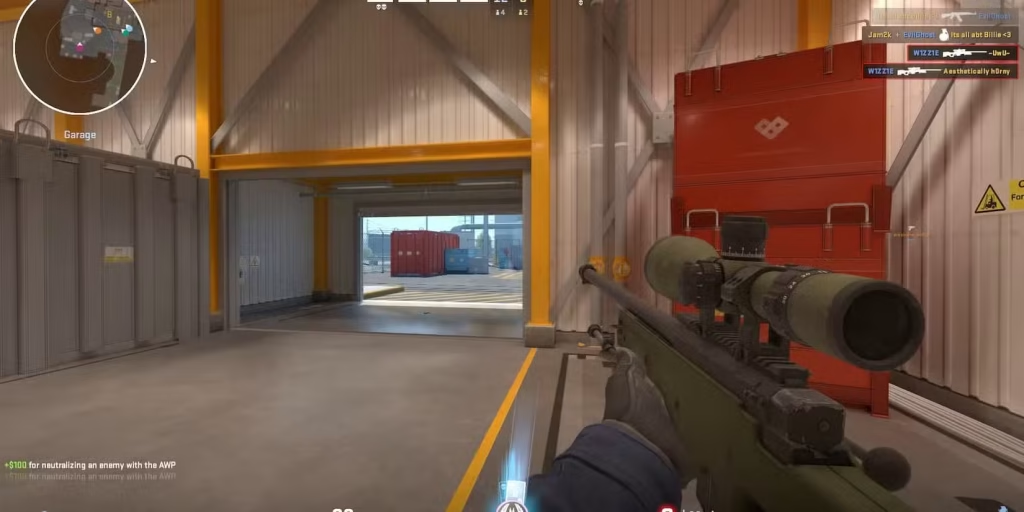
Counter-strafing enables instant movement cessation by tapping the opposite directional key, canceling momentum for immediate shooting accuracy.
Execution Breakdown:
- Initiate left strafe with A key
- Execute immediate stop by tapping D key
- Momentum cancellation creates stationary shooting platform
- Perfect timing enables pixel-perfect headshot execution
The milliseconds difference between opposite key tapping versus simple key release often determines duel outcomes.
Pre-Aim Integration
Pre-aiming combined with strategic strafing reduces reaction time requirements by anticipating enemy positions before visual confirmation.
Practice Routine: Dedicate 15 minutes daily to counter-strafing drills in aim training maps, focusing on rhythm development and muscle memory formation.
Strafing Rhythm Development
Developing consistent strafing rhythm transforms chaotic movement into calculated combat maneuvers.
Optimization Tip: Record your practice sessions to identify timing inconsistencies and acceleration pattern flaws that impact combat performance.
Peeking techniques represent the tactical application of movement mechanics for information advantage and combat superiority.
Jiggle Peeking Tactics
Jiggle peeking involves rapid directional tapping to expose minimal character model portions while gathering critical engagement intelligence.
Effective Jiggle Peeking Protocol:
- Position near cover edges for quick exposure and retreat capabilities.
- Quick directional taps create unpredictable movement patterns that disrupt enemy aim tracking and crosshair placement.
Strategic applications include:
- AWP Baiting: Force sniper shots during reload cooldowns for tactical advantage.
Shoulder Peeking Strategies
Shoulder peeking utilizes even more minimal exposure than jiggle peeking, showing just shoulder portions to draw enemy reactions.
Shoulder Peeking Execution:
- Maintain cover proximity for quick safety retrieval.
- Execute rapid, slight movement into open areas.
- Immediately return to protected positions.
- Repeat sequences cautiously without overexposure risks.
Wide vs Close Peeking Scenarios
Understanding situational peeking applications determines engagement success rates and survival probabilities.
Common Mistake: Players often shoulder peek with excessive movement, creating vulnerable exposure windows that skilled opponents exploit for elimination.
Wide Peeking Applications:
- Passive Angle Testing: Identify enemy positions without full combat commitment.
Optimal wide peeking situations:
- Suspected defensive positioning
- AWP counter-strategies implementation
- Aggressive timing domination strategies
Close Peeking Applications:
- Uncertain angle assessments
- Methodical corner clearing procedures
Pro Strategy: Combine close peeking for information gathering with wide peeking for elimination execution.
Advanced players integrate peeking techniques with utility usage and sound manipulation for maximum tactical effectiveness.
Bunny hopping represents one of CS2’s most technically demanding movement skills, requiring precise timing coordination between jumping actions and air strafing maneuvers.
Bhop Mechanics Breakdown
Bunny hopping involves chaining consecutive jumps while maintaining movement momentum through air strafing techniques.
What is Bunny Hopping and Its Origins
Originating from classic Counter-Strike iterations, bhopping enables sustained velocity through rhythmic jump sequencing.
Bunny Hopping Mechanics in CS2
Proper bhopping technique requires:
- Initial Momentum Generation through running jump initiation.
- Perfect Landing Timing for subsequent jump execution.
- Air Strafing Coordination with mouse movement direction synchronization.
- Forward Key Avoidance after initial jump to preserve velocity.
Why Learn Bhopping?
- Silent Movement Capabilities across open map areas and rotation pathways.
When and Where to Use Bunny Hopping
Strategic bhopping applications provide distinct competitive advantages:
- Rapid Rotation Execution between map positions for defensive repositioning or offensive flanking maneuvers.
Ideal Bhopping Scenarios:
- CT side rotations between bomb sites
- Escape and evasion tactics during compromised positioning situations.
Risk Assessment: Avoid bhopping during active firefights due to accuracy penalties and vulnerability exposure.
Advanced Movement Integration
Elite players combine bhopping with other advanced movement techniques for comprehensive combat superiority.
Practice Methodology: Utilize workshop bhop maps for dedicated technique development, focusing on timing consistency and movement flow maintenance.
Time Estimate: Dedicate 20-30 minute sessions daily for consistent bhopping skill progression.
Jiggle peeking represents one of the most crucial movement skills in CS2 for gathering intelligence and manipulating enemy behavior without committing to full exposure. This technique stands in stark contrast to reckless wide peeking, which typically results in immediate elimination against competent opponents.
Unlike dangerous wide swings that expose your entire hitbox, jiggle peeking employs precisely timed lateral movements designed to exploit opponent timing, disrupt crosshair placement, and provoke premature reactions that reveal enemy positions and weapon choices.
What Jiggle Peeking Isn’t
Many players mistakenly believe jiggle peeking involves running aggressively around corners hoping to spot enemies. This misconception frequently leads to instant death against prepared defenders. True jiggle peeking requires deliberate control rather than hopeful aggression.
Proper Execution Steps
- Position yourself adjacent to cover elements like boxes, walls, or doorways
- Execute rapid taps of A or D keys to reveal a minimal portion of your character model
- Immediately press the opposing movement key to swiftly return to safety
The primary objectives include forcing opponents to reveal their position through gunfire, collecting tactical information about enemy setups, or establishing pre-aim positions based on observed opponent tendencies.
Strategic Applications
Jiggle peeking proves exceptionally effective against sniper positions. AWPers commonly maintain tight angle holds, and if you move sufficiently to provoke their shot, they enter an extended reload phase—creating your window to capitalize on their vulnerability. This explains why experienced players frequently employ jiggle peeking in mid-corridor or apartments on maps like Mirage, strategically baiting sniper fire without sacrificing your life.
Within CS2’s enhanced environment featuring improved hit registration and sub-tick precision, jiggle peeking delivers tighter feedback. Your lateral movements register with greater accuracy, enabling you to exploit angles with minimal exposure time. However, this precision also means adversaries can more effectively punish poorly executed jiggles—making your timing and movement speed absolutely critical.
When you integrate jiggle peeking with shoulder peeks, counter-strafing, and tactical utility deployment, you transform into a defender’s nightmare. You’ll force enemies to question their holds, deplete their ammunition reserves, and provide your team with vital intelligence—all while preserving your survival.
Shoulder peeking serves as jiggle peeking’s more refined counterpart, sharing similar foundations but pursuing distinct tactical goals. While jiggle peeking may reveal portions of your head and torso to provoke enemy fire or identify opponents, shoulder peeking operates with even greater minimalism—it focuses on displaying only the minimal shoulder area (or weapon model visibility) to elicit enemy reactions or gain positional awareness about who maintains angle control.
In CS2’s environment with refined hitbox detection and animation systems, shoulder peeking gains increased value. Due to how peeker’s advantage functions—particularly on elevated ping or reduced tick rate servers—the capacity to safely draw out shots or collect intelligence without genuinely exposing your cranial hitbox becomes a tactical game-changer.
Technical Execution Guide
- Position your character near a corner or wall obstruction.
- Execute rapid, minimal movement into the open area, displaying exclusively your shoulder region.
- Return immediately to protective cover.
- Repeat when necessary—but maintain discipline and avoid greed.
Practical Use Cases
This methodology proves particularly valuable when attempting to:
- Identify AWPers or scoped rifle users.
- Provoke enemy fire before initiating coordinated pushes.
- Collect auditory information such as scope activation sounds or footstep cues.
- Induce enemy anxiety or forced repositioning.
One excellent implementation scenario occurs when preparing to assault a bombsite while suspecting an AWP angle hold. Instead of dry peeking (which commonly concludes in instant death), you execute a shoulder peek. If the sniper discharges their weapon, they enter cooldown—now you can either aggressively swing or deploy tactical utilities.
Shoulder peeking achieves optimal performance when supported by solid movement fundamentals—especially rapid counter-strafing execution. Your peeking actions must demonstrate precision, tight control, and rapid execution. If you remain exposed excessively, you become an effortless elimination. If your movement proves insufficiently minimal, you might fail to trigger the enemy’s reaction.
Advanced practitioners frequently combine shoulder peeks with acoustic manipulation, such as simulated stepping sounds or jump peeking, to compel opponent overreactions. This represents psychological warfare—making your adversary believe you’re preparing to peek when you’re not, and exploiting their resulting panic.
If jiggle peeking emphasizes calculated intelligence collection, shoulder peeking concentrates on subtlety and misdirection. It constitutes a minor movement with major strategic consequences.
To maximize your peeking effectiveness in CS2, you must understand how to seamlessly integrate both techniques while recognizing their respective limitations and optimal application scenarios.
Combining Techniques
Elite players don’t rely exclusively on either jiggle or shoulder peeking—they master the art of sequential implementation. Begin with shoulder peeks to assess enemy presence and weapon types, then transition to jiggle peeking for more detailed intelligence gathering, and finally execute wide peeks when opponents are psychologically primed for minimal exposure rather than full commitment.
CS2-Specific Considerations
The transition to CS2’s Source 2 engine introduced significant changes that affect peeking execution. The improved sub-tick system provides more responsive movement registration but demands greater precision in your timing execution.
Mistakes to Avoid
Greedy repetition represents the most common error. After successfully baiting an enemy shot, inexperienced players often repeat the same peek, expecting different results. This predictable behavior allows skilled opponents to anticipate and eliminate you on subsequent exposures.
Another critical error involves insufficient counter-strafing. In CS2’s refined movement system, simply releasing movement keys doesn’t provide sufficient stopping power—you must actively press the opposite direction key to cancel momentum instantly.
Poor angle selection also undermines peeking effectiveness. Choosing positions where your shoulder exposure provides inadequate visual information to the enemy renders the technique ineffective.
Strategic application involves understanding when each technique provides maximum value:
- Initial intelligence gathering: Use shoulder peeking to confirm enemy presence
- Detailed information collection: Implement jiggle peeking after establishing enemy positions
- Execution timing: Coordinate peeks with teammate utility usage or enemy reload sounds
- Psychological warfare: Alternate between techniques to create uncertainty
For comprehensive CS2 mastery, consider exploring our Complete Guide to understand how these movement techniques integrate with broader gameplay strategies.
Mastering these nuanced peeking methods typically requires 15-20 hours of dedicated practice across various maps and against different opponent skill levels to develop reliable muscle memory.
Strategic movement in Counter-Strike 2 extends far beyond mechanical execution—it’s about audio interpretation and temporal awareness. The most successful players don’t just react to what they see; they anticipate based on what they hear. Every sound emitted by opponents creates exploitable moments where their attention is divided or their capabilities are temporarily reduced.
Consider this scenario: you’re holding an angle and detect an enemy reloading their weapon. This creates a 2-3 second window where their ability to return fire is compromised. This isn’t random aggression—it’s calculated exploitation of auditory intelligence.
The half-second vulnerability window when enemies deploy grenades or execute jumps provides perfect opportunities for aggressive peeks. During these moments, opponents often have their crosshairs misaligned, are mid-animation, or suffer from reduced situational awareness.
Your own audio output requires careful management. Approaching peek positions at full sprint broadcasts your location to everyone within auditory range. Professional players instead approach silently, then execute rapid, controlled bursts when prepared to engage.
Beyond individual duels, team synchronization creates overwhelming pressure. When two players swing an angle simultaneously—known as a double peek—the defender must choose which threat to address, inevitably allowing one attacker to secure the elimination.
Practical implementation requires:
- High-quality audio equipment capable of distinguishing directional cues
- Map-specific sound knowledge including material-based audio variations
- Demo analysis to identify and correct timing deficiencies
- Professional match observation to study how elite competitors leverage audio information
Common timing mistakes include:
- Peeking during enemy reloads but failing to account for their positioning advantages
- Failing to coordinate with teammates, resulting in staggered engagements that allow defenders to reset
- Over-reliance on visual information while neglecting the strategic value of auditory cues
Advanced players also monitor utility deployment patterns. Hearing multiple explosive devices detonate at one bombsite suggests reduced defensive presence elsewhere, creating opportunities for uncontested map control.
The art of bunny hopping represents one of Counter-Strike’s most technically demanding movement disciplines. Originating from the classic 1.6 era, this technique enables players to maintain velocity through sequential jumps rather than decelerating as with standard movement.
Proper execution requires more than rapid key presses—it demands rhythmic precision, airborne directional control, and momentum preservation through precisely timed inputs.
In the transition to CS2, the Source 2 engine introduced significant modifications to aerial mobility mechanics. Air acceleration parameters feel more constrained, reducing the tolerance for imperfect timing while increasing the skill ceiling for mastery.
Strategic applications include:
- Accelerated map rotations on complex layouts like Overpass
- Stealthy traversal across exposed areas where footstep audio would normally reveal positioning
- Unconventional flanking routes that circumvent expected defensive positions
- Evasive maneuvers against sniper positions or pre-aimed angles
- Positional unpredictability through erratic mid-air movement patterns
Technical execution breakdown:
- Initiate with sprinting jump to generate initial propulsion
- Execute subsequent jumps immediately upon landing to preserve momentum
- Employ air strafing techniques by synchronizing mouse movement with directional keys
- Avoid forward movement input after the initial jump to maintain aerial velocity
CS2-specific mechanical changes:
- Sub-tick registration provides more responsive jump detection
- Visual feedback systems provide clearer indication of movement efficiency
- Collision detection refinement creates more consistent interaction with level geometry
Optimal application scenarios:
- Rapid defensive repositioning when rotating between bomb sites
- Sound-muffled descents from elevated positions like Heaven on Nuke
- Post-engagement relocation to avoid retaliation or additional contact
- Bullet trajectory avoidance through unpredictable aerial pathways
Risk assessment considerations:
- Combat situation vulnerability due to accuracy penalties while airborne
- Acoustically revealing terrain where failed hops generate more noise than standard movement
- Low-health situational exposure when traversing open areas without adequate cover options
Elite-level CS2 gameplay incorporates sophisticated movement techniques that provide tactical advantages beyond basic positioning. These advanced methods separate competent players from truly dominant competitors.
Silent descent techniques enable players to drop from elevated positions without generating auditory cues that would reveal their movement.
Execution methodology for silent drops:
- Approach edges with crouched movement before descending
- Coordinate landing timing to connect with sound-absorbing surfaces or angled terrain that minimizes audio propagation
- Maintain crouch posture throughout the descent to further reduce noise generation
Strategic ledge jump locations:
- Dust2 Xbox to Catwalk transition
- Ancient mid-area elevation changes
- Inferno logs to banana wall access
Air strafing mechanics represent the pinnacle of movement control. This technique enables players to modify trajectory mid-air, maintain velocity through curves, and achieve precise landing positioning.
Technical execution principles:
- Cease forward directional input once airborne
- Synchronize mouse movement with directional keys to control aerial pathways
- Avoid excessive correction inputs that disrupt momentum and movement fluidity
Practical benefits include:
- Enhanced bunny hopping performance through improved air control
- Escape and repositioning capabilities when disengaging from unfavorable encounters
- Reduced impact damage through controlled landing techniques
Ladder movement tactics provide unconventional positioning options that most opponents don’t anticipate or prepare for adequately.
Advanced ladder techniques:
- Nuke ladder to Heaven silent access
- Vertigo ladder-based angle holding positions
- Custom server ladder flick techniques for 180-degree engagement capability
Professional implementation requires understanding that ladder-based combat suffers from significant accuracy penalties, making these positions better suited for distraction or informational gathering rather than primary fighting positions.
- Rapid Rotation Execution between map positions for defensive repositioning or offensive flanking maneuvers.
Bunny hopping serves as a tactical movement enhancer rather than a primary travel method in CS2. Understanding when to deploy this technique separates skilled players from those who merely show off flashy moves without strategic purpose.
Optimal Usage Scenarios:
- Rapid Map Rotation: When transitioning between bomb sites or defensive positions, chaining 2-3 consecutive bhops can cut your travel time by 15-20%, especially on maps with long corridors like Overpass’s connector areas.
- Tactical Repositioning: After engaging enemies or deploying smokes, bhopping enables swift retreats while keeping opponents guessing your location.
- Evading Precision Fire: Unpredictable mid-air movement patterns make it challenging for AWPers to track and land clean shots.
- Flanking Maneuvers: Unexpected bhop routes through unconventional paths can catch entire teams off guard during executes.
High-Risk Situations to Avoid:
- During Active Firefights: Attempting to bhop while under direct fire results in predictable trajectories and easy eliminations.
- On Audible Surfaces: Failed hops generate louder impact sounds than standard walking, potentially revealing your position.
- Low Health Scenarios: When survival is priority, bhopping through exposed areas increases vulnerability compared to methodical cover usage.
- Against Coordinated Teams: Experienced squads will anticipate bhop patterns and pre-aim common landing spots.
The guiding principle remains: employ bhops for positional advantages, not combat superiority. Dedicate 10-15 minutes daily in private servers to develop consistent timing, then integrate these movements organically into your gameplay flow.
Nothing compares to the satisfaction of executing flawless bhops through smokes, emerging behind unsuspecting enemies. The psychological impact of seemingly teleporting across the map cannot be overstated.
In high-pressure situations, audio intelligence becomes paramount—and mastering silent drops can determine whether you survive or become an easy elimination. This is where silent drops and ledge jumps provide critical advantages.
Silent drops enable descent from elevated positions without generating detectable noise. This proves invaluable across multiple competitive maps:
- Mirage (descending from Window into Connector without alerting defenders).
Perfecting Silent Drop Execution:
- Approach the ledge while maintaining crouch-walk momentum before stepping off gradually.
- Coordinate your landing to impact sloped surfaces or specific texture types that minimize sound propagation.
- Maintain crouch hold during impact to further dampen audio cues.
Ledge jumps, conversely, represent calculated hops designed to scale obstacles that typically impede progress. A well-executed ledge jump conserves time, establishes unconventional sightlines, and facilitates stealthy positioning.
Essential ledge jump locations include:
- Dust2: Transition from Xbox platform to Catwalk elevation.
- Ancient: Mid-section elevation changes and platform transitions.
- Inferno: Ascending from Logs to Banana wall positioning.
Refining these techniques enables:
- Accelerated map control acquisition
- Early round pick opportunities or defensive setups
- Opponent disorientation through atypical angle establishment.
Skill development recommendations:
- Utilize custom Complete Guide to advanced movement mechanics.
- Practice crouch-jump combinations and Weapons Unlock guides often include specialized jump training sections.
- Memorize ledge collision geometry and timing windows for consistent execution.
Action Checklist
- Practice counter-strafing drills for 15 minutes daily in aim training maps
- Master strafing rhythm through short burst movement sequences
- Integrate pre-aiming with strafing movements for reduced reaction time requirements
- Develop jiggle and shoulder peeking proficiency through controlled exposure practice
- Practice jiggle peeking in controlled environments for 30 minutes daily
- Master counter-strafing timing in aim training maps
- Combine shoulder peeking with utility usage in realistic scenarios
- Study pro player demos focusing specifically on their peeking timing and angle selection
- Practice identifying and exploiting audio cue vulnerability windows (reloads, grenade throws, jumps)
- Master counter-strafing mechanics in aim training maps for 30 minutes
- Coordinate double peeks with teammates in practice sessions
- Implement silent movement techniques on 3 key maps
- Analyze professional match demos to study advanced timing applications
- Practice 2-3 consecutive bhops in private servers for 15 minutes daily
- Master silent drops on 3 key maps (Mirage, Nuke, Vertigo)
- Identify and practice 5 essential ledge jumps across competitive map pool
- Silent Movement Capabilities across open map areas and rotation pathways.
- Passive Angle Testing: Identify enemy positions without full combat commitment.
- AWP Baiting: Force sniper shots during reload cooldowns for tactical advantage.
No reproduction without permission:Tsp Game Club » Movement Mechanics in CS2: Strafing, Peeking, and Bunny Hopping