
TL;DR
- CS2’s Source 2 engine delivers unprecedented 3D audio precision for tactical advantage
- Footsteps reveal enemy position, movement type, and tactical intent through advanced sound modeling
- Strategic audio manipulation enables baiting, flanking, and psychological warfare tactics
- Proper audio settings and equipment provide a 0.5-1 second reaction time advantage
- Audio-driven positioning and pre-aiming can transform defensive holds into offensive opportunities
In the high-stakes arena of Counter-Strike 2, milliseconds determine match outcomes. While precision aiming and strategic positioning remain fundamental, the game’s sophisticated audio system represents an often-underutilized tactical weapon. Mastering CS2’s sound mechanics provides critical intelligence before visual confirmation, transforming average players into clutch performers. This comprehensive guide explores the technical foundations of CS2’s audio architecture, practical applications for competitive play, and advanced techniques that separate elite competitors from the pack.
Sound as Your Sixth Sense
Competitive CS2 demands complete audio awareness—neglecting sound interpretation creates a severe competitive handicap. Audio signals deliver actionable intelligence before enemy visualization. Footstep patterns during rotations, grenade pin extraction sounds, even subtle container jumps—these auditory cues must actively shape your tactical decisions. CS2’s enhanced audio framework elevates listening from passive reception to active tactical analysis.
The system’s brilliance lies in audio integration within core gameplay mechanics. Players can distinguish between full sprints and careful walking, jumping versus landing impacts, or weapon transitions during peeking maneuvers. During high-pressure clutch scenarios, your auditory processing often proves more valuable than crosshair placement.
Tactical advantages extend beyond survival to influence overall playstyle development. Aggressive competitors leverage sound to apply psychological pressure, while defensive specialists utilize audio for trapping and baiting strategies. Losing audio awareness strips away this strategic dimension entirely.
CS:GO to CS2 Audio Revolution
While CS:GO established competent audio foundations, CS2’s transition to Source 2 technology represents a quantum leap in sound fidelity and functionality.
CS:GO’s audio propagation suffered from map geometry limitations and technical inconsistencies. Footstep reliability fluctuated due to legacy sound mixing methodologies. CS2 addresses these limitations through consistently accurate and deeply immersive auditory behavior.
The advanced engine incorporates high dynamic range (HDR) audio, enhanced occlusion modeling (sound obstruction by objects), and dynamic echo simulation responsive to environmental conditions. Essentially, you can now accurately determine distance, directional origin through corridors or behind barriers—with logical consistency. Inferno’s Banana footstep echoes differ audibly from Apartments acoustics, providing precise enemy positioning data.
The redesigned audio mix ensures footstep definition, grenade bounces, and reload auditory cues maintain prominence during intense combat situations.
CS2’s audio engineering transcends aesthetic enhancement—it’s fundamentally integrated with gameplay mechanics. Source 2 technology enables sound propagation mimicking real-world physics. Audio travels through open areas, reflects from surfaces, and experiences attenuation or redirection based on intervening obstacles. This means you’re not merely processing sounds—you’re interpreting environmental acoustic shaping.
This sophisticated system empowers competitors with advanced sound tracking capabilities. Hearing two rapid footsteps followed by silence might indicate an enemy initiating sprinting then transitioning to walking for stealth approach. The simulation even calculates sound reflection patterns, enabling vertical positioning identification above, below, or through passageways.
The audio framework excels at differentiating between distinct sound categories. Reloading produces unique acoustic signatures compared to blade deployment. Smoke grenade versus flashbang bounces exhibit subtle but distinguishable differences. Mastering this auditory language creates battlefield interpretation fluency through sound isolation.
Source 2 Audio Architecture
Valve’s Source 2 migration delivered substantial fidelity improvements. The audio engine now supports complex sound environments, enhanced spatial precision, and responsive mixing systems. When combat events occur—firearm discharges, foot impacts, or object collisions—the resulting sounds demonstrate increased immediacy, precision, and detail resolution.
Positional audio achieves unprecedented granularity through Source 2. Stereo or surround sound configurations enable enemy direction pinpointing within minimal degree variance. This precision proves decisive during close-quarters engagements.
Another advantage involves dynamic range management. Powerful sounds like AWP discharges maintain thunderous presence, while subtle indicators like scoped weapon mode transitions retain distinct presence within the mix. This layered approach facilitates critical sound isolation even amidst chaotic firefight conditions.
Advanced Footstep Analysis
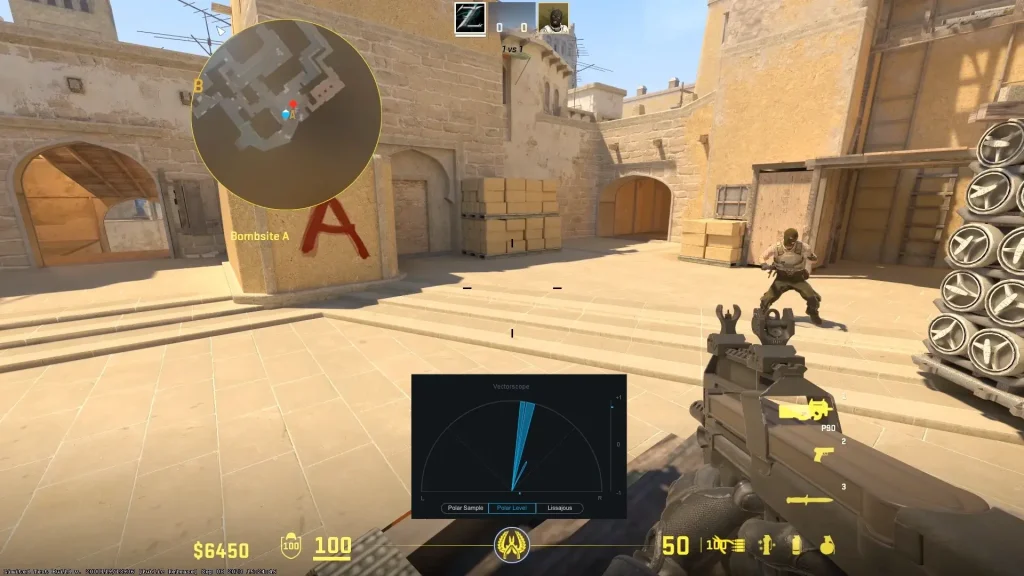
Footstep mechanics transcend simple sound effects—they constitute tactical evidence trails. Each movement generates sound waves detectable by nearby opponents, dependent on movement classification and proximity. These auditory indicators follow radial distribution models. Sprinting generates audible detection at significantly extended distances compared to walking or crouching maneuvers.
Material composition, obstruction presence, and elevation differentials now influence footstep acoustic characteristics, providing enhanced three-dimensional projection accuracy.
When sprinting through Mid corridors, your boot impacts generate echoes alerting all players within auditory range. Walking significantly reduces sound radius dimensions. While not completely silent, the reduction provides sufficient stealth when enemies experience distraction or utilize inferior audio equipment.
This audio model incentivizes strategic mobility decisions. Need to bait opponents? Simulate rushes with pronounced footstep patterns then withdraw. Require infiltration behind enemy formations? Employ walking or crouching to maintain operational secrecy.
Sound-Based Prediction Systems
Elite competitors leverage audio for predictive analysis rather than reactive responses. Footstep patterns reveal not just positional data but directional movement and velocity characteristics. Hearing opponents sprinting toward corners enables pre-aim head-level positioning readiness for immediate engagement upon visual contact.
Combining auditory processing with map knowledge creates formidable tactical advantages. Mirage’s Apartments footstep followed by jump sound typically indicates window smoke preparation or bench jump execution.
Auditory intelligence facilitates proactive utility deployment. Hearing enemy pushes through short corridors? Launch pop-flash maneuvers around corners before enemy appearance. This preemptive sound utilization transforms defensive postures into offensive initiatives.
Stealth Movement Mastery
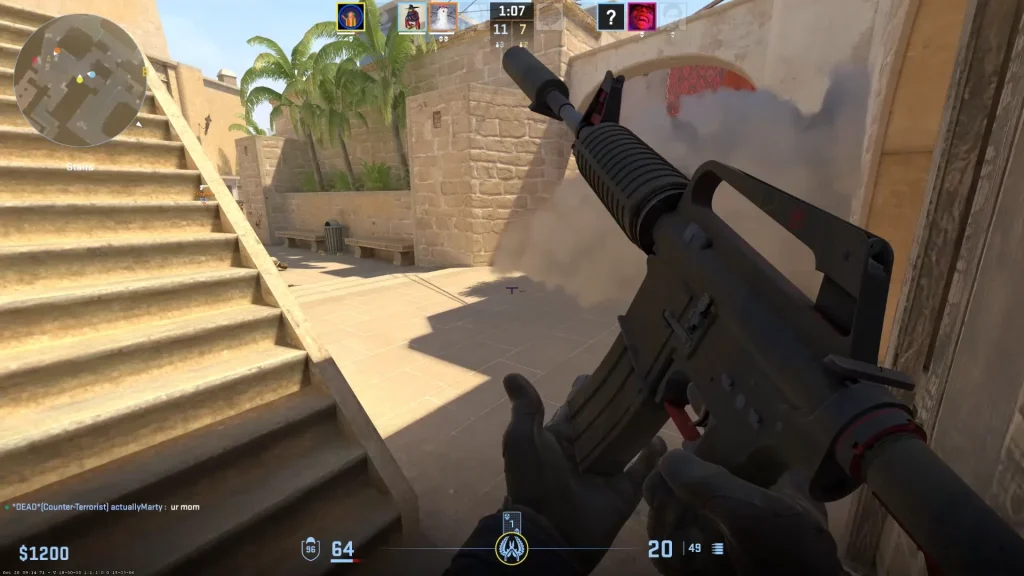
Advanced angle holding transcends basic positioning—it involves intelligent auditory adaptation. CS2 rewards competitors who modify their holding strategies based on surrounding soundscapes. Knowing enemies will peek enables patient waiting rather than risky positional adjustments.
This approach proves particularly effective when securing tight angles like Mirage’s Connector or Inferno’s Banana corridor.
Alternative tactics involve permitting opponents to generate noise before initiating action. Hearing enemy movement through Overpass’s Monster tunnel? Delay engagement until secondary opponent detection. Sound establishes engagement tempo—once mastered, your actions synchronize with this rhythm intuitively.
Professional Audio Configuration
Competitive CS2 necessitates audio equipment prioritization—superior headsets deliver greater competitive returns than GPU or monitor upgrades. CS2’s sound design depends on directional precision, and your gear determines auditory cue detection effectiveness.
Stereo configurations combined with quality virtual surround software remain professional standards. These setups provide clear left-right balance with surprising accuracy when properly configured.
True surround sound configurations like 5.1 or 7.1 can sometimes reduce clarity through excessive channel distribution.
Many elite competitors disable traditional surround systems, preferring virtual surround processing solutions like Dolby Atmos, DTS Headphone:X, or Windows Sonic technologies. These systems simulate three-dimensional audio through stereo headsets with superior directional reliability.
Ultimately, audio performance depends more on configuration optimization than equipment sophistication. Proper equalization settings, surround simulation, and spatial representation understanding provide decisive advantages.
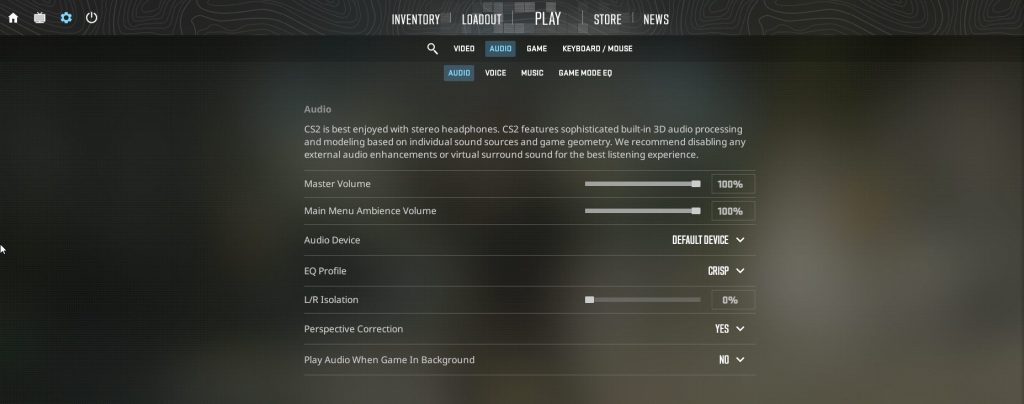
Practical optimization requires appropriate in-game settings configuration. CS2 provides several critical audio options requiring adjustment for optimal footstep detection and tactical listening capabilities.
Here’s a quick table of recommended settings:
| Setting | Recommendation |
|---|---|
| Master Volume | 100% (adjust system volume instead) |
| Audio Device | Direct output to headphones (no enhancements) |
| Spatial Audio | On (use Windows Sonic or Dolby Atmos) |
| L/R Balance | Centered (adjust if you have hearing imbalance) |
| EQ / Bass Reduction | Reduce bass, boost mids and highs |
| Music Volume | 0% (especially round start/end music) |
| Voice Chat Volume | 50–70% (low enough to hear footsteps) |
Configuration objectives involve maximum clarity achievement. Footstep and utility auditory cues occupy mid-to-high frequency ranges, requiring these frequencies to maintain prominence and definition.
Common oversight involves unnecessary application disabling like Discord’s noise suppression or Windows audio enhancements. These features can suppress subtle game audio or distort spatial cue accuracy.
In high-intensity situations, the line between teammate and enemy audio cues can become challenging to distinguish. This is why veteran competitors emphasize strategic communication: announcing their positioning shifts, angle checks, or rotational movements. However, even in the absence of voice comms, you can develop the ability to mentally filter out your squad’s sonic signature. Their movement patterns tend to follow predictable rhythms—opponent footsteps typically display more irregular, covert, or urgent patterns that experienced players learn to recognize instinctively.
You will also detect variations in firearms management. If your ally is positioned at the A bombsite while you detect a magazine change from Catwalk area, probability suggests it’s not your friendly player. Developing recognition of these auditory indicators evolves into an almost subconscious tactical sense. The more gameplay experience you accumulate, the more your cognitive processing will automatically categorize friendly versus hostile players through developed instinct.
Each locomotion method in CS2 generates a distinctive sonic profile. Sprinting produces the most audible presence. Leaping generates an additional perceptible impact sound upon landing. Standard walking reduces your step volume, and crouch movement? That represents the stealth approach—virtually inaudible unless you collide with environmental objects. Competitors must excel at understanding these variations to regulate the acoustic signature they emit during matches.
Executing a jump-peek around a corner? Your footfalls will reveal your position. Maintaining forward movement into a bombsite? Opponents will detect your approach before visual contact occurs. However, if you incorporate gradual walking or crouch-walking techniques, you can approach distracted adversaries with unexpected effectiveness.
Additionally, movement-generated noise differs according to surface materials. Wooden flooring creates contrasting acoustic characteristics compared to concrete or metallic surfaces. Strategic players leverage this knowledge to identify someone’s location, even without direct line of sight. Detect footsteps on timber surfaces? They’re probably positioned in Palace area. Hear metallic resonance? Possibly they’re moving across Heaven platform.
The essential conclusion: every movement decision represents a tactical choice between velocity and concealment. Perfecting the sounds these movements produce represents how you maintain tactical superiority in CS2 engagements.
Every auditory element in CS2 carries strategic significance—particularly those occurring during intense combat scenarios. Reloading your firearm, transitioning between weapons, or even activating grenade pins can compromise your location to alert opponents. If you’re within acoustic range of an enemy and choose to reload without protective covering or appropriate timing, you’re essentially encouraging them to check angles and capitalize on your vulnerability.
Reloading represents one of the most revealing audio indicators. Each weapon features a unique reload acoustic signature, and skilled players can determine the specific armament simply through auditory recognition. If you detect an extended reload sequence featuring metallic snapping sounds, you might be confronting an AWP sniper rifle. A quicker, mechanical click-intensive reload? Likely a rifle such as the M4 or AK-47 platform. This category of intelligence proves invaluable—it informs you not merely that an opponent is nearby but additionally what category of threat you’re preparing to engage.
Firearm transition constitutes another crucial auditory cue. Switching between primary weapons to secondary pistols or melee blades produces a subtle yet detectable sound. If you’re sufficiently close, this can indicate that the adversary potentially exhausted their ammunition reserves or preparing for close-quarters combat. Numerous professional competitors simulate weapon transitions to lure opponents into exposing themselves—it represents an advanced psychological engagement that benefits attentive listeners.
Tactical equipment deployment arguably generates the most pronounced and telegraphed sonic indicators. The acoustic signature of a grenade safety pin extraction, the distinctive ignition sound of molotov cocktails, or the acoustic bounce characteristics of flashbang grenades can all signify strategic intentions. Want to simulate a bombsite assault? Deploy a flashbang device. Need to pressure defending CT operators at B location? Bounce smoke canisters or incendiary devices into the area. It’s not exclusively about deployment execution—it concerns being acoustically detected during the deployment process.
When employed strategically, these auditory elements can influence opponent decision-making. Simulate reloading sequences to provoke aggressive pushes. Draw utility items to suggest offensive pressure, then strategically withdraw. Audio functionality extends beyond reactive measures—it also serves for constructing tactical ambushes.
One of the frequently underestimated components within CS2’s acoustic environment involves the map architecture itself. Every competitive environment in CS2 possesses its individual auditory fingerprint. From the constricted passageways of Nuke’s B bombsite to the expansive architectural openings of Mirage Middle area, the environmental design influences how sound propagates—and how you should respond accordingly.
Consider Inferno map dynamics as an illustration. When an opponent sprints through Banana corridor, the acoustic characteristics reverberate due to the elongated stone barrier structures. This enhances detection capabilities for rapid assaults even from Top Middle or Counter-Terrorist spawn regions. Meanwhile, within Vertigo’s layout, the metallic grating surfaces amplify footstep volume and improve distinguishability. If someone is moving stealthily through B staircase areas, a trained auditory system can detect their presence significantly before visual contact occurs.
Vertical audio considerations also demand attention. In Overpass environment, for example, players frequently utilize sound originating from lower levels (such as Connector area) to estimate enemy positioning above their current location. The maps are engineered to amplify tactical audio gameplay. Understanding which zones generate greater acoustic presence or feature enhanced sonic transparency can assist your decisions regarding sprinting versus stealth movement.
Even persistent environmental audio elements—like the combustion noise of molotov devices or the ambient resonance proximal to explosive sites—contribute to environmental complexity. You must learn to filter these persistent sounds while concentrating on player-generated auditory cues. This explains why environment-specific audio proficiency proves essential. Engage with identical maps consistently, and you’ll commence forecasting movement patterns based on how the sounds deviate from the standard ambient background.
Elite competitors frequently appear prescient, as though they anticipate opponent actions before they materialize. The reality? They’re processing audio—intensively processing auditory information. Sound indicators reveal substantial intelligence that, when accurately interpreted, enables players to predict rotational movements, flanking maneuvers, and bombsite assaults before they develop.
Let’s hypothesize you detect one flashbang deployment originating from A Long corridor on Dust 2 environment, followed by rapid footstep sequences. You can reasonably conclude it’s not an isolated player—organized teams typically coordinate flashbang support for each other. Anticipate multiple adversaries. Or, if you perceive sprinting movement into Apartments region on Mirage map but no subsequent auditory indicators, it might represent a deceptive maneuver to prompt defensive rotations. This represents superior competitive gameplay constructed entirely upon sophisticated sound interpretation capabilities.
Another scenario: you detect a swift angle check followed by acoustic silence. This could indicate the opponent identified someone’s presence and currently repositioning for subsequent angle verification or awaiting reinforcement support.
Every pause in movement, sudden noise emission, or even irregular movement patterns communicates narrative information. Your responsibility? Become the strategic narrator. Interpret the implied meanings and respond appropriately.
In individual matchmaking scenarios, players who perfect this capability achieve dominance. You can execute flanking maneuvers while other competitors remain immobilized by uncertainty. You can initiate rotational movements earlier than your teammates while they provide delaying actions. And you can preserve economic resources more frequently because you recognized unfavorable situations before other participants identified the circumstances. Audio functions as your tactical radar system—maintain acoustic awareness, and the gameplay will provide substantial intelligence.
Have you observed someone executing perfect pre-aiming techniques and questioned their awareness source? Frequently, it’s not illicit software advantages—it’s simply exceptional audio processing capabilities. In CS2, intelligent players utilize sound to narrow potential enemy locations, providing benefits in both reaction speed and targeting precision.
Developing professional-level audio recognition requires systematic training approaches that many competitors neglect. Begin with isolated training sessions using community workshop maps specifically designed for audio drills—these environments eliminate visual distractions and force exclusive reliance on sonic cues for positional awareness development.
Footstep patterns disclose not merely location data but additionally directional movement and velocity information. Detect an opponent accelerating toward a corner? You can pre-aim head-level positioning and prepare to engage immediately upon their angle exposure. If the acoustic signature demonstrates reduced velocity or intermittent characteristics, they might be employing walking techniques or conducting systematic angle inspections, which demands more precise timing coordination from your perspective.
Combine this environmental knowledge with map familiarity, and you transform into lethally effective competitor. Let’s hypothesize on Mirage environment, you detect footstep activity in Applications corridor, followed by leaping acoustic signature. They’re probably coordinating window smoke deployment or executing platform jumping maneuvers. This provides critical seconds for aiming adjustments or positional recalibration. It’s not supernatural capability—it’s simply utilizing the intelligence the gameplay provides through its acoustic systems.
Audio functionality additionally enables preparatory utility deployment. Detect an adversary advancing through Short corridor? You can deploy pop-flash devices around the corner before their visual appearance. This proactive audio utilization converts defensive positioning into offensive advantage, enabling control over engagement pacing.
How to Use Sound for Pre-Aiming and Pre-Firing
Advanced players transform audio cues into lethal positioning advantages. When you detect enemy movement patterns, you can establish crosshair placement that anticipates their exact peek timing and angle.
Footstep analysis provides multidimensional data—not just location, but movement speed, direction changes, and even player intention. Sprinting footsteps suggest aggressive peeks, while intermittent walking indicates careful angle clearing.
Combine environmental acoustics with movement patterns for deadly accuracy. On maps like Mirage, distinguishing between Apps footsteps and Underpass movement by surface sound differences gives you 2-3 second preparation windows.
Audio-driven utility deployment creates tactical superiority. Hearing an opponent approach Short allows perfectly timed pop-flashes that blind them exactly as they round the corner.
Intelligent Angle Holding Based on Sound Intelligence
Strategic angle maintenance evolves from passive waiting to active sound interpretation. CS2’s audio engine rewards tactical adjustments based on the surrounding acoustic environment. When audio indicates an imminent enemy peek, maintain position without revealing your presence through unnecessary movement.
Critical choke points like Mirage Connector or Inferno Banana demonstrate this principle perfectly. Rapid footstep sequences suggest rushing opponents, requiring wider angle coverage, while measured walking indicates tighter prefire timing opportunities.
Advanced tactic: permit opponents to generate noise before engagement. Detecting movement through Overpass Monster? Delay engagement until secondary targets are audible. Audio establishes engagement rhythm—master this tempo and your actions synchronize perfectly with enemy movements.
Mastering Silent Rotations and Flanking
Stealth movement represents a sophisticated skill in CS2. Executing rotations and flank maneuvers without detection frequently provides greater value than mechanical aiming precision. Successfully infiltrating behind distracted enemy teams during site executions practically guarantees elimination opportunities.
Primary principle: consistently utilize walking or crouching when proximity to enemies demands concealment. Avoid sprinting unless absolutely certain your audio signature won’t be detected.
Secondary technique: leverage map geometry to conceal movement sounds—sprint when positioned near auditory cover like bomb defusal tones, combat exchanges, or explosive detonations.
Tertiary strategy: maintain unpredictability. Repeated flanking through identical routes enables prepared opponents to anticipate and counter. Vary approach timing, alter movement velocities, and weaponize sound against adversaries. Simulate flanking with audible footsteps, then reverse direction. Or initiate sprinting to indicate rotation intention, then halt before detection threshold.
Effective flanking secures round victories. Exceptional flanking? It psychologically devastates opponents. Materializing behind enemy lines undetected and securing eliminations with ease delivers more than tactical success—it achieves psychological domination.
Stereo vs Surround Sound Configuration for Competitive Advantage
For dedicated CS2 competitors, initial hardware upgrades should prioritize audio equipment over visual or processing components. The auditory differentiation between stereo and surround configurations can fundamentally alter gameplay perception.
Stereo audio, when combined with quality virtual surround software or calibration, remains the preferred choice for elite competitors. It delivers precise left-right audio separation and demonstrates remarkable accuracy when properly configured.
Authentic surround sound systems, including 5.1 or 7.1 setups, may occasionally compromise audio definition through excessive channel distribution. Numerous professional gamers deactivate complete surround functionality, opting instead for virtual surround processing solutions such as Dolby Atmos, DTS Headphone:X, or Windows Sonic. These technologies replicate three-dimensional audio using stereo headsets and typically provide superior reliability for exact noise source identification.
Ultimately, competitive advantage derives less from equipment sophistication and more from calibration expertise.
Professional Audio Settings for Maximum Footstep Detection
Transition to practical implementation. Premium audio equipment proves ineffective when in-game configuration remains unoptimized. CS2 provides essential audio customization options requiring configuration for optimal footstep clarity and tactical awareness.
Presented below is an optimized configuration table:
| Setting | Recommendation |
|---|---|
| Master Volume | 100% (adjust operating system volume instead) |
| Audio Device | Direct output to headphones (no enhancements) |
| Spatial Audio | On (use Windows Sonic or Dolby Atmos) |
| L/R Balance | Centered (adjust if you have hearing imbalance) |
| EQ / Bass Reduction | Reduce bass, boost mids and highs |
| Music Volume | 0% (especially round start/end music) |
| Voice Chat Volume | 50–70% (low enough to hear footsteps) |
Configuration objective: achieve maximum auditory clarity. Footstep and utility sounds occupy mid-to-high frequency ranges, requiring these frequencies to remain prominent and distinct.
Frequently neglected optimization: deactivate unnecessary applications like Discord’s noise suppression or Windows audio enhancements. These can diminish subtle game audio or distort positional cues.
Recognizing Location-Specific Acoustic Signatures
Each CS2 battlefield develops its own distinctive audio vocabulary. Extended gameplay reveals the extensive intelligence gathering possible simply through auditory source identification.
Consider Inferno as illustration: footsteps in secondary mid produce hollow, distant sounds, but transition to sharp, echoing characteristics upon entering apartments.
Develop auditory training to associate sounds with specific map locations. Advanced play involves not merely detecting footsteps, but precisely identifying “footsteps on scaffolding above B site,” providing exact positional intelligence and predictive behavioral analysis.
Developing Advanced Audio Muscle Memory
Every competitive CS2 environment contains critical choke points, rotation pathways, and defensive positions where audio intelligence proves decisive.
Illustrative examples include:
- Dust2: The auditory signature of jumping onto Xbox indicates attempted Mid to Cat advancement.
- Ancient: Movement across stone surfaces generates distinctive echoing properties—recognizing this audio cue means opponents position near Cave or Donut areas.
- Mirage: Experienced players differentiate between B Apartments movement and Underpass positioning through surface-specific footstep characteristics.
Initiate training by selecting preferred battlegrounds and dedicating sessions exclusively to auditory recognition development.
Effective voice chat management represents one of the most critical yet frequently overlooked skills in competitive CS2. While communication remains essential for coordination, poorly managed voice volume directly compromises your ability to hear crucial enemy movements, utility usage, and weapon handling sounds that provide tactical advantages.
Professional players maintain voice volumes at approximately 40-60% of game audio levels, ensuring footsteps, reload cues, and grenade pin pulls maintain auditory priority. They enforce strict communication protocols emphasizing brevity and timing over extended commentary. Concise phrases like “One apps,” “Flashed A,” or “Rotating B” deliver maximum information with minimal audio interference.
When solo queuing, don’t hesitate to mute disruptive teammates who compromise your audio awareness. Victory often depends on focusing on what the game environment reveals rather than what random players vocalize. The in-game audio mixer provides precise control over voice chat levels – utilize it to ensure critical sound cues aren’t drowned out by unnecessary chatter.
Elite CS2 teams treat audio as a strategic weapon system, employing sound with the precision of a military operation. Their communication transcends basic callouts to include audio orchestration commands that synchronize team movements based on sound manipulation principles.
Consider the Inferno B execute scenario: one player generates deliberate noise in Banana while three teammates execute silent infiltration through CT smoke. Alternatively, teams might deploy mid-flash combinations with single shot discharges specifically designed to trigger defensive rotations before pivoting to alternate site attacks.
These advanced tactics rely fundamentally on controlling what opponents auditory systems process. Phrases like “Fake footsteps now,” or “Cease movement, auditory surveillance required” form the backbone of their tactical vocabulary.
For organized squads, designate a dedicated audio analyst responsible for interpreting sound patterns and calling strategic adjustments. This specialized role functions as having tactical sound intelligence integrated directly into your team’s decision-making framework.
Audio dependency transforms from advantage to liability when players misinterpret acoustic information. The most prevalent mistake involves overcommitting resources based on isolated sound events rather than contextual auditory patterns.
This cognitive error manifests when hearing isolated footsteps triggers full site abandonment, only to discover the sound represented merely a single player executing deception maneuvers rather than a coordinated assault.
Panic responses to rapid footstep sequences often cause misidentification of individual movements as team-wide offenses. The fundamental issue resides not within the sound transmission system but within the player’s interpretive processing of those auditory signals.
Advanced players implement confirmation protocols: awaiting additional auditory evidence, utility deployment sounds, or teammate intelligence before committing to tactical responses.
Another critical error involves rotation decisions without verifying acoustic source triangulation. Environmental audio propagation can create deceptive directional cues, where sounds originating from Mid or Lower Tunnels appear to emanate from entirely different map sectors.
Remember: professional competitors never react to initial auditory stimuli exclusively. They pause, process multiple sound layers, and confirm intelligence before executing tactical decisions.
During high-intensity combat scenarios, human auditory processing naturally prioritizes high-decibel events like gunfire, explosive detonations, and objective notifications.
However, CS2’s advanced audio engine means the most tactically valuable sounds often register at the lowest volume thresholds. These barely audible cues – faint reload sequences, subtle jump acoustics, scoped weapon zoom transitions – frequently determine 1v2 or 1v3 outcome success probabilities.
Most competitors extensively train visual target acquisition and weapon control systems while neglecting auditory processing development.
Specialized weapons like the AWP or SCAR-20 generate distinctive unscoping audio signatures when players deactivate magnification systems.
Developing the ability to auditory filter through combat chaos represents a critical skill differentiator. Maintain cognitive calm, suppress panic responses, and focus auditory attention on information-rich sound layers rather than auditory distractions.
Therefore, systematically train your auditory systems to detect comprehensive soundscapes. Even during maximum intensity engagements, these subtle auditory tells can provide the precise timing or positional intelligence necessary for exceptional play execution.
While most players focus exclusively on mechanical skill development, professional competitors recognize that auditory intelligence gathering delivers equivalent tactical value to aim proficiency.
Initiate training with customized practice scenarios. Establish private servers with bot configurations programmed for randomized movement patterns while you maintain stationary positions attempting to deduce bot locations exclusively through footstep acoustic analysis.
Proceed to match replay analysis with specialized auditory focus configurations. Deactivate commentator audio streams and concentrate exclusively on in-game sound propagation patterns.
Additionally, disable all musical audio tracks during competitive sessions. Condition your cognitive processing to prioritize game-generated audio intelligence over entertainment elements.
Your auditory processing capability functions as an additional weapon system. Develop it with the same systematic methodology applied to crosshair placement training, and your comprehensive game awareness will demonstrate significant improvement trajectories.
Professional match recordings contain invaluable auditory training data – but require specific analytical approaches for maximum benefit extraction.
Instead of merely observing highlight executions, concentrate analytical attention on what professional auditory systems detect and how they process that intelligence into tactical decisions.
Observe how elite players execute rotation decisions based on singular footstep events. Notice their deliberate peek timing coordination with enemy reload audio signatures.
Certain content creators provide perspective camera footage with uncompressed game audio streams – utilize these resources to study professional communication patterns and auditory response protocols.
During your own gameplay sessions, replicate this professional discipline framework. Instead of immediate aggressive responses, implement brief auditory surveillance periods. Rather than visual-only peeking, deploy sound baiting maneuvers first.
Professional competitors don’t possess supernatural abilities – they simply demonstrate superior auditory intelligence processing capabilities.
In high-stakes Counter-Strike 2 matches, auditory intelligence often determines victory more consistently than raw aiming skill alone. The transition to Source 2 technology revolutionized how players process battlefield information through sophisticated audio cues that function as an invisible radar system.
Why Audio Intelligence Wins Games
Competitive players who neglect audio optimization essentially compete with significant sensory deprivation. The auditory landscape provides critical intelligence about enemy movements, weapon status, and tactical intentions before visual confirmation becomes possible. CS2’s sophisticated audio engine transforms subtle environmental noises into actionable intelligence that can predict rotations, site executions, and defensive setups with remarkable accuracy.
Advanced players leverage sound not merely for reaction but as proactive strategic weapons. Aggressive playstyles utilize audio to apply psychological pressure, while defensive specialists create elaborate traps using sound as bait.
Evolution of Audio from CS:GO to CS2
While CS:GO delivered competent audio performance, CS2 represents a quantum leap in acoustic realism and tactical utility. The migration to Source 2 technology introduced multiple groundbreaking audio enhancements that fundamentally altered competitive play dynamics.
Source 2 incorporates high dynamic range (HDR) audio, superior sound occlusion physics, and dynamic echo simulation that responds to specific map geometries. This technological advancement means players can now discern elevation differences, distance calculations, and positional data through auditory cues alone.
The revamped audio mixing ensures crucial sounds like footstep impacts, grenade bounces, and reload mechanisms maintain distinct presence during intense combat situations.
Sound Radius and Distance Calculation
Footstep audio in CS2 operates on sophisticated radius-based propagation models that account for movement velocity, surface materials, and environmental obstructions. Each movement category generates distinct auditory footprints with precise distance parameters that experienced players can calculate mentally during engagements.
Sprinting generates the most extensive sound radius, audible from approximately 40-50 meters depending on surface acoustics. Walking reduces detection range to about 15-20 meters, while crouch-walking minimizes audio emission to near-silent levels around 5-7 meters.
The audio engine’s environmental awareness means footsteps on metal grates echo with metallic resonance, while wooden surfaces produce hollow percussive sounds that experienced players can differentiate instantly.
Teammate vs Enemy Audio Identification
Valve implemented subtle audio differentiation between friendly and hostile sound sources. Teammate footsteps typically register at 10-15% lower volume with slightly diffused directional cues compared to enemy audio signals.
Advanced players develop what’s known as ‘audio filtering’—the subconscious ability to disregard predictable teammate movements while remaining hyper-aware of irregular enemy patterns.
Movement Type Sound Signatures
Every movement category produces unique acoustic characteristics that experienced players learn to recognize and interpret for tactical advantage.
Jumping creates distinctive two-part audio sequences: the initial leap sound followed by landing impact noise that varies by elevation difference and surface material.
Surface-dependent audio variations provide additional intelligence layers. Metal surfaces generate sharp, ringing tones that carry further, while carpeted areas dampen sound transmission significantly.
Reloading and Weapon Switch Tactics
Every audible action in CS2 represents potential vulnerability or deception opportunity. Reloading sequences provide particularly valuable intelligence because each weapon category features distinct reload audio patterns with specific timing characteristics.
AWPs produce characteristically long, metallic reload cycles with distinctive bolt-action sounds, while rifles generate faster, mechanical clicking patterns that experienced players can identify weapon-by-weapon.
Weapon switching generates subtle but detectable audio cues that can indicate tactical intentions. Switching to knife might signal rushing preparation, while pistol switching could indicate primary weapon ammunition depletion.
Environmental Sound Mapping
Each CS2 map possesses unique acoustic fingerprints that experienced players memorize through repeated exposure. Inferno’s Banana corridor creates pronounced echo effects due to stone wall acoustics, while Nuke’s ventilation systems produce distinctive metallic resonance patterns.
Vertical audio detection represents another critical skill layer. Overpass’s connector area allows players to detect movement both above and below their position through careful audio analysis.
Predicting Enemy Behavior Through Audio Patterns
Elite competitors process audio information at near-instinctive levels, anticipating enemy actions through sound pattern recognition before visual confirmation occurs.
Advanced audio interpretation allows players to detect fake executions by analyzing sound sequence inconsistencies and timing anomalies.
Common prediction patterns include: single flashbang throws followed by multiple footsteps indicating team pushes, or isolated running sounds without follow-up activity suggesting individual player fakes.
Headphone Configuration for Maximum Precision
Serious competitors prioritize audio equipment selection and configuration with the same rigor they apply to mouse sensitivity and monitor refresh rates.
Stereo headphone configurations, when properly optimized with virtual surround processing, deliver superior directional accuracy compared to physical surround sound systems that often create audio confusion through excessive channel separation.
Virtual surround technologies like Dolby Atmos for Headphones or Windows Sonic provide more consistent 3D audio positioning than traditional 5.1 or 7.1 setups for CS2’s specific audio engine requirements.
Optimal In-Game Audio Settings Breakdown
| Setting | Recommendation |
|---|---|
| Master Volume | 100% (adjust operating system volume controls instead) |
| Audio Device | Direct headphone output without enhancement processing |
| Spatial Audio | Enabled (utilize Windows Sonic or Dolby Atmos) |
| L/R Balance | Center calibration (adjust only for hearing imbalance situations) |
| EQ / Bass Reduction | Reduce low frequencies, emphasize mid-high ranges |
| Music Volume | 0% (critical for competitive play) |
| Voice Chat Volume | 50–70% (prevents communication overlay on critical game sounds) |
External audio equalization software like SteelSeries GG Sonar or Peace EQ + Equalizer APO can further optimize frequency response for footstep detection prioritization.
One frequently overlooked optimization involves disabling Discord’s noise suppression features, which can inadvertently filter out subtle in-game audio cues that provide tactical advantages.
Advanced Baiting Techniques
Strategic players employ sophisticated audio deception methods to manipulate enemy decision-making and create advantageous engagement opportunities.
Bomb defuse sound traps represent particularly effective deception tactics. A single tap on the bomb mechanism followed by immediate concealment frequently triggers defensive players to expose themselves believing they’re interrupting a legitimate defuse attempt.
Weapon dropping creates convincing audio illusions suggesting rotation movements or equipment changes that prompt premature enemy peeking.
Timing and Execution of Audio Deception
Successful sound manipulation requires precise timing calibration and psychological patience. The objective involves creating audio scenarios that prompt predictable enemy reactions which can then be countered effectively.
Metal surface audio manipulation creates particularly effective confusion tactics. Walking repeatedly across metal grates generates misleading positional data that causes enemies to misjudge your actual location and tactical intentions.
Sound baiting mastery transforms players from reactive participants to proactive battlefield controllers who dictate engagement terms through auditory intelligence.
Mastering these techniques requires developing audio discipline—the ability to remain stationary and silent while waiting for enemy reactions to audio deception attempts.
Action Checklist
- Configure audio settings: 100% master volume, spatial audio enabled, music disabled, voice chat at 50-70%
- Practice sound isolation in custom games with bots for 15 minutes daily
- Develop map-specific audio recognition through focused listening sessions
- Implement strategic movement patterns based on sound radius awareness
- Practice movement sound differentiation in custom games focusing exclusively on acoustic recognition
- Master weapon reload identification through isolated sound training sessions
- Develop map-specific audio memory through focused repetition on 2-3 maps weekly
- Implement sound baiting strategies in competitive matches
- Configure audio settings table according to professional recommendations (5 minutes setup)
- Practice 15 minutes daily in custom servers focusing solely on footstep identification without visual assistance
- Master 2-3 specific map audio languages before expanding to additional environments
- Implement sound-based flanking strategies in competitive matches
- Configure voice chat volume between 40-60% of master volume to preserve critical game audio detection
- Practice 15 minutes daily in custom servers with audio-only location detection exercises
- Analyze one professional demo weekly focusing exclusively on sound decision patterns
- Implement confirmation protocols before rotation commitments
- Develop audio strategy calls with your regular team based on professional coordination models
- Configure HRTF and spatial audio settings for optimal 3D positioning
- Test footstep detection ranges for each movement type in custom games
- Practice teammate vs enemy audio differentiation in deathmatch modes
- Implement sound bait techniques in competitive matches
- Develop audio muscle memory through dedicated listening sessions
No reproduction without permission:Tsp Game Club » Understanding Sound in CS2